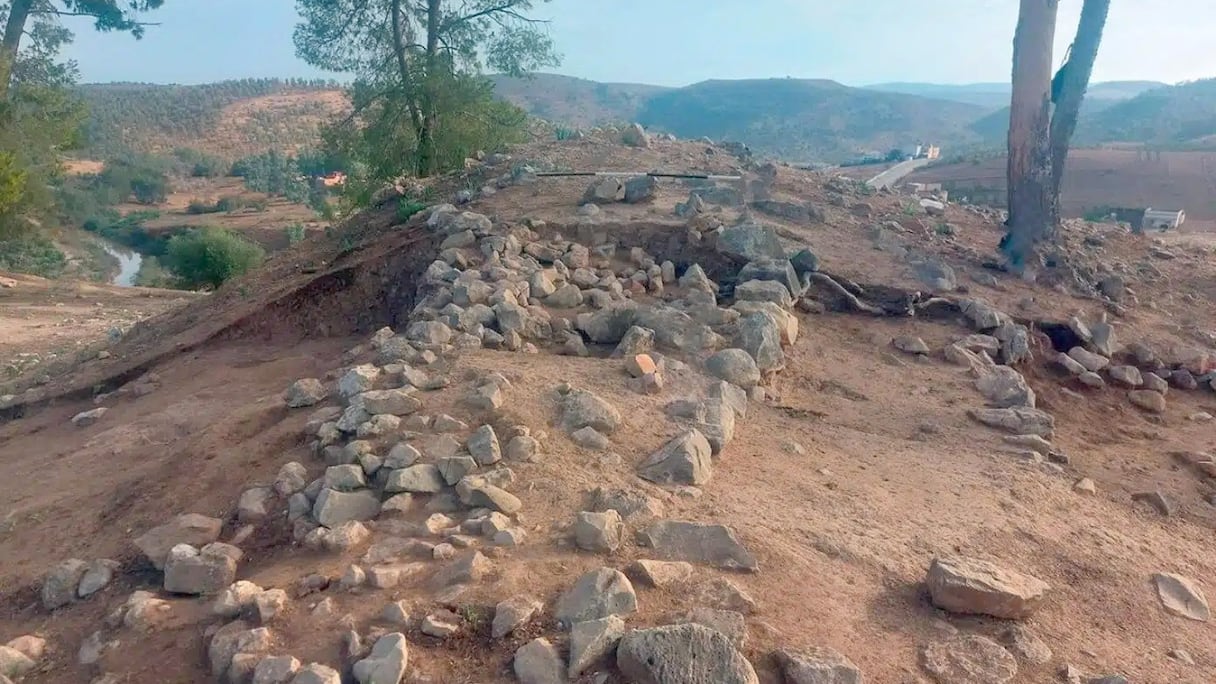
Archaeological excavations at Oued Beht in Khemisset province are shedding new light on a little-known period of Morocco’s ancient history. Monumental structures, stone tools, and burials found at the site point to human occupation spanning several millennia, from the Neolithic period through the Middle Ages.
These findings come from the third research campaign at Oued Beht, conducted in October and November 2023. The excavations provided evidence that the site was occupied during the second millennium BC, offering new insights into the transition from the Neolithic period to the Bronze Age.
The results, reported by the specialist website Greek Reporter, are part of a research project focused on the extensive archaeological site, which sits on elevated ground overlooking a watercourse.
The 2023 campaign opened six new excavation areas, building on work carried out in 2022. Those earlier investigations had already revealed a major agricultural settlement covering between 9 and 10 hectares, with activity dating from the mid-fourth to the early third millennia BC.
A substantial defensive complex
In the southern part of the site, researchers focused on a large group of stone structures locally known as “Wall B1.”
Investigations showed that the imposing structure was built in several phases. An initial construction made of earth and clay appears to date from after 2000 BC. Several centuries later, a stone wall, together with a ditch and an embankment, was added to reinforce the complex.
Radiocarbon analysis of 17 samples confirms that this part of the site was occupied between the beginning and middle of the second millennium BC.
Researchers consider these remains among the oldest clearly documented architectural structures in the region. More importantly, they provide further evidence of the emergence of Bronze Age societies in northwestern Morocco, alongside the development of comparable communities in the southern Iberian Peninsula.
Stone tools and pottery found in context
Research in the northern part of the site also uncovered three polished stone axes preserved in their original position.
This discovery is particularly significant. Thousands of similar tools had already been collected from the surface at Oued Beht over the past several decades, but these are the first such pieces to be found directly in their archaeological context.
Nearby excavations also uncovered pottery fragments whose radiocarbon dating places their use in the Late Neolithic period, between 3100 and 2900 BC.
Medieval remains add another chapter
The site does not only preserve evidence from prehistoric periods. Research was expanded after local residents reported finding human bones while building a house on the northern edge of the site.
Archaeologists identified several east-west-oriented burials there. Laboratory analysis of a tooth dated one of the burials to between AD 1221 and 1279.
Survey work also identified a medieval village dating from the 11th to 13th centuries, along with graves and a stone-paved path.
A site occupied across millennia
The latest research is helping archaeologists better understand how the landscape and patterns of human settlement around Oued Beht evolved over several millennia.
Researchers have identified natural sources of clay and stone that ancient populations used to make pottery and produce tools.
Earlier surveys had covered around 260 hectares without uncovering remains of this nature. The latest campaign has therefore significantly expanded knowledge of the site.
Oued Beht now stands out as a major archaeological site for understanding the transformation of prehistoric and protohistoric societies in northwestern Morocco, from Neolithic farming communities to the earliest forms of social organization associated with the Bronze Age, before the site was occupied again during the medieval period.
