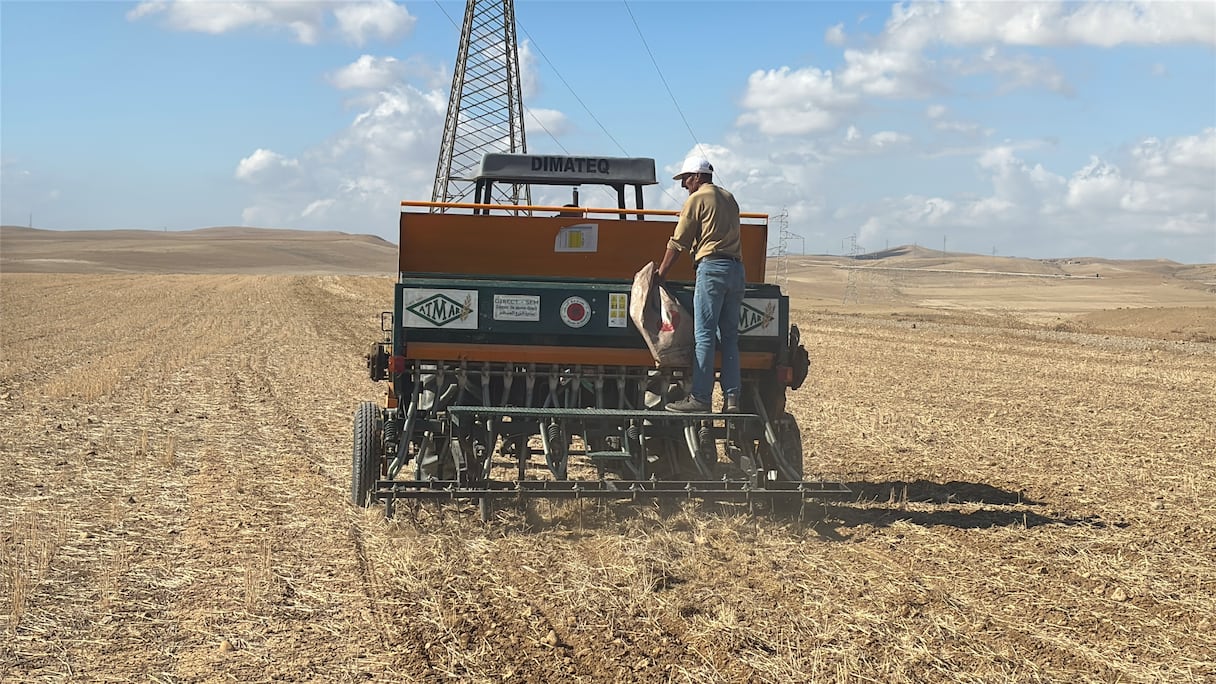
In Guercif province, the 2026-2027 agricultural season is getting underway with encouraging signs. Autumn rains, which arrived as the agricultural season began, have given an initial boost to sowing operations. However, production costs, particularly the price of fuel used to operate agricultural machinery, remain one of the main challenges facing farmers.
Saïd Taie, a member of the Al Fahama direct seeding cooperative, said he was relieved by the rainfall. Speaking to Le360, he said the rain had come at the right time, at the start of the season, restoring farmers’ confidence after years of difficult weather conditions. According to him, this promising start raises hopes of good results, provided rainfall remains regular during the early stages of the season.
The farmer also pointed to the growing benefits of direct seeding in terms of working conditions and productivity. He recalled the positive results achieved with this technique during the previous agricultural season, as well as its contribution to reducing production costs, particularly labor expenses, which are becoming an increasingly heavy burden for farmers. Sowing one quintal of seeds costs around 100 dirhams.
However, this shift in farming methods has not removed all the obstacles, according to Taie. The cost of fuel for direct seeding machines remains one of the main barriers to wider adoption, as these machines consume significant quantities of diesel.
Call for support for agricultural fuel
Against this backdrop, he is calling on the relevant authorities to introduce dedicated assistance for fuel used in agriculture, similar to the support measures available to road transport, freight transport and maritime fishing. Such assistance, he believes, would ease farmers’ financial burden and encourage them to adopt modern farming techniques.
For his part, Mehdi El Ouadi, head of the Agricultural Projects Implementation Department at the Provincial Directorate of Agriculture in Guercif, described the recent rainfall as a positive sign for the start of the season. He said the directorate had begun rolling out the direct seeding program, one of the strategic initiatives aimed at changing farming practices and strengthening the sector’s ability to adapt to climate change.
El Ouadi explained that the technique allows seeds to be planted without prior plowing. It therefore helps preserve soil moisture while reducing fuel consumption and production costs. It also offers environmental benefits by helping store carbon in the soil and limit emissions that contribute to climate change.
He added that the Provincial Directorate of Agriculture, in coordination with its partners, is encouraging the adoption of this technique by providing agricultural cooperatives with direct seeding machines. The initiative also includes training, guidance and technical support programs.
According to El Ouadi, these efforts helped bring the area cultivated using direct seeding to around 1,364 hectares during the previous season, with yields exceeding 26 quintals per hectare.
Read also : Fez-Meknes kicks off farming season with rainfall twice last year’s level
Direct seeding: 10,000 hectares by 2030
Logistical resources have also been strengthened with the acquisition of six new direct seeding machines, bringing the total number available in the province to 10. The directorate aims to expand the area cultivated using this technique to 10,000 hectares and increase the number of machines to 25 by 2030.
The official said these efforts are part of the National Direct Seeding Program, which aims to cover one million hectares nationwide by 2030, in line with the objectives of the Generation Green strategy. The goal is to move toward more sustainable agriculture and more efficient management of natural resources.
Between the optimism generated by autumn rainfall and efforts to expand direct seeding, the success of the agricultural season in Guercif will also depend on farmers’ ability to overcome financial constraints, particularly rising fuel costs. A dedicated support scheme therefore appears necessary to help sustain this promising start and translate it into tangible gains in production and yields.
