Africa continues to face a major infrastructure deficit. While a handful of countries have made significant progress in addressing these gaps, the continent as a whole remains far behind and needs more than $100 billion in annual infrastructure investment to catch up.
In recent years, however, major industrial, urban development and infrastructure projects have been launched across the continent. Some have become benchmarks in Africa and beyond, including Morocco’s Tanger Med port.
Governments and investors are increasingly committing substantial resources to large-scale construction projects. Many are integrated megaprojects expected to have a significant impact on the economic and social development of their host countries.
Given the number of projects underway, this overview focuses on selected developments launched or under construction in several African countries and across different sectors. It excludes projects already completed, such as Morocco’s Mohammed VI Tower and Nador West Med port. It also leaves out projects that have yet to begin construction, including the Lobito Corridor, the Nigeria-Morocco Atlantic Gas Pipeline and the Abidjan-Lagos Highway.
These major developments are expected to benefit individual countries and wider regions by addressing structural infrastructure shortages that continue to hold back the continent’s growth.
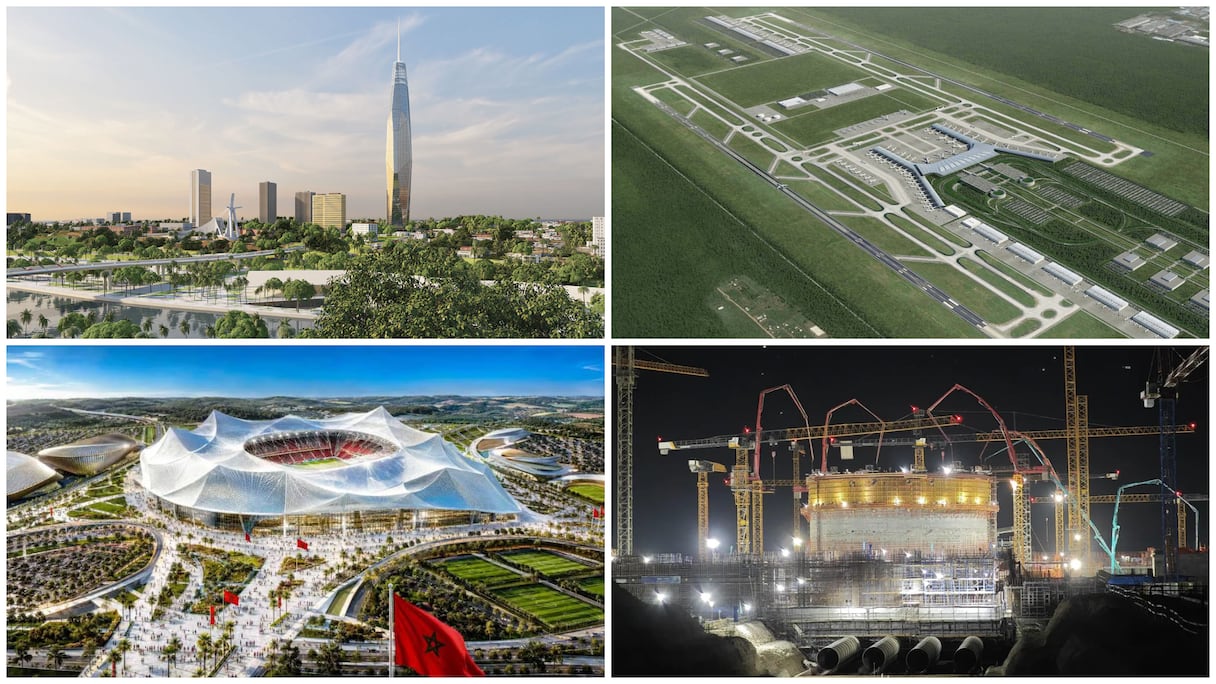
Egypt: A 4,800-MW nuclear power plant
Africa currently has only one operational civilian nuclear power plant, South Africa’s Koeberg facility, whose operating life was recently extended by 20 years. Egypt is set to join it with a massive nuclear power plant under construction at El Dabaa, in the Libyan Desert west of Alexandria, on the Mediterranean coast in Matrouh Governorate, around 300 kilometers west of Cairo.
The agreement to build the plant was signed with Russian state-owned company Rosatom on December 11, 2017. Construction of the first reactor officially began in July 2022. Under the agreement, Rosatom is responsible for building the entire facility, supplying nuclear fuel, training employees, and maintaining and repairing the generating units.
Read also : Africa’s fuel squeeze: Higher pump prices, bigger import bills and rising costs
Construction is progressing. Reactor pressure vessels for Units 1 and 2 have been installed. Manufactured in Volgodonsk, Russia, the vessels are designed for an initial operating life of 60 years, which can be extended to 80 years.
Once completed, the plant will have four Generation III+ VVER reactors, each with a capacity of 1,200 MW, giving it a total installed capacity of 4,800 MW. The reactors feature advanced safety systems and are designed to withstand the impact of a 400-ton aircraft traveling at 150 meters per second.
The project is estimated to cost $30 billion. Russia will contribute to its financing through a loan of up to $25 billion at an interest rate of 3%. The first reactor is scheduled to become operational and connect to Egypt’s electricity grid in 2028. The remaining units are expected to come online gradually by 2030, when the plant should reach full capacity.
The project is intended to strengthen Egypt’s electricity supply and diversify an energy mix that still relies heavily on natural gas. It is also expected to reduce carbon oxide emissions by the equivalent of 14 million tons annually.
Morocco: Hassan II Stadium in Benslimane to seat 115,000 ahead of 2030 World Cup
Morocco is co-hosting the 2030 FIFA World Cup with Spain and Portugal. As part of its major infrastructure program, which includes highways, high-speed rail and sports facilities, the Kingdom is building what is planned to be the world’s largest covered stadium in Benslimane.
With a planned capacity of 115,000 spectators, the stadium is also designed to offer a premium match-day experience, with high-end VIP and VVIP facilities and hospitality services suited to major international events.
The venue will serve as the centerpiece of the future Morocco Sport City, a 100-hectare complex designed to host major sporting events. In addition to the main stadium, the project includes an athletics stadium with 24,000 seats, a multi-purpose sports hall, a gymnastics hall, a convention and exhibition center, a park, a hotel and other entertainment facilities. The overall cost of the integrated development is estimated at 5 billion dirhams.
To improve access to Hassan II Stadium, located around 40 kilometers from Casablanca, plans include building a 60-kilometer continental highway and expanding and upgrading regional and national roads to ease traffic around Benslimane.
The project also includes four outdoor parking areas with a combined capacity of more than 10,463 vehicles. The stadium will be connected to the regional express rail network, with several stations serving the site, as well as to a high-speed rail line.
According to Fouzi Lekjaa, president of the Royal Moroccan Football Federation, Hassan II Stadium is expected to be ready in early 2028. It could host the 2029 FIFA Club World Cup, which Morocco hopes to organize, bringing together 32 clubs, before potentially staging the 2030 World Cup final.
Ethiopia: Bishoftu airport aims to become one of the world’s largest
Ethiopia plans to give Africa’s largest airline one of the continent’s biggest airports, with ambitions to make the new Addis Ababa Bishoftu International Airport one of the world’s largest. The project is intended to ease congestion at Addis Ababa’s Bole International Airport while supporting the expansion plans of Ethiopian Airlines.
Under its Vision 2035 strategy, the airline aims to expand its fleet to 271 modern aircraft, serve more than 200 destinations and carry 65 million passengers.
Located in Bishoftu, around 40 kilometers from Addis Ababa at an altitude of 1,900 meters, the new airport will have four runways and capacity to accommodate 270 aircraft. Construction was officially launched by Prime Minister Abiy Ahmed on January 10, 2026.
The first phase is expected to handle 60 million passengers annually by 2030, with a 660,000-square-meter terminal and two runways. Capacity is then expected to increase gradually to 110 million passengers a year, while the airport will eventually be able to handle four million tons of cargo.
The airport hub is being built across 35 square kilometers and is designed as an integrated airport city, with commercial, logistics, hotel and maintenance facilities. A high-speed rail line will connect the new airport to Addis Ababa. The overall cost is estimated at $13 billion.
The new facility is expected to strengthen Ethiopian Airlines’ competitiveness, improve air links across Africa, expand trade and tourism corridors, and position Ethiopia as a major intercontinental hub.
Morocco: Kenitra-Marrakech high-speed rail line is a major infrastructure undertaking
Morocco, the first African country to operate a high-speed rail line, is now extending its network south from Kenitra to Marrakech. The existing 186-kilometer line between Tangier and Kenitra can reach commercial speeds of up to 320 kilometers per hour. The extension is intended to bring high-speed rail to more of the country’s main cities.
The new Kenitra-Marrakech route will involve around 430 kilometers of additional track. King Mohammed VI launched the project on April 24, 2025, from Rabat-Agdal railway station, extending the existing high-speed connection between Tangier and Kenitra.
The line will serve Rabat and Casablanca before continuing to Marrakech, strengthening connections between different parts of the country and making travel between northern and southern regions easier.
The journey-time savings are expected to be substantial. Once the high-speed line is operational, travel between Tangier and Marrakech is expected to take 3 hours and 30 minutes, compared with more than 6 hours and 30 minutes today. The journey from Rabat to Marrakech will fall to 1 hour and 40 minutes, while Casablanca-Marrakech trips will take around 1 hour and 15 minutes.
Read also : African Diaspora Remittances: Here are the top 10 recipient countries
These shorter journeys are expected to change intercity travel, particularly for business trips, tourism, administrative visits and family travel.
The project involves several major engineering structures, including the 1,400-meter Settat Rise viaduct, which requires an investment of 900 million dirhams. The structure will rest on 29 supports and include 28 spans, each measuring 50 meters, with heights ranging from 6 to 36 meters.
The project is around 41% complete, with delivery scheduled for September 2029, less than a year before the 2030 World Cup. The line is expected to play a major role in transporting the tens of thousands of supporters expected to travel across the country for the tournament.
The Kenitra-Marrakech high-speed rail extension is estimated to cost 53 billion dirhams, excluding the purchase of rolling stock. It forms the second stage of Morocco’s wider high-speed rail plan, which aims to connect Tangier to Agadir by 2040 in around four hours through a 900-kilometer Atlantic line.
Nigeria: Dangote refinery expansion aims for world-leading capacity
Having already built Africa’s largest refinery, with a processing capacity of 700,000 barrels per day, Nigerian billionaire Aliko Dangote is now expanding the facility. The goal is to double its capacity to 1.4 million barrels per day, which would make it the world’s largest refinery on a single site, surpassing the Jamnagar refinery in India, operated by Reliance Industries Limited.
The expansion will require an investment of $14.3 billion, with the new unit expected to become operational in 2029.
In addition to increasing fuel production, the expansion will raise output of polypropylene, an industrial polymer widely used in food packaging, textiles and automobile manufacturing.
The Dangote refinery covers 2,500 hectares in the Lekki Free Trade Zone in Lagos State. It was inaugurated on May 22, 2023, but did not begin operations until January 2024. It processes crude oil into products including kerosene, diesel and unleaded gasoline.
The facility receives crude through what is described as the world’s largest subsea pipeline network, stretching 1,100 kilometers. It has been operating at full capacity since the outbreak of the Middle East war, which has put pressure on global fuel markets.
Kenya: Dangote’s Lamu refinery to process 700,000 barrels a day
After Nigeria, Aliko Dangote has launched another major refining project in East Africa: the Dangote East Africa Petroleum Refinery on Kenya’s Lamu Island.
The groundbreaking ceremony took place on September 30, 2026, bringing together several African heads of state and the Nigerian businessman. The refinery is planned to have a processing capacity of 700,000 barrels of crude oil per day.
Read also : US consolidates visa processing into 20 African hubs, ending services in 25 countries
Construction is expected to take four to five years and require an investment of around $16 billion. Dangote’s group is expected to provide 30% of the funding through its own capital, with the remainder coming from loans.
Once operational, the refinery will be able to supply fuel products, including diesel, kerosene and gasoline, to countries across East Africa. These include Kenya, Uganda, Tanzania, South Sudan, Rwanda, the Democratic Republic of Congo, Ethiopia and Burundi.
Crude oil will be sourced from regional producers, including Uganda and Kenya, as well as other African suppliers such as Angola and Nigeria.
Dangote has said he wants to reserve 30% of the refinery’s capital for East African countries. The governments of Ethiopia, Kenya and Rwanda have expressed interest in acquiring stakes in what would become Africa’s second-largest oil refinery, after the Lekki facility, which also belongs to the Nigerian billionaire.
The refinery is expected to strengthen energy independence across the region, where countries rely heavily on fuel imports, particularly from Gulf states. That dependence leaves them vulnerable to shortages and sharp price increases during international crises.
Ethiopia: Africa’s largest fertilizer plant
Ethiopia is building what is set to become Africa’s largest fertilizer production facility. The project is particularly significant for a country where agriculture, including wheat, tea and coffee production, plays a central role in the economy and employment.
Located in Gode, in the country’s southeast, the plant has been expanded following a redesign of the project. The original plan called for an annual production capacity of three million tons of urea-based fertilizer. The revised project will have a total capacity of 5.5 million tons, including a blending plant capable of producing two million tons of NPK fertilizer, made from nitrogen, phosphorus and potassium.
The expanded project includes additional infrastructure to support production and diversify the range of fertilizers manufactured at the site. This includes a gas pipeline connecting the plant to the Calub gas field, a 120-MW power plant and a polypropylene packaging unit.
The revised scale of the project has also pushed up its estimated cost to $4 billion. Dangote’s group will hold a 60% stake, while the Ethiopian state, through Ethiopian Investment Holdings, will own the remaining 40%.
Ethiopia’s domestic fertilizer needs are estimated at 2.5 million tons a year. Any surplus production will be exported to neighboring countries. Once operational, the plant is expected to reduce the country’s foreign currency expenditure on fertilizer imports while generating export revenue.
Construction began in October 2025, with the plant scheduled to start operations in 2029.
Senegal: Ndayane deepwater port targets West Africa’s hinterland
Senegal is building a new deepwater port at Ndayane to ease congestion and access problems at the Port of Dakar. Located on the Petite Côte, around 50 kilometers south of the capital, the commercial port is being developed by Emirati group DP World in partnership with the Senegalese government.
The port will include an 840-meter quay with a draft of more than 18 meters, allowing it to accommodate large container ships measuring up to 366 meters in length. Its annual handling capacity is estimated at 1.2 million twenty-foot equivalent units (TEUs).
Read also : Morocco emerges as Africa’s new tourism leader
The port will be supported by a 1,200-hectare special economic zone, including an integrated logistics and industrial hub designed to stimulate local economic activity and improve access to West Africa’s hinterland, including Mali and Burkina Faso. The aim is to make Ndayane the center of a wider economic ecosystem.
The first phase is scheduled to enter service in 2028. Once operational, the port is expected to relieve pressure on Dakar’s existing port and strengthen Senegal’s position as a major logistics hub in West Africa.
Mozambique: Building a future global LNG powerhouse
Following major offshore gas discoveries, with proven reserves estimated at more than 5 trillion cubic meters, Mozambique is seeking to become a major global gas producer. Most of the reserves are located in the Rovuma Basin in the north of the country, off the coast of Cabo Delgado province.
Several liquefied natural gas projects have been launched by international energy companies, including TotalEnergies, ExxonMobil and Eni.
Following the major discoveries announced between 2010 and 2013, several large-scale developments have moved forward. Eni was the first to develop a floating liquefied natural gas facility, which began operating in 2022. The Italian company is now developing the Coral Norte project, with an investment of $7.2 billion.
Even larger is TotalEnergies’ Mozambique LNG project, estimated to cost between $20 billion and $23 billion. Suspended in 2021 following a violent jihadist insurgency and the attack on Palma, the project has gradually resumed. Production is expected to begin around 2029, with planned annual output of 13 million tons of LNG.
US energy company ExxonMobil is also involved in the Rovuma LNG megaproject, in partnership with Eni. The onshore and offshore development in Area 4 involves massive investment and is designed to produce 18.6 million tons of LNG annually.
According to Standard Bank, the project could add around $11 billion a year to Mozambique’s GDP and generate approximately $150 billion in cumulative government revenue over 30 years. ExxonMobil, which holds a 50% stake in the company responsible for developing the project, says around 7,000 Mozambicans are involved in construction, with another 700 expected to work during the operational phase. The US company also plans to invest $40 million in a training center for workers in the sector.
Mozambique is also pursuing regional integration projects to supply gas to southern African markets. One such development is a planned gas connection between Inhassoro, the port of Beira and South Africa’s gas network.
Abidjan Metro: A system designed to carry 500,000 passengers a day
To address severe traffic congestion in Abidjan, authorities have launched a metro project in the economic capital of Côte d’Ivoire, the largest economy in the West African Economic and Monetary Union (WAEMU).
Line 1 will run from Anyama to Port-Bouët, including the airport, and cross seven municipalities: Anyama, Abobo, Adjamé, Plateau, Treichville, Marcory and Port-Bouët.
The 37.5-kilometer route will have 18 stations and require a range of infrastructure, including viaducts, rail bridges, roads, pedestrian bridges, high-voltage substations and a maintenance center. One of its main structures will be a 500-meter viaduct.
The viaduct will run alongside the Félix Houphouët-Boigny road and rail bridge, allowing trains to cross the Ébrié Lagoon between Plateau and Treichville. The system is expected to use Alstom Metropolis trains, with 26 trainsets planned, including 20 trains and five cars.
Construction is progressing, but delays have raised concerns among future passengers. The project was first planned in 2012, and the setbacks have contributed to an increase in its estimated cost, now put at 1,166.43 billion CFA francs, or 1.77 billion euros. Funding is being provided by the Ivorian state, with support from the French Treasury and a group of banks that includes Société Générale and BNP Paribas.
The Abidjan Metro is scheduled to enter service in late 2028. Once operational, it is expected to carry between 500,000 and 540,000 passengers a day.
Abidjan’s Tower F: Set to become Africa’s tallest building
Abidjan, Côte d’Ivoire’s economic capital, is home to what is set to become Africa’s tallest tower. At 421 meters, including its spire, Tower F will surpass Egypt’s Iconic Tower in the New Administrative Capital, which stands 398 meters tall with 80 floors. It will also rise above Rabat’s Mohammed VI Tower in Morocco, at 255 meters and 55 floors, Johannesburg’s Leonardo, at 250 meters and 55 floors, and the Carlton Centre, at 223 meters and 50 floors.
Located in the Plateau district, Tower F has been included in Abidjan’s urban development plans since the 1970s. It is the sixth tower in the city’s administrative district.
Construction of the high-rise began in July 2021. The building has reached a height of 333 meters and is awaiting the installation of its spire, which will bring it to 421 meters. At the top, a lantern-shaped structure will offer visitors a 360-degree panoramic view of Abidjan and the Ébrié Lagoon.
The project is overseen by the Ministry of Construction, Housing and Urban Planning. The tower will mainly house office space as part of the administrative district.
With around 140,000 square meters of gross floor area spread across 75 floors above ground, a ground floor and three basement levels, the building is intended to meet strong demand for administrative office space in the Ivorian economic capital. Its facilities will include offices, reception areas, restaurants, meeting rooms and a sky bar.
The building will be served by 21 elevators and two freight lifts. A separate panoramic elevator will give visitors access to the lantern at the top.
Tower F was designed by architect Pierre Fakhoury, whose other major projects in Côte d’Ivoire include the Basilica of Our Lady of Peace in Yamoussoukro, the Hôtel Ivoire tower and the Postel 2001 tower. The building has received Edge certification, a standard for environmentally sustainable construction and energy efficiency.
The project is being carried out by PFO Africa and Belgian construction group BESIX, which has worked on major international developments including Dubai’s Burj Khalifa and Rabat’s Mohammed VI Tower, alongside Moroccan company TGCC.
Read also : Morocco leads Africa’s aerospace industry as Tunisia expands its footprint
East African Crude Oil Pipeline: The world’s longest heated oil pipeline
Stretching 1,443 kilometers, the East African Crude Oil Pipeline (EACOP) is a buried pipeline designed to transport crude from oil fields in the Lake Albert basin in northwestern Uganda to a marine terminal in Tanga, on Tanzania’s Indian Ocean coast. It is described as the world’s longest heated oil pipeline.
The project includes six pumping stations and a heating system that uses electric heat tracing. Oil from the Tilenga fields must be maintained at 50 degrees Celsius throughout the journey.
As a landlocked country, Uganda needs the pipeline to transport and export its oil production. The Lake Albert fields are estimated to contain around 6.5 billion barrels of crude, of which 1.4 billion barrels are considered recoverable.
The pipeline will carry crude from the Tilenga fields, operated by France’s TotalEnergies, and the Kingfisher fields, operated by China’s CNOOC. Once both fields reach full production, output could reach 230,000 barrels per day. The pipeline itself has a transport capacity of 246,000 barrels per day and is designed to operate for 25 years.
The project’s cost has been revised to $5.6 billion. Ownership is divided among TotalEnergies, with a 62% stake; CNOOC, with 8%; Uganda National Oil Company (UNOC), with 15%; and Tanzania Petroleum Development Corporation (TPDC), with 15%.
The pipeline is more than 95% complete, and filling is expected to begin in December 2026. Crude extracted from Uganda’s oil fields will be transported to Tanga, where it will be stored before being loaded onto tankers. The first exports are scheduled for March 2027.
More projects on the horizon
Several other major developments could move into the construction phase next year or in the coming years.
These include the Lobito Corridor, which is planned to connect Angola’s Port of Lobito with the Copperbelt region of the Democratic Republic of Congo and Zambia, facilitating mineral exports through the Angolan port.
Other proposed projects include the Nigeria-Morocco Atlantic Gas Pipeline, the Trans-Saharan Gas Pipeline, which would connect Nigeria to Algeria through Niger, and the Grand Inga hydropower project on the Congo River, planned to become the world’s largest hydroelectric complex.
