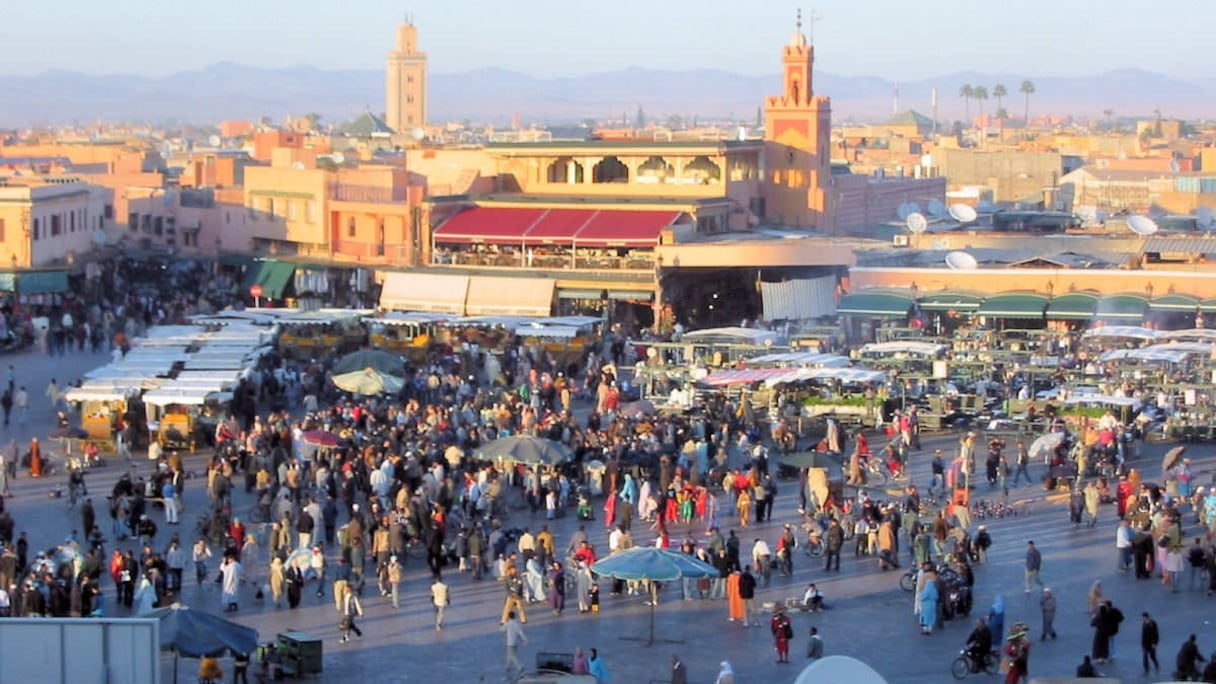
The latest report by the Organisation for Economic Co-operation and Development (OECD), titled “OECD Tourism Trends and Policies 2026,” compares tourism performance across 53 countries, with a focus on three African economies: Morocco, South Africa and Egypt. The findings place Morocco ahead of its regional peers on most key tourism indicators.
According to the report, Morocco welcomed 19.8 million international visitors in 2025, a 14% increase from 2024. The OECD notes that the figure has already surpassed the 17.5 million target set under the country’s 2023-2026 tourism roadmap, a milestone originally expected to be reached a year later. France remained Morocco’s largest source market, accounting for 29% of arrivals, followed by Spain at 23% and the United Kingdom at 7%.
The report attributes this performance not only to rising international arrivals but also to robust domestic tourism. In 2025, domestic travelers generated more than 12 million overnight stays in classified tourist accommodation, up 3% year-on-year. At the macroeconomic level, tourism contributed 7.3% of GDP, equivalent to 116.2 billion dirhams in 2024, an increase of 0.5 percentage points compared with 2019.
Tourism also continued to strengthen the labor market. The sector supported 894,000 direct jobs in 2025, an increase of 92,000 since 2022, accounting for 8.2% of total employment. Tourism receipts exceeded 138 billion dirhams by the end of 2025, up 21% from 114.5 billion dirhams a year earlier.
Converted into U.S. dollars, tourism receipts reached $11.5 billion in 2024, compared with $10.6 billion in 2023, according to International Monetary Fund data cited by the OECD. Tourism represented 40.7% of Morocco’s services exports that year, down 0.7 percentage points from 2023 as other export sectors also expanded.
The report also notes that the Moroccan government allocated 1.9 billion dirhams to tourism in 2025 through the Ministry of Tourism, Handicrafts, and Social and Solidarity Economy, which oversees the country’s tourism strategy through the Moroccan National Tourism Office (ONMT) and the Moroccan Agency for Tourism Development (SMIT).
Morocco Overtakes Egypt
The report’s most notable regional comparison concerns Egypt, long regarded as Africa’s leading tourism destination.
According to the OECD, Morocco welcomed 19.8 million international visitors in 2025, surpassing Egypt’s 18.9 million.
Between 2019 and 2025, Morocco’s international arrivals grew by 53%, outpacing Egypt’s 47% increase.
Egypt, however, continues to lead in tourism revenues. According to the report, the country generated $15.3 billion in tourism receipts in 2024, compared with $11.5 billion for Morocco. Data from UN Tourism show that the gap persisted in 2025, with Egypt earning $17.8 billion, while Morocco generated $14.7 billion.
Egypt also posted a larger tourism trade surplus, reaching $11.3 billion in 2024 compared with $8.6 billion for Morocco. The report attributes part of the difference to distinct market structures, noting that outbound tourism spending totaled $4.1 billion in Egypt versus $2.9 billion in Morocco.
The OECD notes that this edition does not include a country profile for Egypt, unlike Morocco and South Africa, limiting the comparison to available statistical data.
The contrast with South Africa is even more pronounced.
South Africa recorded 8.9 million international arrivals in 2024, still nearly 13% below its 2019 level, before recovering to 10.5 million visitors in 2025, an 18% annual increase. By comparison, Morocco had already exceeded its pre-pandemic tourism levels several years earlier and welcomed nearly twice as many international visitors.
Morocco also outperformed South Africa in tourism’s contribution to the economy. In South Africa, tourism accounted for 4.9% of GDP in 2024 and 5.7% of total employment, supporting approximately 954,000 jobs. Morocco’s tourism sector generated $11.5 billion in receipts that year, almost double South Africa’s $6.4 billion.
The OECD also highlights significant differences in source markets. South Africa relies primarily on regional visitors, with Zimbabwe accounting for 24.5% of arrivals, followed by Mozambique at 17.8% and Lesotho at 10.9%. Morocco, by contrast, remains heavily oriented toward European markets.
A Wider Gap With South Africa
While South Africa has a strong domestic tourism market, recording 40.2 million domestic trips in 2024, up 6.1%, with spending rising 12.4% to 136.4 billion rand, its public tourism budget declined by 5.7% during the 2024-2025 fiscal year to 2.4 billion rand, unlike Morocco, where public investment continued to increase.
Overall, Morocco ranks ahead of South Africa across all major indicators tracked by the OECD, including international arrivals, tourism’s contribution to GDP and employment, and foreign currency earnings.
The report notes that both countries are overhauling their tourism strategies, although on different timelines.
Morocco is implementing its 2023-2026 Tourism Roadmap, structured around nine thematic pillars and five cross-cutting priorities aimed at promoting intangible cultural heritage while encouraging investment in accommodation and tourism experiences through the “Go Siyaha” and “Moukawala Siyahia” programs.
South Africa, meanwhile, continues to operate under its 2016-2026 National Tourism Sector Strategy but adopted a new Tourism White Paper in September 2024 to replace the policy framework introduced in 1996.
The new strategy introduces a separate regulatory framework for short-term rentals, simplifies visa procedures, and places greater emphasis on developing local tourism businesses and suppliers.
Comparing the two governance models, the OECD notes that Morocco is investing heavily in workforce development through the “Kafaa” and “CAP Excellence Tourisme” programs. The latter aims to establish 12 hospitality and tourism centers of excellence by 2026 alongside reforms at the International Higher Institute of Tourism in Tangier.
Morocco has also launched a comprehensive overhaul of its hotel classification system, introducing a new star-rating model based on service quality, “mystery guest” inspections, and new accommodation categories linked to luxury and five-star hotels.
South Africa, by contrast, has focused on visitor safety and crisis management. In May 2024, it approved a scenario-based tourism crisis management framework and expanded its “Trusted Tour Operator Scheme,” which offers 24-hour visa processing for Chinese and Indian group travelers through 110 accredited operators in 2025.
A Lead to Preserve
The OECD’s comparative assessment paints the picture of a Morocco that has firmly established itself as Africa’s leading tourism destination, driven by sustained growth since the recovery from the COVID-19 pandemic.
The organization cautions, however, that the global tourism outlook remains uncertain, particularly due to developments in the Middle East, which continue to affect tourism-dependent economies worldwide.
It also identifies broader challenges facing the sector, including better coordination between national and local tourism policies, ensuring tourism generates greater social benefits for local communities, and adapting destinations to increasingly frequent extreme weather events.
For Morocco, the OECD suggests that continuing hotel classification reforms, expanding the “Go Siyaha” program, which aims to support more than 1,700 tourism projects by 2026, and further professionalizing the tourism workforce will be key to addressing those challenges and maintaining the country’s competitive edge in the years ahead.