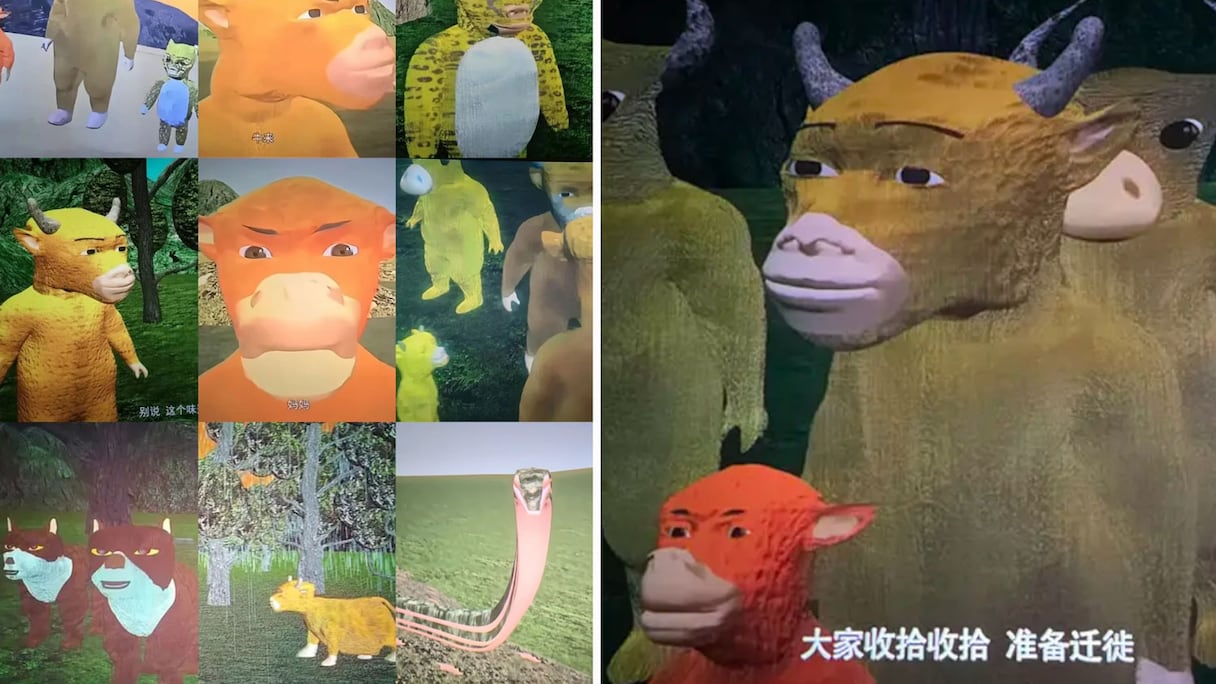
Niu Lai, a low-budget animated film about a calf growing up and learning about family, love and sacrifice, has gone from barely making any money to drawing thousands of moviegoers after its notoriously rough animation and bizarre plot turned it into a viral sensation.
Released on Aug. 5 with almost no publicity, Niu Lai earned only around 10,000 yuan ($1,480) during its first 10 days in cinemas, with some days bringing in just 200 yuan, according to Chinese movie-tracking platform Maoyan.
Things took a different turn when clips and reviews mocking the film began spreading across Chinese social media. On Monday alone, Niu Lai brought in 8.2 million yuan ($1.2 million) and attracted nearly 300,000 admissions. Its total box office has since reached 17.1 million yuan ($2.5 million), according to Maoyan.
That unexpected surge has put the little-known animation in competition with much bigger productions, including Christopher Nolan’s The Odyssey, which opened in China on Aug. 14.
The film has been widely mocked for its stiff-looking 3D animation, unusual visuals, poor voice acting and an abstract storyline involving a newborn calf and his journey through life. Some of the most popular reactions on Douban, a major Chinese movie-review platform, have called it “unbelievably terrible” and a “must-watch for Chinese stock market investors.”
Others have embraced the film precisely because it looks so unlike the polished, highly produced animation audiences are used to seeing.
Some viewers have even presented Niu Lai as an antidote to the growing flood of AI-generated content online. Social media users have praised its apparently handmade quality, with some jokingly calling for “human slop” to make a comeback as they grow tired of what they see as the endless stream of AI-generated material.
Read also : Marvel unveils new X-Men cast for 2028 film
The film’s roughness has become part of its appeal. Instead of hiding its shortcomings, audiences are turning them into the main attraction, sharing clips, memes and reactions and encouraging friends to see it simply to discover how strange it really is.
A 19-year-old student in Shanghai told the Associated Press that he recommended the movie to friends as a prank and successfully convinced two of them to go. Both found the experience entertaining, although one reportedly fell asleep during the screening.
Others appear to be genuinely charmed by its simplicity.
Zhong Jiaming, a vocational schoolteacher in Guangzhou, described Niu Lai as a rare find at a time when films can be visually polished while failing to connect with audiences.
“This is a movie for the young at heart,” he said, describing it as simple and honest, like a bedtime story for children.
The film’s sudden popularity has also created some practical problems. Cinemas have added screenings to keep up with demand, while some theaters have reportedly had to make their own posters because the film did not even have a conventional promotional campaign.
Whether audiences are laughing at Niu Lai, laughing with it, or genuinely enjoying its deliberately unpolished charm, the film has achieved something its creators probably could not have expected: a movie that began its theatrical run almost unnoticed is now drawing crowds, generating millions of yuan and finding itself mentioned in the same box-office conversation as The Odyssey.
Not bad for a film whose biggest selling point may be that people simply cannot believe it exists.
