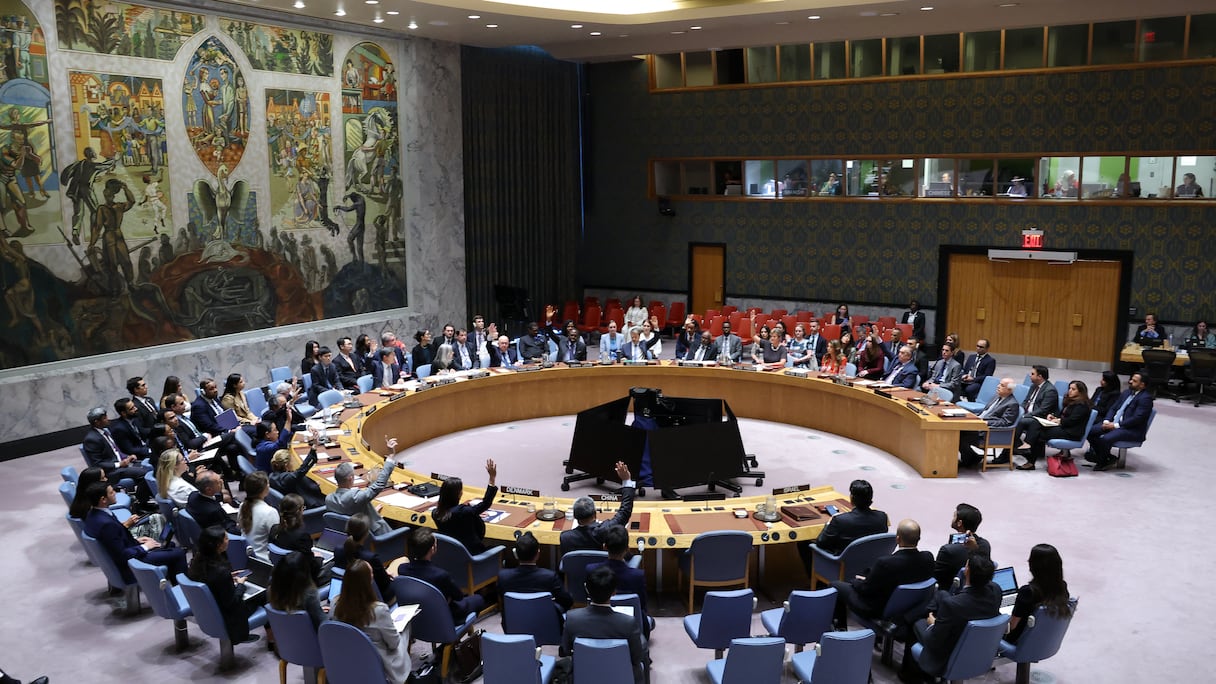
The tone was set on the night of the vote. For Algérie Patriotique, a website founded by Lotfi Nezzar, son of Algeria’s former defense minister, Russia’s veto was “a monumental humiliation for American diplomacy.” Washington was portrayed as an “overzealous salesman for unilateralism,” while Moscow had supposedly “brushed aside” the American initiative. The headline captured the mood: “One raised hand and Trump’s plan collapses like a house of cards.” That same evening, Aljazair Al Youm proclaimed a “historic precedent,” declaring that “Russia stands with Western Sahara”.
By the following day, the story had acquired a central figure: Algeria’s ambassador to the UN, Amar Bendjama. Echorouk and Aljazair Al Youm reproduced his remarks to the Council: self-determination, he insisted, remained the “fundamental and indispensable reference point,” while Algeria could neither “remain silent” nor “become complicit.” The diplomat also thanked Russia for proposing a “technical extension” of MINURSO’s mandate. Algerian readers were told that much. What they were not told was what happened to the proposal.
That is the first fact Algerian media largely left out. The Russian draft, which Algiers supported, won just three of the Council’s 15 votes: those of Russia, China and Somalia. Eleven members abstained, while the United States voted against, according to the UN’s official account. Of roughly a dozen Algerian outlets reviewed, only one, Eddiwan, reported the tally. The others simply said the draft had been “rejected” or portrayed it as the victim of an American veto. Algérie Eco and L’Express DZ both reported that Washington had “vetoed” the Russian text. Algérie Patriotique spoke of “mutual vetoes.” Yet with only three votes, the draft was nowhere near the nine required for adoption. The American vote made no difference. It is a clever sleight of hand: diplomatic isolation is recast as a draw.
The second omission is the most consequential. With no resolution adopted, MINURSO’s mandate, extended last year until October 31, 2026, has not been renewed. The veto Algeria had sought to preserve the mission in its existing form has instead stripped it of its legal mandate. Once again, only Eddiwan says so plainly. Echorouk and Aljazair Al Youm continue to refer to Moscow’s proposed “technical extension” as though it had passed. An Algerian reader could therefore put down the newspaper believing MINURSO had been saved, just as the mission is packing its bags.
The third missing piece is the Royal Office statement. Issued that same evening, it acknowledged the non-renewal of MINURSO’s mandate, announced that the mission’s personnel and equipment would leave the southern provinces “in the coming days,” and called for the Sahara issue to be removed from the Security Council’s agenda. None of the outlets reviewed reported it. Only one article addressed it: an opinion piece by former Algerian diplomat Amar Belani, who argued that Morocco had “rushed to declare victory” and that the Council “remains seized” of the matter under paragraph 6 of Resolution 2797. It is a weak argument. That wording appears in almost every Security Council resolution and does not, in itself, establish a mandate. A Council that remains “seized” of an issue does not thereby keep alive a mission whose mandate it has failed to renew.
The media silence has been matched by an official one. By the day after the vote, neither Algeria’s Foreign Ministry nor its presidency had issued a statement, and the official APS news agency had published no dispatch on the result. The only response from the Sahrawi side came from the Polisario’s UN representative, Sidi Omar, who thanked Russia, according to Reuters. He was thanking the country whose veto had just deprived MINURSO of its mandate.
The pattern is unmistakable. What Algerian media remember from October 30 is Moscow’s raised hand. What they leave out is what that hand brought down. A government confident of its diplomatic victory would have announced it in an official statement. Algiers instead left its newspapers to celebrate, taking care not to spell out the result.
