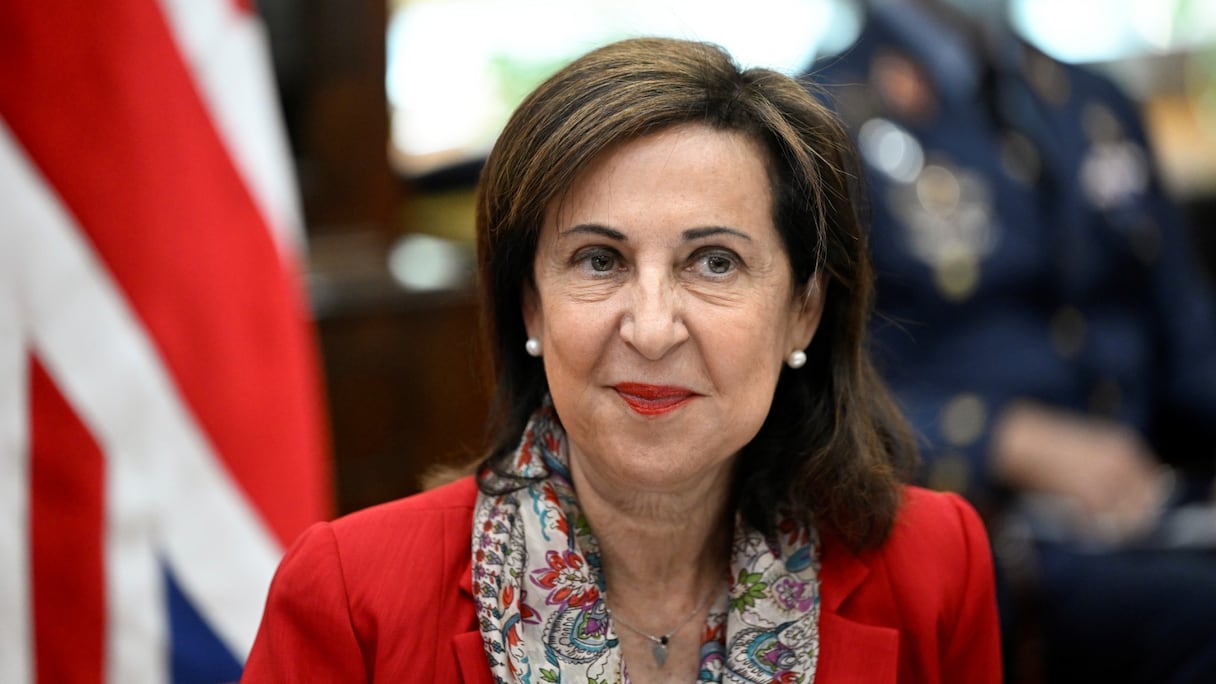
Spanish Defense Minister Margarita Robles said Tuesday that a Supreme Court ruling concerning immediate returns at the Ceuta border created a “pull factor” that contributed to the mass arrival of migrants on July 30 and 31.
Appearing before Spain’s Congress, Robles based her account on a report by the country’s Defense Staff tracing the buildup to the crossings through three stages.
The first began after a July 8 court ruling established that people who reached Ceuta by swimming could not immediately be returned by sea. According to Robles, the decision was subsequently given an “interested interpretation” that spread rapidly across social media.
From that point, she said, “several hundred” people began crossing before the numbers progressively rose into the thousands.
The ruling itself was not the only factor identified by Spanish authorities. According to Robles, Facebook groups also circulated claims that Morocco’s Throne Day celebrations would provide an opportunity to cross into Ceuta because fewer Moroccan police officers would supposedly be deployed at the border.
Read also : How a Spanish court ruling helped trigger the Ceuta migration crisis
Social media and a self-organized movement
Robles rejected the idea that the mass crossings were necessarily the product of a centrally organized operation.
Instead, she described the movement as a form of “self-organization” among migrants, driven by messages suggesting that conditions had become favorable for reaching Ceuta and that there were supposedly fewer obstacles to entering the city.
The speed with which those messages spread across social media meant security forces were unable to “react in time” once simultaneous crossing attempts began involving thousands of people, she said.
Robles also argued that using force to stop such large groups would have risked catastrophic consequences.
“The number of deaths would have been incalculable,” she told the Congressional Defense Committee.
Her account echoes explanations provided by Morocco shortly after the crisis erupted.
On August 2, Morocco’s Interior Ministry said authorities had adopted a proactive response based on early detection of warning signs, heightened vigilance and reinforced security operations on land and at sea.
Read also : Official: Attempted crossings to Ceuta and Melilla explained by the Interior Ministry
Rabat said the measures helped contain the situation while protecting lives, maintaining public order and securing the border under the principles of legality and proportionality.
Moroccan authorities also attributed the crossing attempts partly to misleading information circulating on social media, human-trafficking networks and what they described as an erroneous interpretation of Spanish court decisions.
Spain creates unified command for Ceuta crisis
Robles’ appearance opens a week in which eight Spanish ministers are expected to answer questions in Congress over Madrid’s handling of the crisis, 26 days after around 80,000 migrants were reported to have entered Ceuta.
The hearings coincide with a broader effort by the Spanish government to centralize its response.
Prime Minister Pedro Sánchez chaired the first National Security Council meeting devoted specifically to the Ceuta crisis on Tuesday. Deputy prime ministers, cabinet members and senior state security officials attended, while Ceuta President Juan Jesús Vivas joined remotely.
The meeting formalized the creation of a unified command structure to coordinate the response.
Territorial Policy Minister Ángel Víctor Torres will lead the coordinating committee, which will also include Vivas, the Spanish government delegate in Ceuta, representatives of the National Intelligence Centre and officials from the ministries involved.