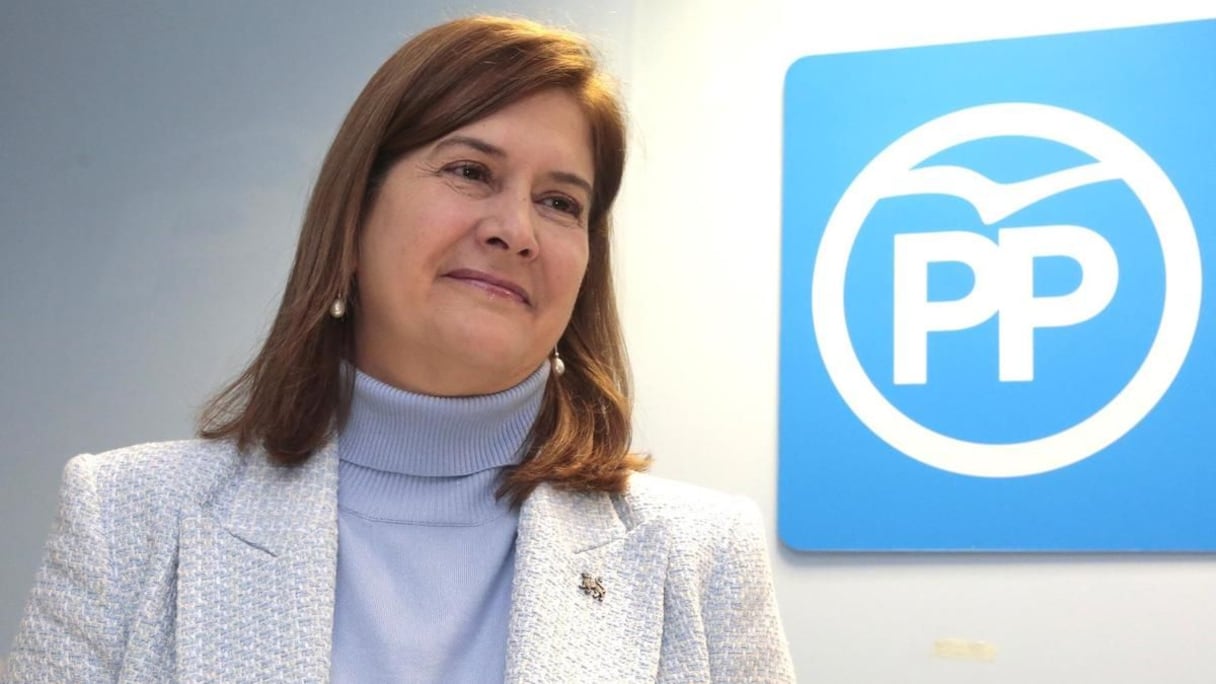
The Spanish broadcaster COPE (Cadena de Ondas Populares Españoles) dedicated over 20 minutes of its program La Tarde to the argument that Morocco effectively materialized out of nowhere in 1957. To support this claim, the broadcaster featured Margarita Torres, introduced to listeners simply as a “historian,” whose statements went unchallenged and lacked any contextualization.
Torres asserted that “until 1957, the Kingdom of Morocco did not exist” and that Ceuta and Melilla “had never been Moroccan.” COPE not only aired her remarks without apparent fact-checking but also used this claim in its headline, characterizing Morocco’s assertions as “pure fantasy” with no historical basis.
A primary concern is the profile of the expert chosen to deliver this particular history lesson. While Torres is indeed a historian, her established academic specialization is not Morocco, the Maghreb, or the history of Spanish-Moroccan relations.
According to her official profile at the University of León, she is a professor of medieval history. Her 1997 doctoral thesis focused on noble lineages in the Kingdom of León, specifically kinship, power, and mentalities between the ninth and 13th centuries. Her main publications cover the Kingdom of León, Castilian and Leonese nobility, El Cid, medieval warfare, and genealogy.
Read also : Anti-Moroccan hatred gains alarming ground in Spain
Torres also serves on León’s city council as a member of the Popular Party (PP), according to the municipality’s official list of councillors, and was the party’s mayoral candidate in 2023. While none of this automatically invalidates her views, this context is relevant when she appears on a conservative-leaning broadcaster to defend a highly political argument about Morocco.
Therefore, COPE did not invite a recognized specialist in the history of the Moroccan state. Instead, it invited a medieval historian whose work focuses on León and who is politically affiliated with the PP. She was presented as an authority on the Maghreb and allowed to make historically untenable claims for several minutes without facing a single challenging question.
The Morocco that signed treaties before supposedly existing
The most striking contradiction lies at the heart of Torres’ own argument. After claiming that Morocco did not exist before 1957, she noted that “Moroccan sultans” had signed treaties with Spain in 1767 and 1799.
The obvious question arises: if Morocco did not exist, with whom was Spain signing these treaties?
The 1767 document leaves little room for interpretation. Its official title refers to a “Treaty of Peace and Commerce” concluded between Charles III, King of Spain, and Sidi Mohammed ben Abdallah, explicitly identified as the “Emperor of Morocco.” The text is available in the Historical Archives of Public International Law.
Spain was therefore negotiating, signing agreements, and maintaining diplomatic relations with Morocco nearly two centuries before the date Torres gives for the country’s supposed creation. The United States also established relations with Sultan Mohammed III in 1777 before signing the Treaty of Peace and Friendship with Morocco in 1786, which the U.S. State Department describes as the oldest continuously valid bilateral treaty in American diplomatic history.
Even the International Court of Justice had already rejected the basis of the argument repeated by COPE. In a 1952 judgment, five years before the country’s supposed creation, the court established that Morocco had retained its state personality under international law, including during the Protectorate. The case specifically concerned rights arising from treaties previously concluded between Morocco and the United States. The full set of documents is available on the official website of the International Court of Justice.
Morocco was not created in 1957
What happened in 1957 was much simpler: Mohammed V, previously the Sultan, adopted the title of king. The title of the head of state changed, but no new country came into existence.
Morocco had regained its independence in 1956, after more than four decades under French and Spanish Protectorates. Regaining independence does not equate to being created. The very principle of a protectorate presupposes the prior existence of a political entity placed under foreign protection. In Morocco’s case, the Sultan, the Makhzen, the dahirs, and the state’s legal personality were all maintained.
Long before the Protectorate, Morocco had developed political structures under successive dynasties over several centuries. At the end of the eighth century, the Idrisids established the first major Islamic state centered on the territory of present-day Morocco. They were followed by the Almoravids, Almohads, Marinids, Wattasids, and Saadians. The current Alaouite dynasty has ruled Morocco since the 17th century, long before the formation of many modern states.
Ninth-century Morocco naturally did not have the exact borders, institutions, or official name of today’s Morocco. Similarly, medieval Spain was not the constitutional state we know today. Demanding a degree of institutional and territorial continuity from one country that is not demanded of others amounts to a particularly crude distortion of history.
Read also : From free speech to hate speech? call for Morocco’s ‘destruction’ on Spanish TV faces ethics review
Even the names of the two cities invoked by COPE to support its narrative still reflect their North African geography and the civilizations that succeeded one another there. “Ceuta” entered Spanish through the Arabic form Sabta, itself derived from the Latin Septem. Melilla appears in medieval Arabic sources as Maliliyya, while one theory about its etymology links it to the Amazigh root M·L·L, associated with the color white. These elements do not, on their own, settle the modern sovereignty dispute. They do, however, undermine the narrative that the cities’ three millennia of history are exclusively “Hispanic.”
COPE could have defended Spain’s position on Ceuta and Melilla without effectively erasing Morocco from the map for 12 centuries. It could have invited specialists on the Maghreb, presented competing interpretations, and distinguished between history, law, and political messaging. Instead, it gave the microphone to a historian with no established specialization in Morocco, omitted her political background, and turned an easily verifiable falsehood into an apparent history lesson without proper scrutiny.
Morocco was not created in 1957. What appeared that year was the title of king adopted by Mohammed V. Everything else is a semantic argument that falls far short of the historical record.
