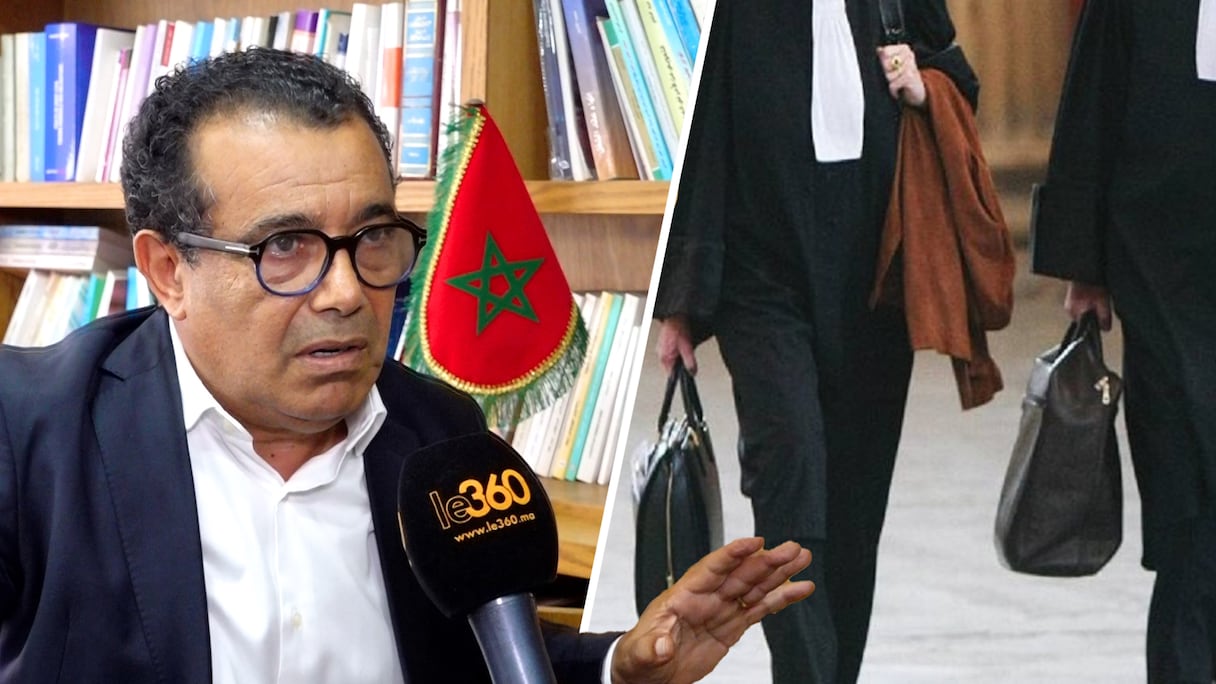
Morocco’s lawyers will continue fighting a controversial law governing their profession despite its entry into force, Rabat Bar President Aziz Rouibah said, signaling that a confrontation that has already kept lawyers on strike for around 100 days is entering a new phase.
Rouibah’s comments were among the first reactions from a senior representative of the profession after Law No. 66.23 was published in the Official Gazette, making it effective despite opposition from the Moroccan Bar Association (ANBM).
The association argues that the legislation undermines lawyers’ independence in their relationship with prosecutors and the Justice Ministry.
Writing on Facebook, Rouibah said lawyers would continue their “professional struggle to defend the independence and dignity of the profession” regardless of the law’s publication and entry into force.
He described the legislation as “unjust and inequitable,” both in the way it was conceived and in the consequences of its provisions.
‘The confrontation is entering a new phase’
“The confrontation is entering a new phase,” he said.
He rejected both outright defiance of the law and any suggestion that lawyers should regard its enactment as a defeat.
“Lawyers are neither nihilists who will act as though nothing has happened, nor adventurers ready for disobedience, nor weak people inclined to feel defeated or capitulate,” Rouibah said.
Instead, he said the profession would continue its campaign using “appropriate legitimate mechanisms” to challenge the legislation.
Rouibah also argued that Morocco’s legal profession had suffered a series of setbacks in recent years that had affected its history, current standing and future prospects.
Pressure grows to end 100-day court strike
The dispute is increasingly being shaped by another issue — the consequences of the prolonged strike for Morocco’s justice system.
Calls for lawyers to return to court are growing as the nationwide stoppage reaches the 100-day mark, with disruption affecting litigants across the country.
Particular concern has been raised over people being held in pretrial detention, whose cases can be affected by delays in court proceedings.
The Moroccan Bar Association, however, has maintained its opposition to the new framework and is preparing further consultations on how the profession should respond now that the legislation has entered into force.
Its council, comprising nearly 200 members, has been called to meet in Rabat to discuss the situation.
Constitutional Court controversy adds to dispute
The standoff has also been complicated by the circumstances surrounding an attempted review of the legislation by the Constitutional Court.
The court was unable to rule on the constitutionality of the law because the referral submitted by the president of the House of Representatives was not accompanied by a certified copy of the legislation.
The procedural failure has drawn criticism from several political parties.
The opposition Justice and Development Party (PJD) on Friday blamed the government, Justice Minister Abdellatif Ouahbi and Parliament for the failure to secure a constitutional ruling on the legislation.
At the same time, the PJD called on striking lawyers to return to courts across Morocco.
That leaves the dispute at a difficult juncture. The government has secured the enactment of its reform, while lawyers continue to challenge a framework they say threatens the independence and dignity of their profession. Meanwhile, after roughly 100 days of disruption, pressure is growing over the consequences for the functioning of the courts.
For Rouibah, however, publication in the Official Gazette has not settled the fight. It has changed the terrain on which it will be fought.
