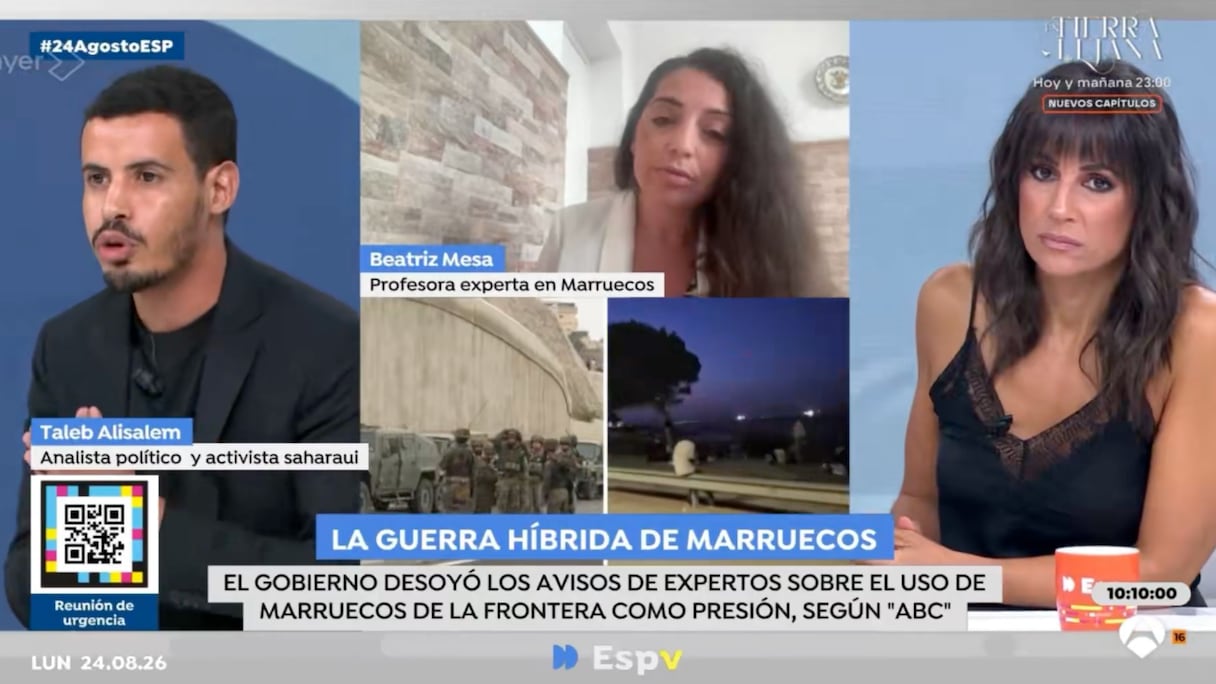
The debate could, however, have been instructive. Espejo Público had invited several guests with differing viewpoints to discuss relations between Morocco and Spain. A commendable approach for a program seeking to tackle a complex issue. But that pluralism would have had to amount to more than simply placing a few different faces on a screen, and each participant would have had to accept hearing arguments that challenged their own narrative.
On Antena 3’s on-screen banner, Taleb Alisalem was introduced as a “political analyst and Sahrawi activist.” But the analysis quickly ran out of road. As soon as Beatriz Mesa tried to test his narrative against the facts, arguments gave way to interruptions and volume prevailed over substance.
Yet the researcher was hardly a guest offering casual commentary on a subject she barely knew. A PhD in political science, academic, journalist and specialist in the Maghreb and Sahel, Beatriz Mesa has spent nearly twenty years studying the region’s political dynamics, including through fieldwork. Facing her, Alisalem apparently believed he could settle the Sahara question with a single word: “Genocide.” No facts, no source, no demonstration. It would no doubt have been a shame to burden such a spectacular accusation with explanations.
Beatriz Mesa tried to recall two realities that Spanish television panels rarely take the time to explain. First, that the Kingdom’s territorial integrity is not, for Moroccans, merely a card to be placed on a negotiating table. Second, and evidently even harder for the separatist activist to hear, that the Polisario does not represent all Sahrawis and that many of them fully identify with belonging to Morocco. Rather than answer her, Alisalem chose to drown out her voice.
“It is enough simply not to respect other people’s opinions,” Mesa eventually protested. Despite the interruptions, she again invited him to respond on the substance. “I am speaking to you with all the respect you are due, and I am asking you to answer me with arguments,” she told him, adding that she was prepared to listen. Alisalem replied that he was not interested “in people who promote hate-filled discourse.”
It is a convenient device. Anyone who challenges his version is no longer defending a different point of view, but “inciting hatred.” As for any Sahrawi who does not align with the Polisario, their voice can simply be discarded.
Antena 3 had indeed assembled different opinions, but the channel had forgotten the first condition of any genuine debate: allowing everyone to speak. Beatriz Mesa brought academic expertise, long field experience and an analysis that broke with the one-sided narrative usually served to the Spanish public. Taleb Alisalem, for his part, launched an accusation of “genocide” and then multiplied the interruptions so that it could not be examined. The channel allowed the second method to prevail over the first. A curious conception of pluralism, in which everyone is free to speak provided they do not contradict the “analyst.”
From Separatist Activist to Television Expert
Born in 1992 in the Tindouf camps, Taleb Alisalem arrived in Spain at the age of ten through the Vacaciones en Paz program. Based in Madrid, he became known as an activist and writer committed to the separatist cause. His publishing house states that he studied international cooperation and development aid.
None of that, of course, deprives him of the right to take part in the debate over the Sahara. It does, however, make it necessary to state clearly where he is speaking from. Taleb Alisalem is not an outside observer of the conflict, but an activist engaged on one side of it. The confusion begins when television programs erase that distinction and elevate activist discourse into expertise without subjecting it to the standards that should accompany such status.
Read also : Lahcen Haddad: “Freedom of expression does not exempt the media from their editorial responsibility”
An analyst can perfectly well hold political convictions. What distinguishes an analyst from a propagandist is not the absence of opinion, but method. It is their responsibility to distinguish facts from interpretation, substantiate conclusions and acknowledge realities that do not fit their own narrative.
Alisalem did exactly the opposite by refusing to hear that a significant proportion of Sahrawis support Morocco’s territorial integrity and do not consider themselves represented by the Polisario. In the Southern Provinces, Sahrawis vote in Moroccan elections, hold municipal and regional office and sit in national institutions. The representativeness of different currents can be debated. But one cannot simply erase one of them in order to preserve the fiction that every Sahrawi is, by definition, a separatist.
When Beatriz Mesa tried to recall this reality, Alisalem did not refute her. He simply made sure she could not be heard.
An Escalation Spanish TV Panels Accommodate
This episode on Antena 3 is not Taleb Alisalem’s first television excess. On July 31, on Cuatro’s Horizonte, he had already claimed that Spain possessed the means necessary to “destroy Morocco politically and economically.”
That call had gone largely unchallenged on the set. It ultimately led academic and political figure Lahcen Haddad to refer the matter to Spanish journalism bodies. The Madrid Press Association subsequently forwarded the case to the Commission for Arbitration, Complaints and Journalism Ethics.
In less than a month, Alisalem has thus moved from the idea of “destroying” politically and economically a country of nearly forty million people to accusing it of “genocide.” First Cuatro, then Antena 3. Each time, the same setup: a television platform, an on-screen caption conferring expert status, and too weak a counterweight to subject his claims to serious scrutiny.
Read also : From free speech to hate speech? call for Morocco’s ‘destruction’ on Spanish TV faces ethics review
Antena 3 has, moreover, made Alisalem one of its recurring guests whenever Morocco is discussed. On Espejo Público, he described the Ceuta migration crisis as a “perfectly prepared and organized operation” by Rabat, claimed that in Morocco “people are already talking about the return of Andalusia to the Moroccan fold,” and attributed to the Kingdom a strategy aimed at sowing chaos in order to test Spain’s response capabilities.
With repeated television appearances, activist rhetoric gradually acquires the appearance of expertise. But repetition does not turn a committed opinion into impartial analysis. Nor does the label “political analyst” neutralize Alisalem’s convictions or relieve the channel of its duty to verify his claims.
After the program, he wrote on X that he had been forced to “put up with this woman named Beatriz,” whom he accused of engaging in “acrobatics” and “talking a lot without saying anything” in defense of Morocco. In light of the footage, the remark is not without irony. The person who was barely allowed to speak was precisely Beatriz Mesa.
Antena 3 is free to invite Taleb Alisalem, just as he is free to openly defend independence for the Sahara. But a broadcaster should neither present an activist as a neutral authority, nor allow him to accuse a country of “genocide” without asking for the slightest evidence, nor accept that he silence, through constant interruptions, the person challenging his narrative.
The plurality of a debate is not measured by the number of guests gathered around a television table. It requires that each person be genuinely allowed to speak, that the gravest accusations be substantiated, and that no one, through repeated television appearances, be allowed to claim a monopoly over the Sahrawi voice.