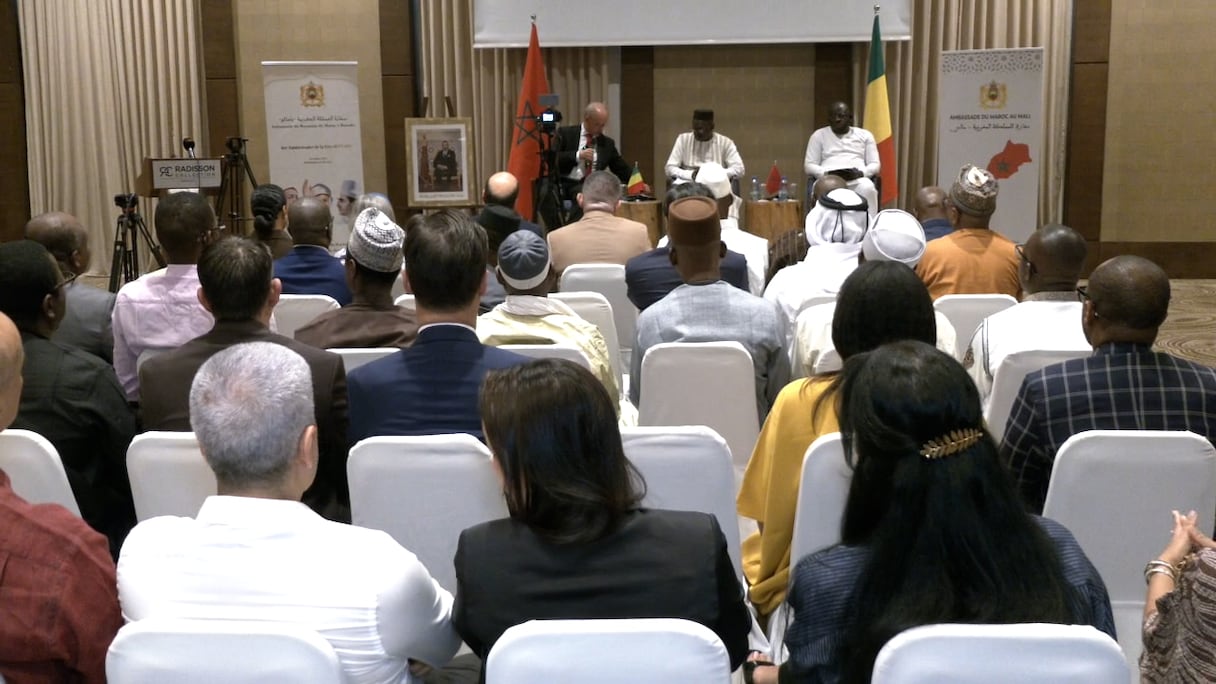
To mark the first anniversary of Eid Al Wahda, Morocco’s ambassador to Mali, Driss Isbayène, organized a roundtable in Bamako on the theme “Morocco’s national unity, a factor of stability and development in the Sahel-Sahara region.” The event took place at the Radisson Collection hotel on Saturday, October 31, 2026.
The Moroccan diplomat said he had organized the conference “to explain the symbolism and origins of the National Unity Day and, at the same time, to help people understand that Morocco’s territorial integrity is not a matter that concerns Morocco alone.” He added that “peace and stability in the Maghreb region also concern peace and stability across the entire Sahel-Sahara region and far beyond.”
“Taking responsibility for development and stability”
He went on to say that “the Sahara issue has dragged on for far too long. Morocco is this Sahara, and it is developing its Sahara. We are ready to take responsibility for the entire issue of development and stability in our country.”
For Driss Isbayène, “Morocco is developing despite all the challenges created by other actors who are genuinely seeking to establish an artificial state south of Morocco.”
He concluded by saying, “We are confident about the future, and unity is only growing stronger.”
One of the speakers, journalist Daouda Tékété, said that “restoring historical truth requires us to adopt an attitude toward our brothers and neighbors (...) who have shown their willingness to regard us as full-fledged members of society, who must fight to ensure that the African continent finally regains its dignity.”
“One continent, one destiny”
He added that “since the Middle Ages, our country has maintained relations with Morocco, continuing through to the First Republic of Mali and the creation of the Casablanca Group, the very first group that did not take the border between the Sahel and the Sahara into account.”
He continued by saying that “the historical development of our relations with Morocco shows that, beyond everything that is said and done, it is a country seeking to ensure that we all feel like full-fledged inhabitants of one and the same continent, with one and the same destiny.”
For his part, Souleymane Satigui Sidibé, executive director of the TIRAC-SAHEL Institute, said that “the autonomy plan proposed by Morocco, which has won the support of the vast majority of nations, is the most viable solution, not only to resolve a crisis that should never have existed in the first place, but also to guarantee international security across the Sahel-Sahara region.”
