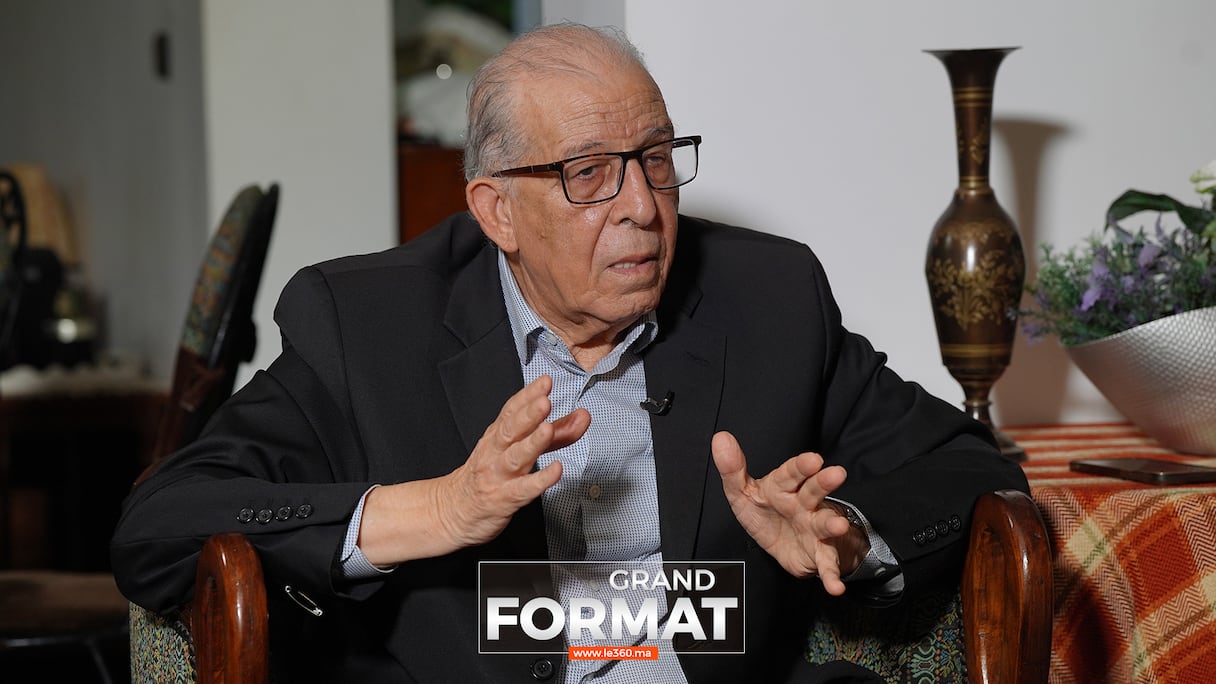
Benaddi has never truly turned the page on the PAM. Even after distancing himself from the party for several years, the former secretary-general continued to follow its development. Its victory in the legislative elections and Fatima Ezzahra El Mansouri’s appointment as head of government have rekindled his attachment to a project he believes he helped build, despite the missteps that marked its trajectory.
“I was delighted by this victory,” he said on Grand Format Le360. Along with other former secretary-generals who helped establish the party, he wanted to mark the occasion by sending El Mansouri a congratulatory statement. She agreed to read it aloud before members of the PAM’s national council.
“It was a way of saying that the idea we had fought for had finally become a reality,” he explained.
For the former left-wing activist, the focus must now shift to governing. “It’s like rugby. When you score a try, you still have to convert it,” he said. In other words, an electoral victory is only the first step. The party must now turn its success at the ballot box into a successful governing experience worthy of the trust placed in it by the King and the Moroccan people.
The Koutla, a “natural” coalition
As consultations continue over the formation of the governing majority, an alliance between the PAM and the Koutla parties, Istiqlal, the Socialist Union of Popular Forces (USFP) and the Party of Progress and Socialism (PPS), is emerging as a leading option. The prospect may seem surprising given the differences between these parties and the Movement for All Democrats, followed by the PAM, in their early years.
“This is a natural coalition,” Benaddi said. But does the Koutla, often regarded as a historic political reference, still have a political reality today? “Symbols matter,” the former PAM leader replied, while acknowledging that the current balance of power no longer resembles the circumstances in which the Koutla was formed.
Fatima Ezzahra El Mansouri met a PPS delegation led by Mohamed Nabil Benabdallah on September 30, 2026.
Read also : Morocco: New House opens, but speaker’s chair remains up for grabs
His reasoning is pragmatic. The PAM would have favored a different configuration if a better option had been available. As for the National Rally of Independents (RNI), Benaddi believes the party has strayed from the course originally set by its founder, Ahmed Osman.
Those who interpret the PAM’s rapprochement with the Koutla parties as an attempt to strengthen its political legitimacy will find little support in Benaddi’s remarks. “The PAM does not need legitimacy,” he insisted. In his view, the issue is no longer whether the party is recognized as a legitimate political force, but whether it can shoulder the responsibilities of power and meet citizens’ expectations.
Fatima Ezzahra El Mansouri’s appointment as head of government also carries a personal significance for Benaddi. He knows her family, particularly her father, whom he knew when he was practicing law and active in the National Union of Popular Forces (UNFP).
When news of her appointment broke, Benaddi sent her a congratulatory text message. The new head of government later called him, leading to an emotional exchange. Beyond their personal ties, the former PAM leader said he was especially proud to see a woman reach such a senior position.
Read also : Constitutional Union to offer critical support to Morocco’s next government
El Mansouri is the second person from Marrakech to become head of government, after Abdallah Ibrahim, the first head of government of independent Morocco, with whom Benaddi was close. Their relationship extended beyond politics. Benaddi also knew Ibrahim’s family environment, having grown up in the same neighborhood as his eldest son, the late Moulay Zaki, and attended the same school.
Beyond these personal connections and memories, Benaddi wants to contribute to the success of the El Mansouri government. His involvement in the Movement for All Democrats, which gave rise to the PAM, and his role in drafting the summary of the report marking 50 years of human development in Morocco inform that commitment. Describing himself as a veteran of the democratic movement, the left and the trade union movement, he believes the time has come to move beyond past divisions and focus on national priorities.
“From the lesser jihad to the greater jihad”
For Benaddi, the composition of the next government is at least as important as the makeup of the governing majority. When El Mansouri spoke of forming a “strong political government” based in particular on competence and integrity, he saw it as a major shift in the PAM’s responsibilities.
“When I heard that, I thought the PAM had moved from the lesser jihad to the greater jihad,” he said. The expression captures what he sees as the party’s transition from winning political power to taking responsibility for governing the country.
The shift takes on added significance given the challenges and threats facing Morocco, which King Mohammed VI addressed in his October 9 speech opening Parliament. The King said the country was experiencing “an exceptional juncture, rich in opportunities that may not come again.”
In this context, Benaddi believes the new head of government must be allowed to make the necessary decisions herself. He recognizes that many people will seek ministerial posts, but insists that party pressure and individual ambitions must not dictate the choices.
His assessment of El Mansouri is unequivocal. “For me, she has ticked all the boxes. I wish her every success,” he said.
To illustrate his confidence, he offered an ironic metaphor: “If I board a plane piloted by El Mansouri, I fasten my seat belt and fall asleep, completely at ease. But if I see people facing suspicions boarding alongside her, I take off my seat belt and get off the plane, even if that means embarking on a new Long March to Beijing, following in Mao Zedong’s footsteps.”
Behind the imagery lies a clear demand. The confidence placed in the new head of government will also depend on the people she chooses to surround herself with. Competence and integrity cannot remain mere declarations of intent. They must guide the selection of ministers, whether they come from the PAM or from other parties joining the governing majority.
Benaddi is particularly reluctant to see members of the outgoing government return to office. He is critical of the previous government’s political record, accusing it of growing distant from citizens and failing to listen closely enough to their concerns.
He says he raised these concerns before tensions between the PAM and the RNI intensified. Two years ago, he claims, he argued that his party should distance itself from the government and join the opposition.
Beyond replacing familiar faces, Benaddi questions whether the next government will be credible. Controversies that have angered public opinion, particularly allegations of conflicts of interest and other disputed practices, should not be brushed aside.
“If we want to restore the credibility of political parties, rebuild trust and encourage Moroccan elites to get involved in politics, that is where we must start,” he said. In his view, the next governing majority’s success will depend not only on its ability to govern, but also on its willingness to address public concerns and break with practices that have fueled distrust.
An opposition that takes responsibility
The former PAM secretary-general does not rule out political confrontation. He believes opposition parties, including the Justice and Development Party (PJD) and the Alliance of the Left, have every right to challenge the government’s decisions and defend their own political positions.
Read also : Morocco to propose new migration cooperation model to European partners
However, he calls for a different approach to opposition politics, one based on the quality of proposals and the ability to persuade. “We need a genuine culture of opposition, grounded in exemplary conduct. We must show the way,” he said.
Asked about threats of “fierce” opposition to the incoming government, Benaddi criticized the terminology. “That vocabulary belongs in the jungle,” he said. Effective opposition, in his view, should help improve government action and serve society’s interests rather than descend into a war of words.
Toward the end of the program, Benaddi was invited to deliver a message to El Mansouri. He expressed confidence in her ability to assume the responsibilities of her new position. That confidence is rooted in his knowledge of her family and political background, but it also comes with clear expectations regarding the composition of the next government, its integrity and its closeness to citizens.
“I have complete confidence in her ability to make the necessary decisions. But she must take full responsibility for them and decide for herself. It is important to listen to everyone, but when it comes time to make a decision, she must follow her conscience, resist pressure and let no one decide in her place,” he advised.
