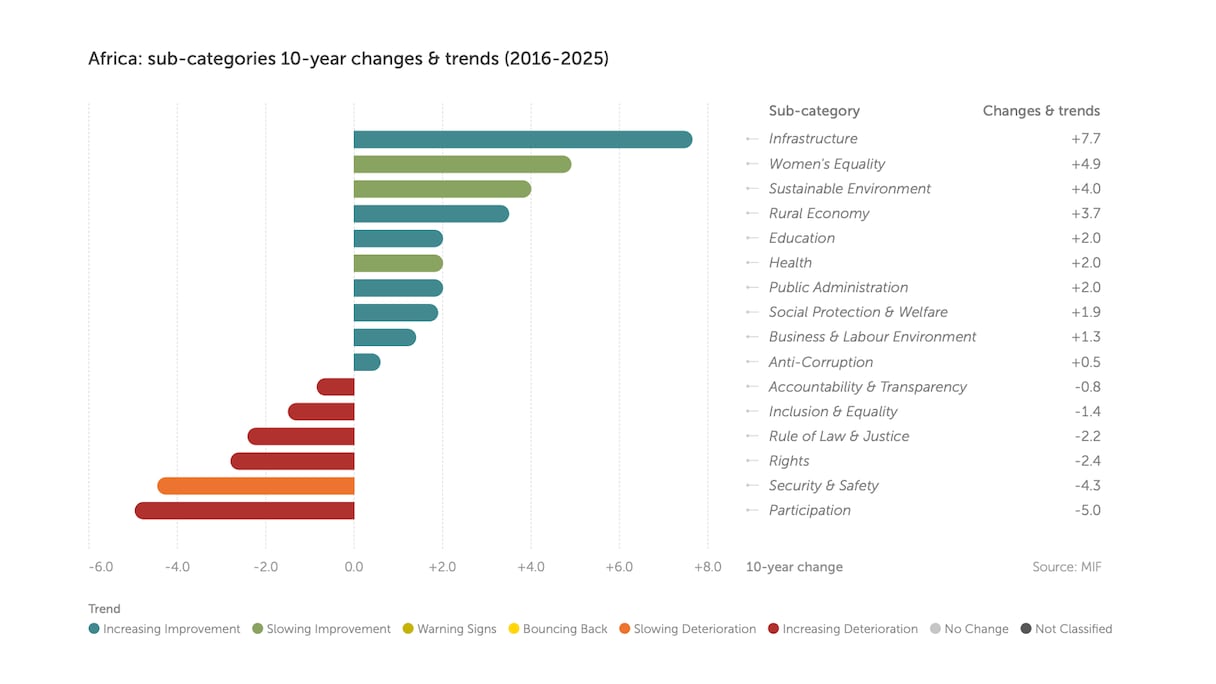
Africa is making progress in economic opportunities and human development — from infrastructure and access to healthcare and education to technology — but democracy and fundamental rights are losing ground amid a succession of coups, devastating wars and bloody crackdowns linked to elections.
This is the central paradox revealed by the latest Ibrahim Index of African Governance (IIAG) 2026, published on Saturday, October 31, which examines how governance has evolved across the continent.
The Mo Ibrahim Foundation defines governance as “the provision of public goods and services in the political, social and economic spheres that every citizen has a legitimate right to expect from the state, and that every state has a responsibility to deliver to its citizens.”
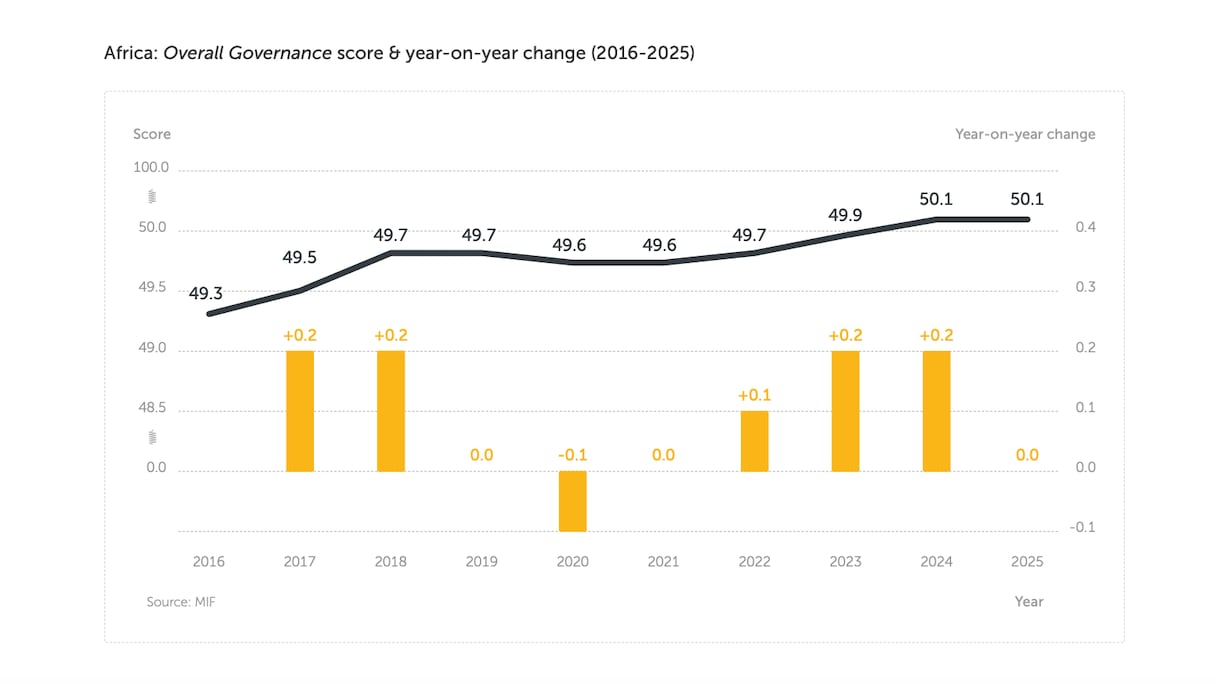
Covering all 54 African countries over the period from 2016 to 2025, the study shows that Africa’s overall governance score edged up by 0.8 points, from 49.3 to 50.1, after a decade of uneven progress. The report highlights deteriorating governance in some of the continent’s largest countries, including South Africa, Nigeria and the Democratic Republic of Congo. It also identifies countries that have made significant gains.
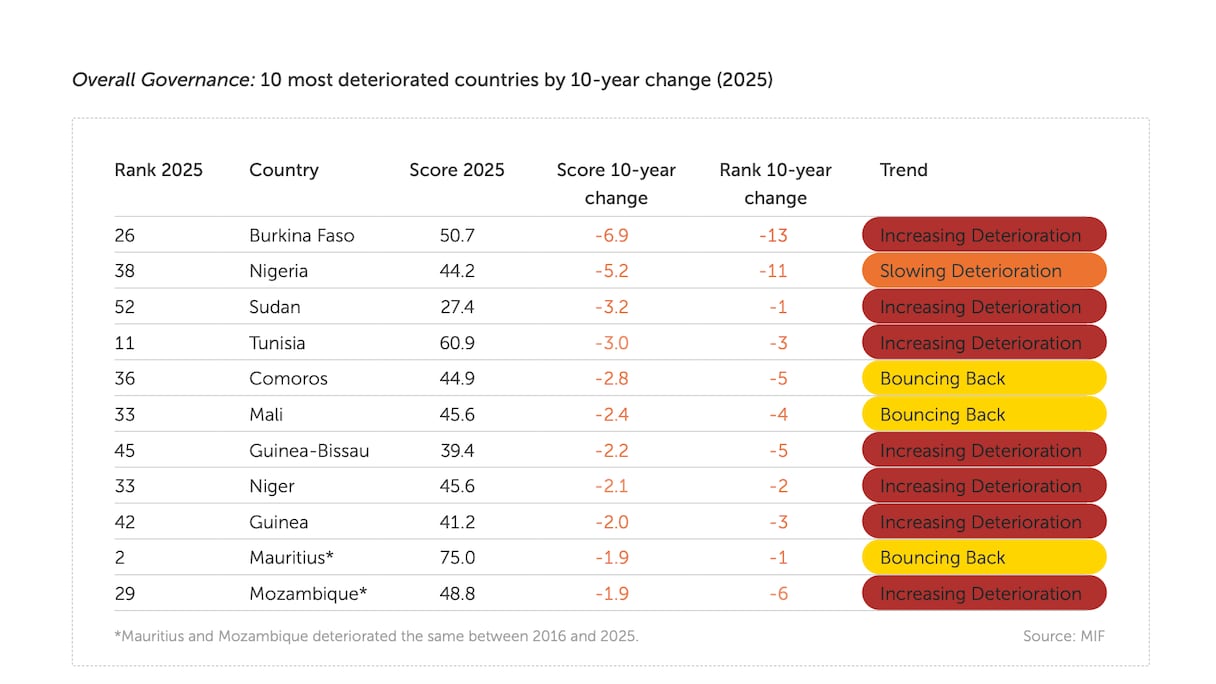
Between 2016 and 2025, 30 countries, home to 49.6% of Africa’s population, recorded improvements in overall governance. By contrast, 23 countries saw their scores decline. Those experiencing an accelerating deterioration include Burkina Faso, Guinea, Guinea-Bissau, Mozambique, Niger, Sudan and Tunisia. Most have experienced coups in recent years.
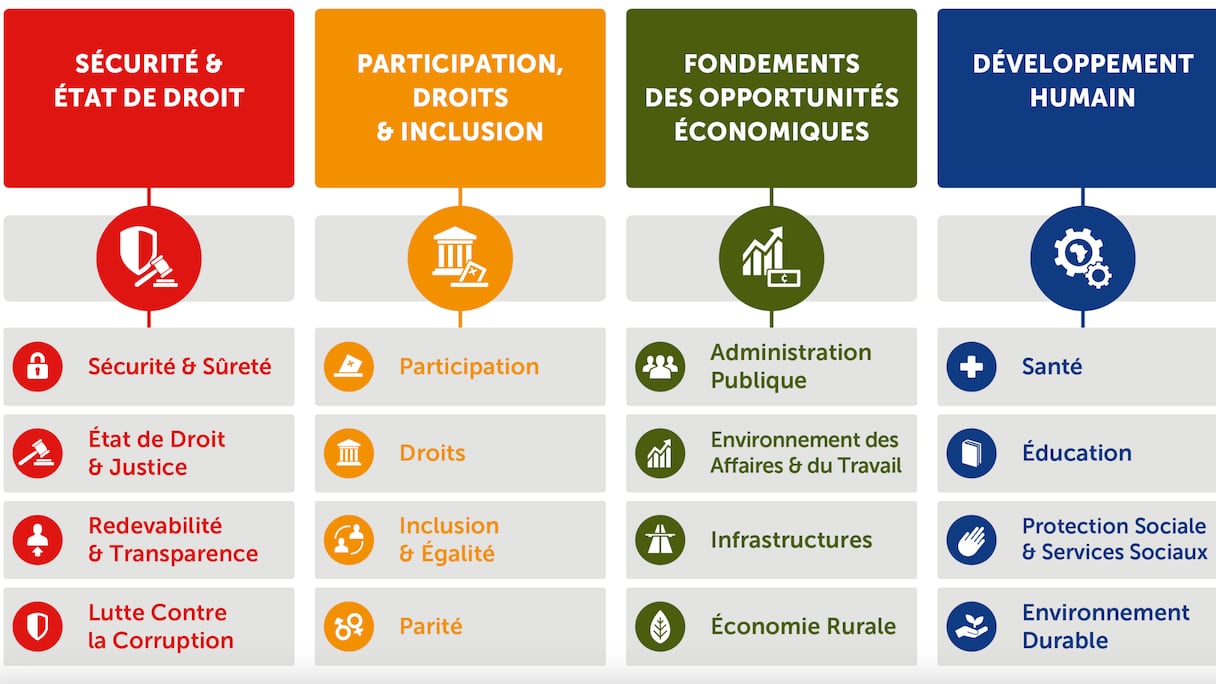
Each country’s governance performance is assessed across four main categories: Security and Rule of Law (safety and security, the rule of law, anti-corruption measures and others); Participation, Rights and Inclusion (rights, inclusion and inequality, gender equality and others); Foundations for Economic Opportunity (public administration, infrastructure, the business and labor environment, and others); and Human Development (health, education, social protection and social services, among others).
Read also : AfDB raises MAD 1bn in first Moroccan dirham bond issue
Each category is divided into subcategories, which are further broken down into indicators providing quantifiable measures of the fundamental dimensions of governance. Altogether, the 2026 IIAG comprises 96 indicators.
IIAG scores measure a country’s performance on each governance indicator for each reference year, on a scale of up to 100.0, with 100.0 always representing the best possible score.
The significance of the IIAG ranking lies in its multidimensional approach, which considers not only economic prospects and human development but also the rule of law, civil liberties and citizen participation.
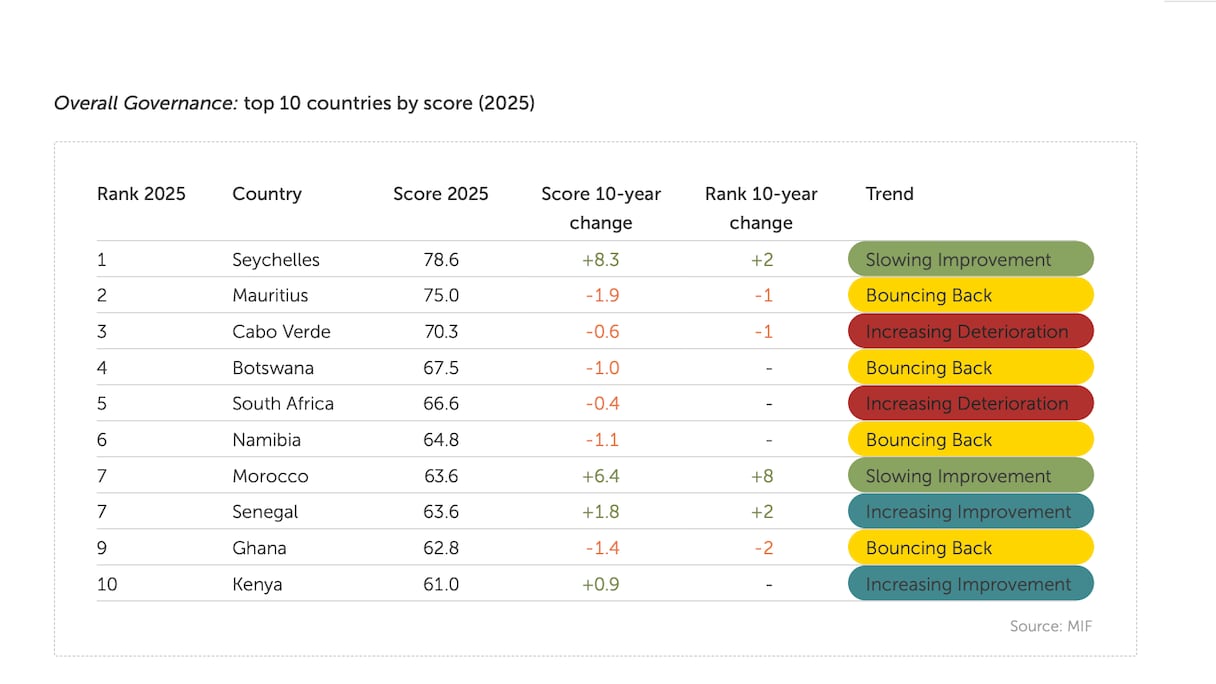
Based on the scores awarded to Africa’s 54 countries, the 10 best performers in overall governance are Seychelles, Mauritius, Cabo Verde, Botswana, South Africa, Namibia, Morocco, Senegal, Ghana and Kenya. Together, they have an average score of 67.4 points, compared with the continental average of 50.1.
Yet this strong performance conceals contrasting trends over the 2016–2025 decade. Only four countries—Seychelles, Morocco, Senegal and Kenya—continued to improve, while the other six recorded a deterioration.
Despite these shifts, the composition of the top 10 has remained largely unchanged. Nine countries have retained their places in the group. Morocco is the sole newcomer, having gained 6.4 points and climbed eight places to reach seventh position in the 2025 IIAG, displacing Tunisia from the top 10.
Africa’s 10 best-governed countries in 2025
| Rank | Country | 2025 score | Points gained or lost over 10 years | Places gained or lost |
|---|---|---|---|---|
| 1 | Seychelles | 78.6 | +8.3 | +2 |
| 2 | Mauritius | 75.0 | -1.9 | -1 |
| 3 | Cabo Verde | 70.3 | -0.6 | -1 |
| 4 | Botswana | 67.5 | -1.0 | — |
| 5 | South Africa | 66.6 | -0.4 | — |
| 6 | Namibia | 64.8 | -1.1 | — |
| 7 | Morocco | 63.6 | +6.4 | +8 |
| 8 | Senegal | 63.6 | +1.8 | +2 |
| 9 | Ghana | 62.8 | -1.4 | -2 |
| 10 | Kenya | 61.0 | +0.9 | — |
Seychelles tops the African rankings. The archipelago, home to fewer than 140,000 people, saw its score rise by 8.3 points over the decade to 78.6, climbing two places to become Africa’s best-governed country in 2025. Seychelles made the greatest progress in areas including transparency, the fight against corruption and environmental protection.
Mauritius follows with 75.0 points, ahead of Cabo Verde (70.3), Botswana (67.5) and South Africa (66.6). South Africa retains fifth place, although its governance performance is deteriorating at an increasingly rapid pace amid corruption, insecurity and other challenges.
Morocco, meanwhile, improved its score by 6.4 points over the decade to 63.6, climbing eight places to enter the continental top 10 in seventh position. This advance was driven by progress in areas including the rule of law, justice, accountability, infrastructure and public administration performance.
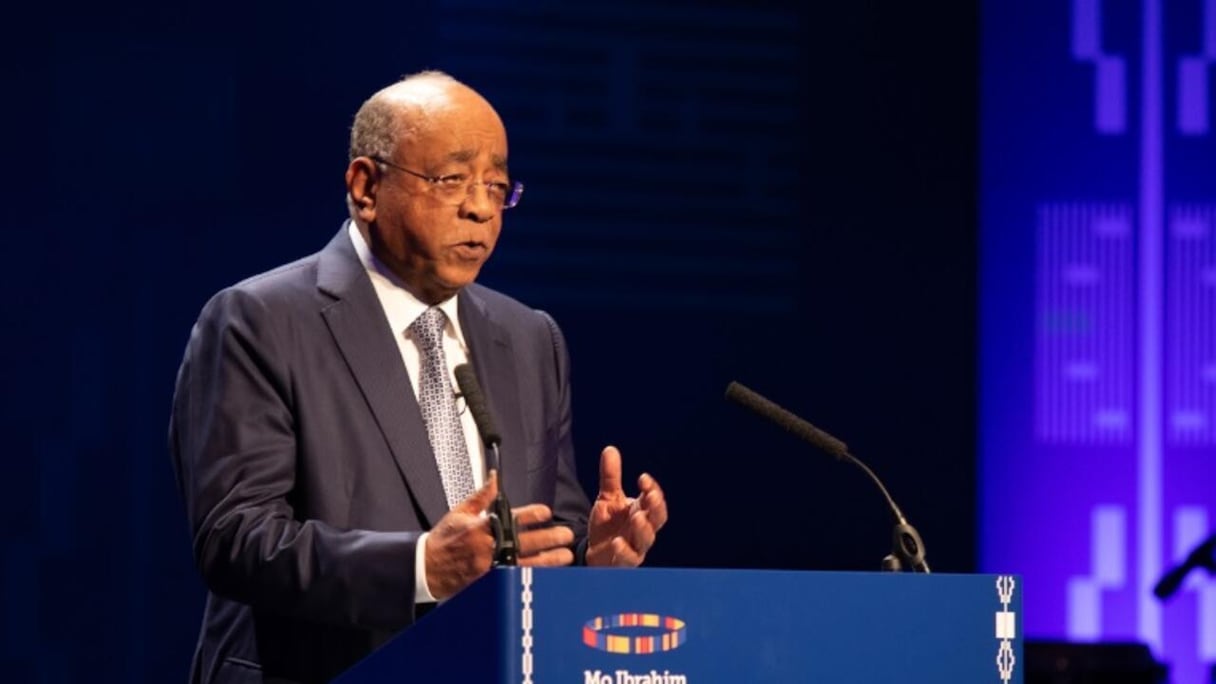
Mo Ibrahim, milliardaire anglo-soudanais et entrepreneur dans le domaine des télécommunications, philanthrope de renommée internationale avec la Fondation Mo-Ibrahim qui publie l'Indice Ibrahim de la gouvernance en Afrique.
Morocco’s entry into the top 10 reflects a shift in the balance of governance performance across North Africa. The Kingdom now ranks ahead of Tunisia (11th), Algeria (19th), Egypt (25th), Mauritania (41st) and Libya (46th).
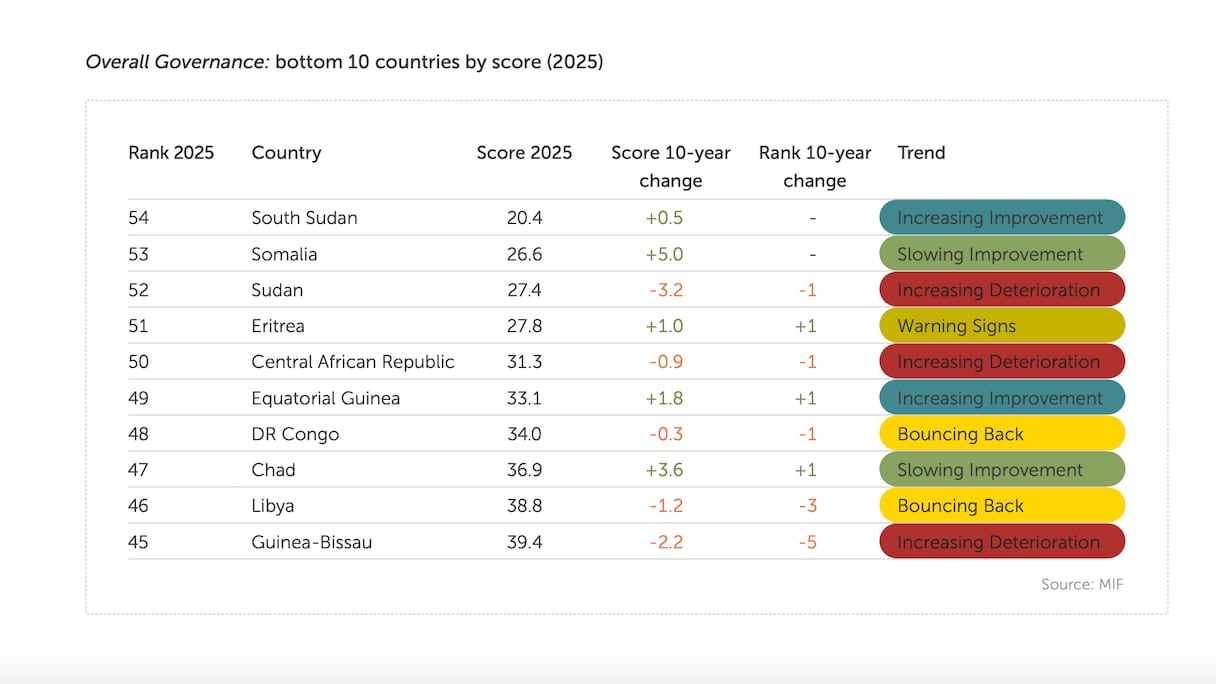
At the bottom of the rankings are the Central African Republic (50th), Eritrea (51st), Sudan (52nd), Somalia (53rd) and South Sudan (54th). These countries have suffered from years of instability or persistent democratic shortcomings.
Beyond the rankings, the index is intended to help governments identify areas where progress is needed. It also serves as a reminder that sustainable governance cannot be reduced to economic modernization or infrastructure development alone.
Mo Ibrahim, the Sudanese-born billionaire who founded the foundation bearing his name, believes the current generations have failed. Yet he remains hopeful that governance will improve in the years ahead, thanks to Africa’s young people, with those under 25 accounting for 60% of the continent’s population. By 2050, one in three young people worldwide will be African. “They are far better educated than the previous generation,” Ibrahim stressed.
