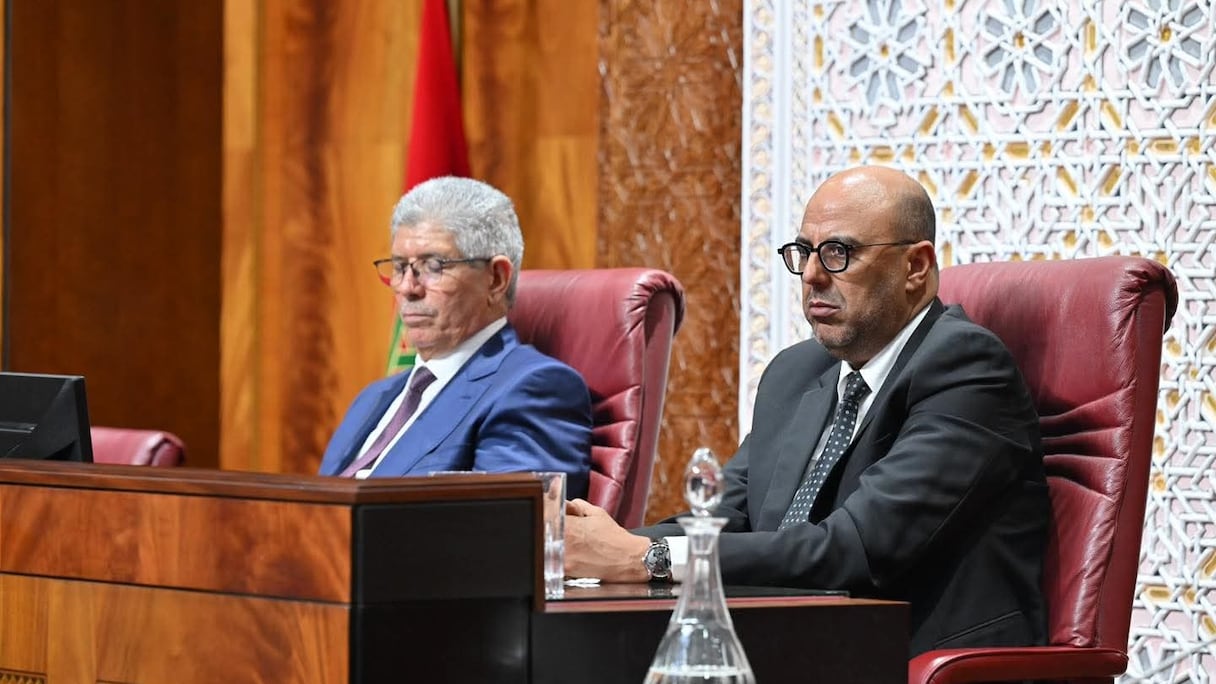
Both houses of Parliament are holding a joint session on Monday to discuss the latest developments concerning the Moroccan Sahara, following last week’s UN Security Council meeting on the issue.
The sitting brings together members of the House of Representatives and the House of Councillors in the wake of the Security Council’s October 30 meeting and a subsequent statement issued by the Royal Office.
2:50 p.m.—UMT calls for stronger parliamentary and non-governmental diplomacy
Speaking on behalf of the Moroccan Labour Union (UMT) group in the House of Councillors, Noureddine Soulaik welcomed the Royal Office statement of October 30, saying the latest developments reaffirmed Morocco’s fundamental national principles and sovereignty over its territory.
The UMT representative highlighted Morocco’s diplomatic achievements and the growing international support for its autonomy initiative under Moroccan sovereignty. He attributed these gains to King Mohammed VI’s strategic vision and a diplomatic approach rooted in firmness and realism.
Soulaik called for continued efforts to bring more countries on board in support of Morocco’s initiative. He advocated stepping up parliamentary and non-governmental diplomacy, turning Parliament into a platform for making Morocco’s case before international institutions and parliamentary assemblies. He also stressed the need to accelerate implementation of the development model for the southern provinces.
2:45 p.m.—Nabila Jalal (Left Alliance): No one has the right to impose a referendum on Moroccans in their own land
Speaking on behalf of the Left Alliance, Nabila Jalal declared emphatically that no one had the right to impose a referendum on the Moroccan people in their own land. In her view, recent resolutions demonstrate both the broad international consensus behind autonomy under Moroccan sovereignty and the opposing side’s continued determination to obstruct any constructive solution. While highlighting the international system’s shortcomings in managing crises—which show that Morocco cannot rely indefinitely on alliances vulnerable to shifting foreign interests—she stressed one overriding priority: strengthening national unity by deepening democracy, advancing development and promoting social justice.
2:30 p.m.—CGEM highlights investment in the southern provinces and its contribution to development
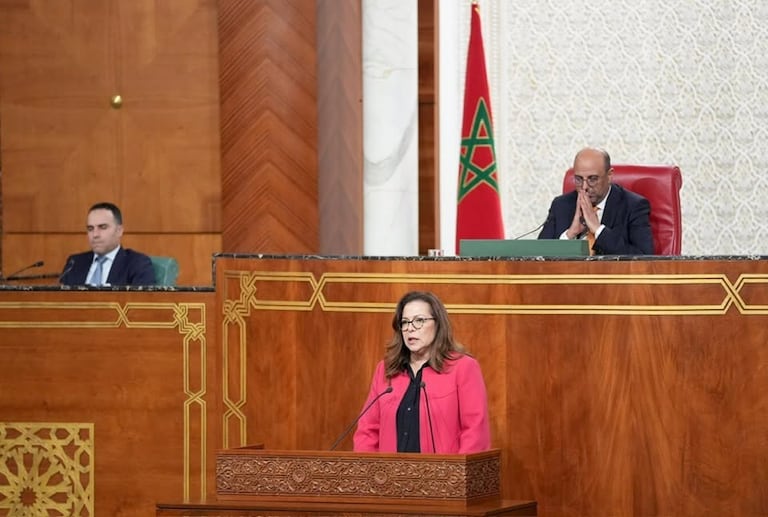
Speaking on behalf of the General Confederation of Moroccan Enterprises (CGEM) group in the House of Councillors, Neila Tazi welcomed the Royal Office statement of October 30, 2026, describing the non-renewal of MINURSO’s mandate as a major development in the handling of the Sahara issue. She reaffirmed Morocco’s commitment to the ceasefire and its openness to serious initiatives aimed at resolving the dispute.
Tazi placed particular emphasis on the economic dimension of Moroccan sovereignty in the southern provinces. She recalled the launch in 2015 of a new development model for the region, initially backed by MAD 77 billion, before pointing to the mobilization of MAD 150 billion in public funding. Among the major infrastructure projects she cited were the Tiznit-Dakhla expressway, the Dakhla Atlantic port, the Atlantic gas pipeline and the royal initiative to give Sahel countries access to the Atlantic Ocean.
Tazi also said the southern provinces recorded average growth of 8.5% between 2014 and 2024, compared with 4.9% nationwide. She cited these figures to highlight the role businesses have played in driving investment, creating jobs and supporting economic development across the region.
2:10 p.m.—UGTM calls for safeguarding diplomatic gains and defending the rights of people in Tindouf
Speaking on behalf of the General Union of Moroccan Workers (UGTM) group in the House of Councillors, Hanae Belkheir welcomed the Royal Office statement issued following the Security Council meeting on October 30, 2026. She described it as a new chapter in the Sahara dispute, arguing that Morocco had moved beyond managing the issue to bringing about major changes.
Belkheir called for Morocco’s diplomatic gains to be safeguarded and for continued international mobilization in support of the autonomy initiative. She also welcomed Security Council Resolution 2797 and reaffirmed her support for elected representatives from the southern provinces, whom she considers the legitimate representatives of the Sahrawi population.
She further stressed the need to uphold the rights of refugees and detainees in the Tindouf camps, calling in particular for them to be able to exercise their right to return to their homeland.
2:15 p.m.—Hassan Derham: Algeria and the Polisario must reconsider their position
Hassan Derham, himself a native of the Moroccan Sahara, spoke on behalf of the Party of Progress and Socialism during the session. In his view, the failure to renew MINURSO’s mandate reflects the Security Council’s failure to resolve the Sahara dispute. “Nevertheless, 11 Council members supported the draft resolution that Russia vetoed, proof that our cause is just and that the Kingdom enjoys international support,” he noted.
For Derham, the Royal Office statement issued after the Security Council vote on Friday, October 30, now serves as the new point of reference. It marks a break with the status quo that some had sought to impose on the handling of the dispute. “One chapter closes with the end of the UN political process, and another begins,” he declared. Morocco, meanwhile, will continue on its path. “It is now up to Algeria and the Polisario to reconsider their position. The failure to renew MINURSO’s mandate is, first and foremost, their failure.”
2:05 p.m. — USFP: “Non-renewal of MINURSO’s mandate marks a major shift”
Speaking on behalf of the Socialist Union of Popular Forces (USFP) parliamentary group, its chairman, Hassan Lachgar, reaffirmed his party’s commitment to defending Morocco’s territorial integrity, stressing that the Sahara is a national cause that cannot be subject to bargaining or short-term political considerations.
The Socialist official also highlighted the economic and social transformation of the southern provinces, pointing to investment in infrastructure, public services and stronger political representation in cities such as Laâyoune, Dakhla, Smara and Boujdour. He said these achievements demonstrated the central place of the southern provinces in Morocco’s national development strategy.
Turning to the latest developments at the United Nations, Lachgar argued that the non-renewal of MINURSO’s mandate was far more than a procedural decision. He described it as “the beginning of a major shift” in the handling of the Sahara dispute, saying that the circumstances that had led to the mission’s establishment no longer applied.
2:00 p.m.—Driss El Azami El Idrissi hails non-renewal of MINURSO’s mandate as “a remarkable achievement and a victory”
Driss El Azami El Idrissi, chairman of the Justice and Development Party (PJD) parliamentary group in the House of Representatives, described the latest developments in the Sahara dispute, marked by the non-renewal of MINURSO’s mandate following Russia’s veto at the Security Council, as “a remarkable achievement” and “a victory” for the legitimacy of Morocco’s sovereignty over its southern provinces. “We stand firmly behind our king,” he declared.
El Azami El Idrissi expressed hope that the people held captive in Tindouf would one day be able to return to their homeland, bringing an end to the separation of so many families. He also praised the wisdom shown by Morocco and its King in handling the dispute, particularly in their approach to Algeria, while highlighting the King’s longstanding policy of extending a hand of friendship to the neighboring country.
“Whatever happens, Morocco is in its Sahara, and the Sahara is in its Morocco, until Allah inherits the earth and all who dwell upon it,” the PJD parliamentary group leader concluded.
1:40 p.m.—Istiqlal Party sees latest developments as a turning point for national sovereignty
Speaking on behalf of the Istiqlal parliamentary group during the joint session of both houses of Parliament, its chairman, Rahhal Mekkaoui, welcomed the Royal Office statement issued following the Security Council meeting, describing it as a turning point in the handling of the Sahara issue and the consolidation of Morocco’s territorial sovereignty.
The Istiqlal official said the latest developments marked a break with decades of stagnation in efforts to resolve the dispute. He pointed in particular to the non-renewal of the UN mission’s mandate and the abandonment of the referendum option, arguing that these developments reflected a commitment to preserving peace and the ceasefire while working towards a definitive settlement.
Mekkaoui also called for Morocco to sustain and intensify its international diplomatic efforts under the leadership of King Mohammed VI to broaden support for the Kingdom’s position. He said that nearly two-thirds of UN member states, including members of the Security Council, now support Morocco.
1:30 p.m.—PAM calls for an end to the Security Council’s handling of the Sahara issue
Speaking on behalf of the Authenticity and Modernity Party (PAM) during the joint parliamentary session, MP Mohamed Sabbari welcomed the latest developments in the Sahara dispute, describing them as a crucial step towards its resolution.
Sabbari highlighted the non-renewal of MINURSO’s mandate after 31 years of presence in the southern provinces. On behalf of his party, he expressed support for the Royal Office statement and the prospect it opens up of bringing the Moroccan Sahara issue to a definitive close.
He also argued that it was time to move beyond the Security Council’s handling of the issue and bring an end to international meetings devoted to it, while taking account of the UN Secretary-General’s reports. Sabbari reaffirmed Morocco’s commitment to the ceasefire and to continued efforts to promote peace and the well-being of local populations.
1:16 p.m.—After MINURSO: Mohamed Ould Errachid outlines Parliament’s three priorities
A native of Morocco’s southern provinces, Mohamed Ould Errachid, President of the House of Councillors, set out the course he believes Parliament should follow after the end of MINURSO. In his opening address to the parliamentary session devoted to the national cause on Monday, November 2, 2026, he identified three priorities for members of both houses: stepping up parliamentary diplomacy by expanding international contacts, strengthening legislative preparedness to respond to current and future developments, and maintaining nationwide mobilization to meet the challenges ahead.
1:15 p.m. — Moroccan Sahara: Ahmed Touizi urges Parliament to turn national consensus into lasting institutional gains
In his opening address to the joint session of both houses of Parliament devoted to the Sahara issue, Ahmed Touizi, President of the House of Representatives, stressed that Morocco’s progress on the issue was no passing development but the result of a “far-sighted royal vision” and diplomacy rooted in firmness and clarity.
He highlighted growing international support for Morocco’s position and the recognition of autonomy under Moroccan sovereignty as “a realistic and credible basis” for resolving the regional dispute.
For Touizi, Parliament’s responsibility goes beyond welcoming the progress already made. It must also play an active role in the next stages. He reaffirmed both houses’ support for King Mohammed VI and their commitment to fully exercising their constitutional, legislative, oversight and parliamentary diplomacy responsibilities in the service of the Kingdom’s highest interests.
The House of Representatives president also called for the national consensus on the Sahara issue to be translated into a “lasting institutional achievement,” alongside continued development in the southern provinces and efforts to strengthen their economic, social and cultural standing, which he described as a tangible expression of national sovereignty.
