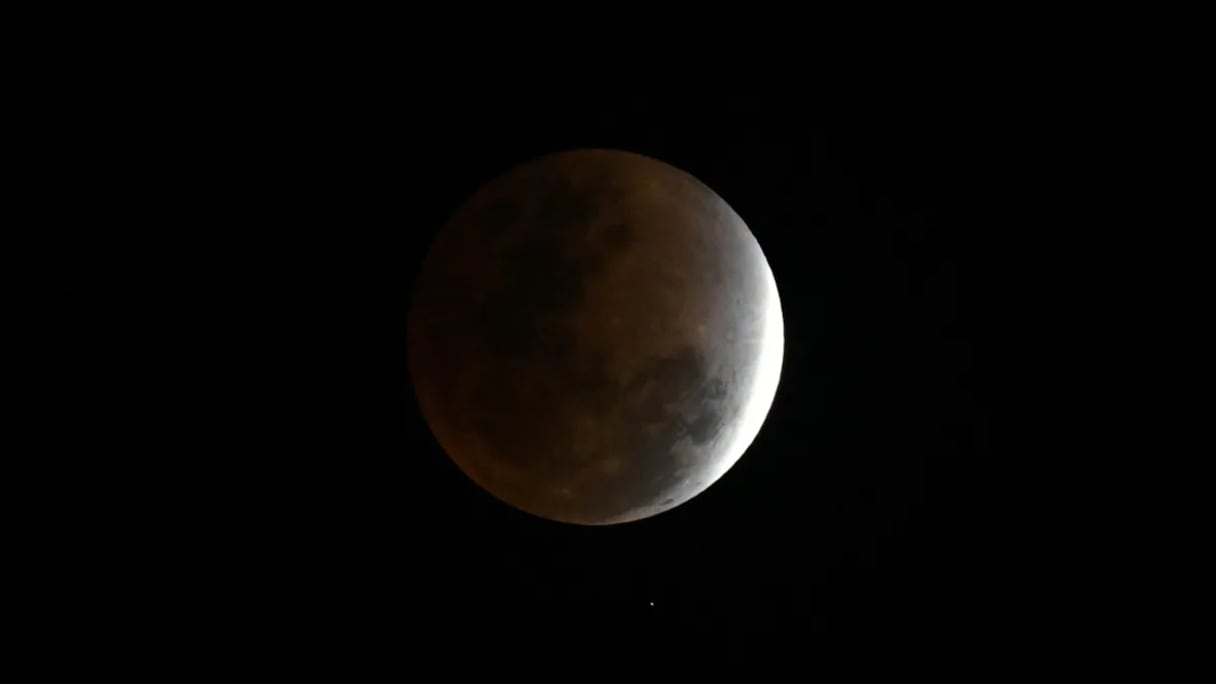
The eclipse will be visible across large parts of Africa, Europe and the Americas, as well as parts of western Asia. In Morocco, the partial phase will begin at around 4:12 a.m. local time, with the eclipse reaching its peak at approximately 5:12 a.m., according to astronomical data cited by NASA and timeanddate.com.
At its peak, most of the Moon will be covered by Earth’s shadow, while a small portion of its surface will remain illuminated by sunlight. The shaded section may take on reddish, orange or copper tones as sunlight passes through Earth’s atmosphere before reaching the Moon.
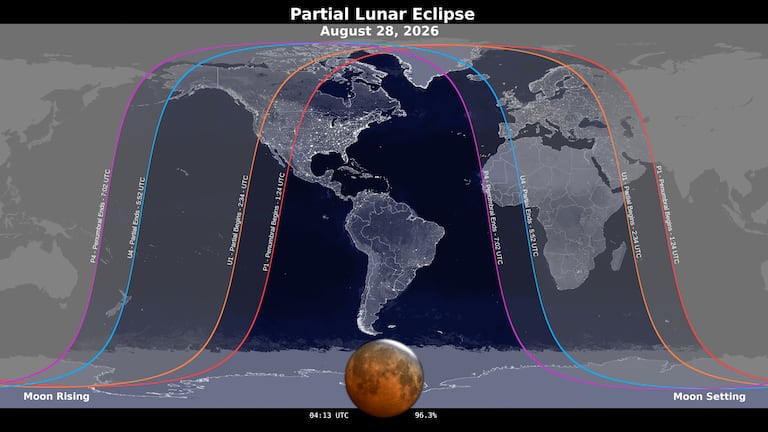
The phenomenon occurs when the Earth moves between the Sun and the Moon, casting its shadow onto the lunar surface. It can only occur during a full Moon.
Astronomer Mazen Younes, a member of the British Astronomical Association, said the Moon will not disappear completely during a partial eclipse, unlike during a total lunar eclipse. Instead, most of its disk will appear copper-red while a small illuminated section remains visible.
The reddish color results from Earth’s atmosphere scattering much of the blue light while allowing some red and orange wavelengths to pass through and bend toward the Moon. This same effect gives the Moon its characteristic reddish appearance during a total lunar eclipse, commonly known as a “blood moon.”
Given the depth of Friday’s eclipse, Younes said the scene could visually resemble a blood moon, although part of the lunar disk will remain clearly illuminated.
Unlike a solar eclipse, the lunar eclipse can be viewed safely with the naked eye and does not require special eye protection. Binoculars or small telescopes can also be used to observe details on the Moon’s surface and its changing color.
The partial eclipse is expected to end at around 6:13 a.m. in Morocco, while the less visible penumbral phase will continue until about 8 a.m.
NASA classifies the August 28 event as one of the notable astronomical events of 2026. Its data indicates that around 96% of the Moon’s disk will enter Earth’s umbral shadow at the peak of the global eclipse, while the portion visible from Morocco is expected to reach about 93%.
Read also : Rare total solar eclipse to darken parts of Europe and the Arctic on August 12
The eclipse belongs to Saros series 138, a cycle in which similar eclipses recur approximately every 18 years, 11 days and eight hours. NASA data indicates that the previous eclipse in this series occurred on August 16, 2008, while the next is expected on September 7, 2044.
According to the astronomical information cited by Younes, Morocco will not see another partial or total lunar eclipse until 2028.