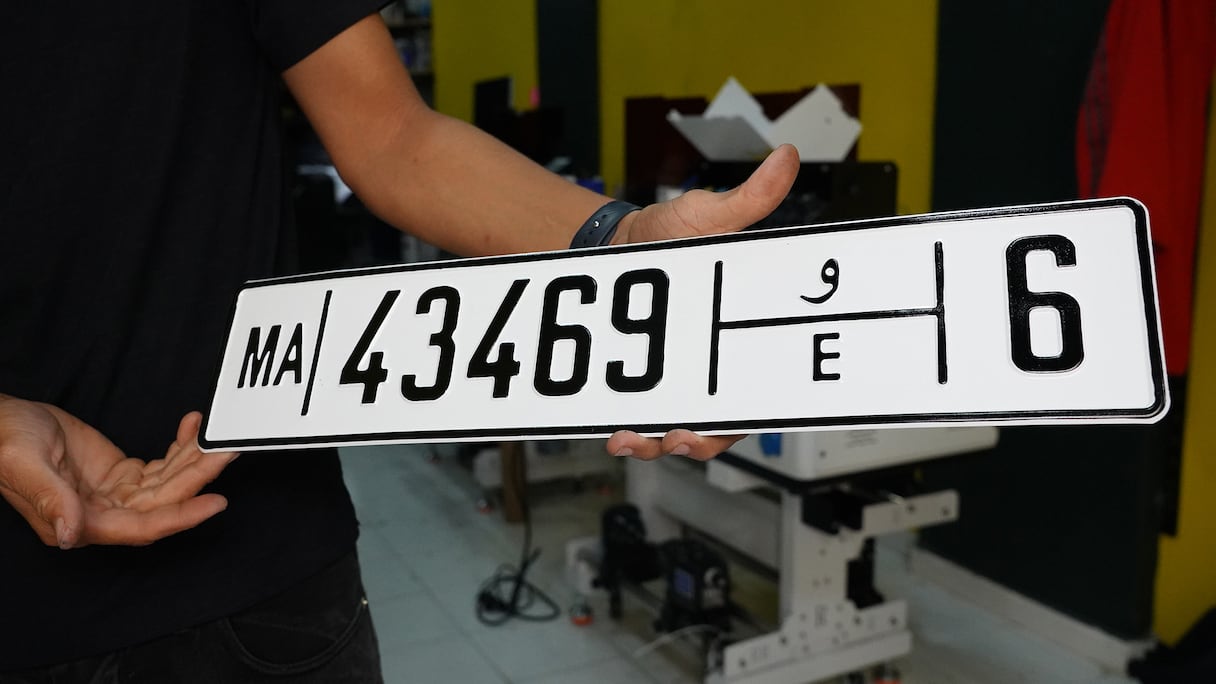
Since the December 31 deadline for replacing certain old license plates was announced, printing and engraving shops have seen an increase in customers. This reform introduces a standardized, modern design for Morocco’s vehicle fleet, gradually replacing older formats and stickers with embossed characters in both Arabic and Latin scripts. This change addresses both national standardization and international road traffic requirements.
The primary change is the addition of Latin characters alongside Arabic ones. While the registration number structure remains the same, the Arabic letter is now accompanied by its Latin equivalent. The “MA” marking, previously an optional addition for vehicles traveling abroad, is now directly integrated into the plate.
At a printing shop in Casablanca’s Bourgogne neighborhood, the process is almost entirely mechanical. Numbers are positioned individually, followed by the “MA” marking and corresponding characters. Once aligned, the plate enters a press. After a few seconds and a metallic sound, the new number appears on the white surface. The entire process takes approximately 15 minutes, leaving the plate ready for installation.
Two finishes are available, with prices varying based on material quality. Saïd, an employee, explained, “White plates start at 150 dirhams, with models costing 170 dirhams, while higher-quality versions can reach 200 dirhams.” Reflective plates, offering better visibility by reflecting light, are also an option.
The manufacturing process involves precise steps: placing, aligning, pressing, and painting. After emerging from the machine, the plate undergoes a final stage. “After putting in the numbers and the ‘MA,’ I move on to painting. I turn on the machine, add the thinner and the paint,” the technician explained as a roller covered the plate.
Read also : Latin letters to be added to Moroccan license plates
Beyond these technical changes lies a broader effort to standardize license plates. NARSA states the reform aims to resolve practical difficulties caused by the coexistence of different plate formats for domestic and international travel. The new model is designed for both situations, featuring a common format and dimensions. “It is mainly for those who travel abroad, so that all the plates are the same,” a young man commented.
This reform does not mandate immediate plate replacement for all motorists. Vehicles already registered in the normal series with plates lacking Latin characters can continue using them until the first transfer of ownership.
However, for vehicles used in international traffic that already have Latin characters and a separate “MA” marking, the old plates will only remain valid until December 31, 2026. The new model is already being issued for new registration procedures following the decision’s publication, applicable to new vehicles purchased in Morocco or imported vehicles, whether new or used.
In Casablanca, some motorists are proactively making the change. One customer replacing his plate stated that the unified system should facilitate travel and prevent misunderstandings at border crossings. “It is a good thing for the plates to be unified to avoid problems when traveling. There were difficulties when we wanted to leave the country or return, particularly during security checks,” he said.
For him, there is no reason to wait until the final weeks. “I came today to change the plate before there are too many people. It is better to do it now and avoid any inconvenience,” he added.
For workshops, this early demand could become the next challenge. Although the transition is gradual, professionals expect the number of customers to rise as the deadline approaches. “There will be a lot of people coming toward the end, we already know that,” one professional said.
For manufacturers, the countdown has already begun. For motorists, the change is relatively simple: a few additional characters and an “MA” marking now built into the plate, but above all the end of the distinction between the plate used in Morocco and the one previously needed for crossing international borders.
