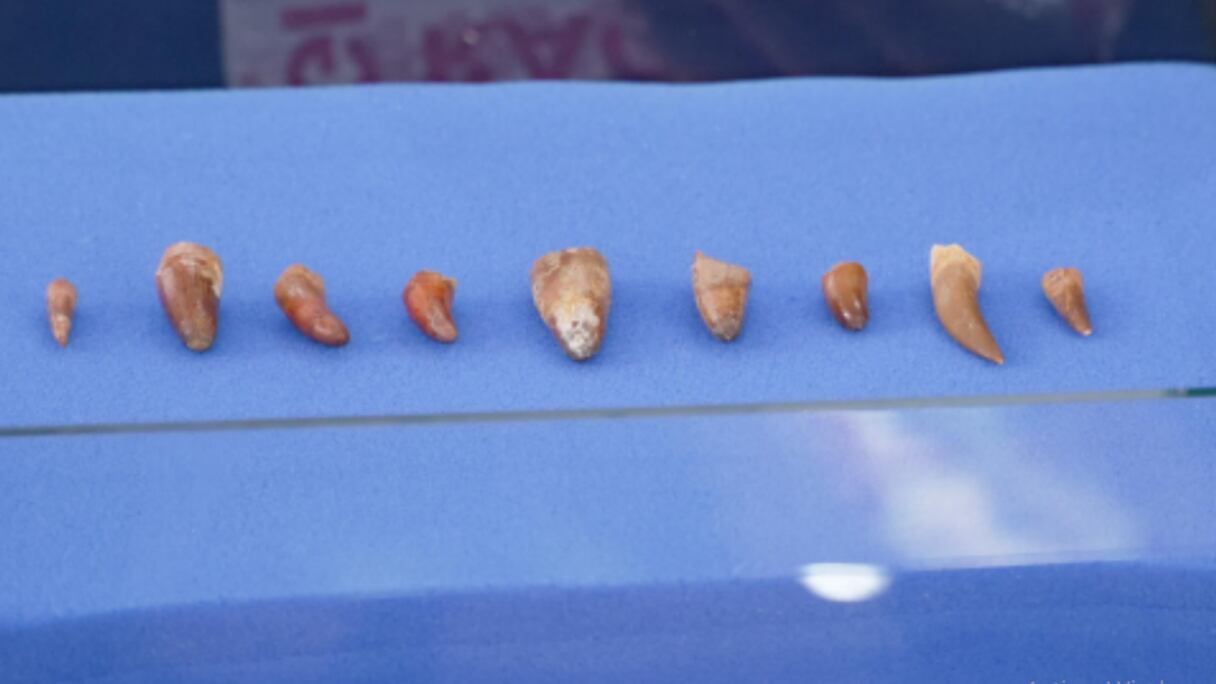
To better understand the issue, Le360 spoke with Abdeljalil Bouzouggar, director of the National Institute of Archaeology and Heritage Sciences (INSAP), about the significance of the recovered fossils, the risks posed by their depletion, what happens to artifacts once they are returned to Morocco, and the measures needed to curb trafficking and preserve the country’s geological heritage.
Bouzouggar explained that the fossils recently returned from France, and officially handed over to Morocco during a ceremony chaired by Minister of Youth, Culture and Communication Mohamed Mehdi Bensaid and French Minister of Culture Rachida Dati, consist of fossilized teeth belonging to various extinct species, including marine animals and dinosaurs.
“The scientific value of these specimens lies primarily in the species they belong to and the geological period they represent,” he said.
He added that studies conducted by Moroccan and international researchers at several fossil sites indicate that the specimens likely originated from the area around Khouribga, among other locations.
The fossils are particularly significant because some date back between 72 and 66 million years, a period that coincides with the extinction of the dinosaurs.
“These teeth, which belong to different extinct species and date back between 72 and 66 million years, will add new knowledge to what we already know about the life forms that existed during that period,” Bouzouggar said.
Read also : Morocco retrieves nine Cretaceous-era fossil teeth from France
He noted that Morocco’s fossil sites yield far more than fossilized teeth. Researchers have also uncovered marine animal skeletons, dinosaur remains, and dinosaur footprints.
According to Bouzouggar, the scientific value of a fossil is not determined by its size or by the number of specimens recovered, but by the knowledge it can provide.
“We may have a small bone measuring no more than 20 centimeters, yet it could allow experts and scientists to reconstruct an entire animal. We should therefore focus not on the size or quantity of the specimens, but on their scientific importance,” he said.
While these fossils hold considerable scientific value, they are increasingly threatened by illegal excavation and trafficking outside Morocco.
Bouzouggar said several regions are particularly rich in paleontological resources, especially southeastern Morocco and the Khouribga area, where illegal excavation and trafficking are driven by demand extending well beyond Morocco’s borders.
“The existence of illegal trafficking in archaeological artifacts and fossils reflects international demand. Because that demand exists beyond our borders, organized groups have become active in this trade,” he said.
He warned that continued uncontrolled exploitation could eventually deplete Morocco’s geological heritage, stressing that these fossils are not merely objects for sale but part of the country’s natural history.
“One day, those trafficking these artifacts may no longer have anything left to export or sell because they are exhausting this heritage,” he said.
“If these fossils disappear, we will be harming our country’s history, particularly its natural history, and depriving both Moroccans and visitors of the opportunity to discover the unique species once associated with this region.”
To combat the problem, Bouzouggar pointed to legislation and international cooperation as key tools against illegal trafficking. Morocco has both the older Heritage Law No. 22-80 and the newer Law No. 33-22, in addition to international legal frameworks and agreements that have enabled the Ministry of Youth, Culture and Communication to recover numerous fossils from the United States and Germany.
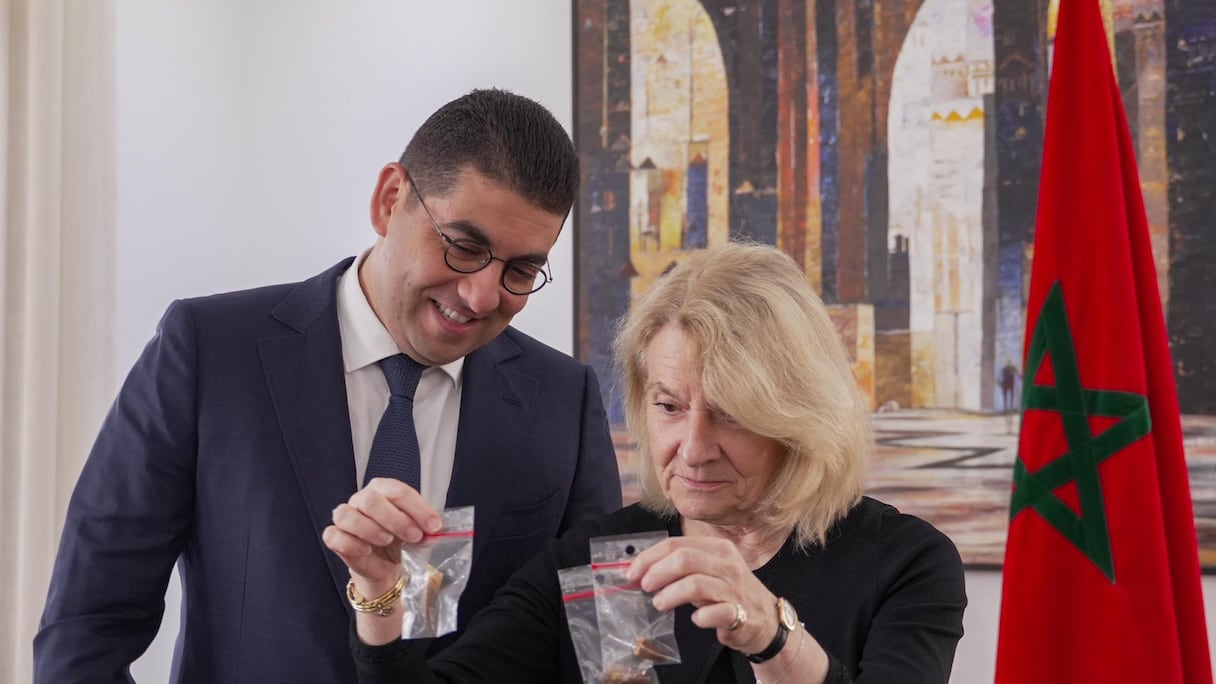
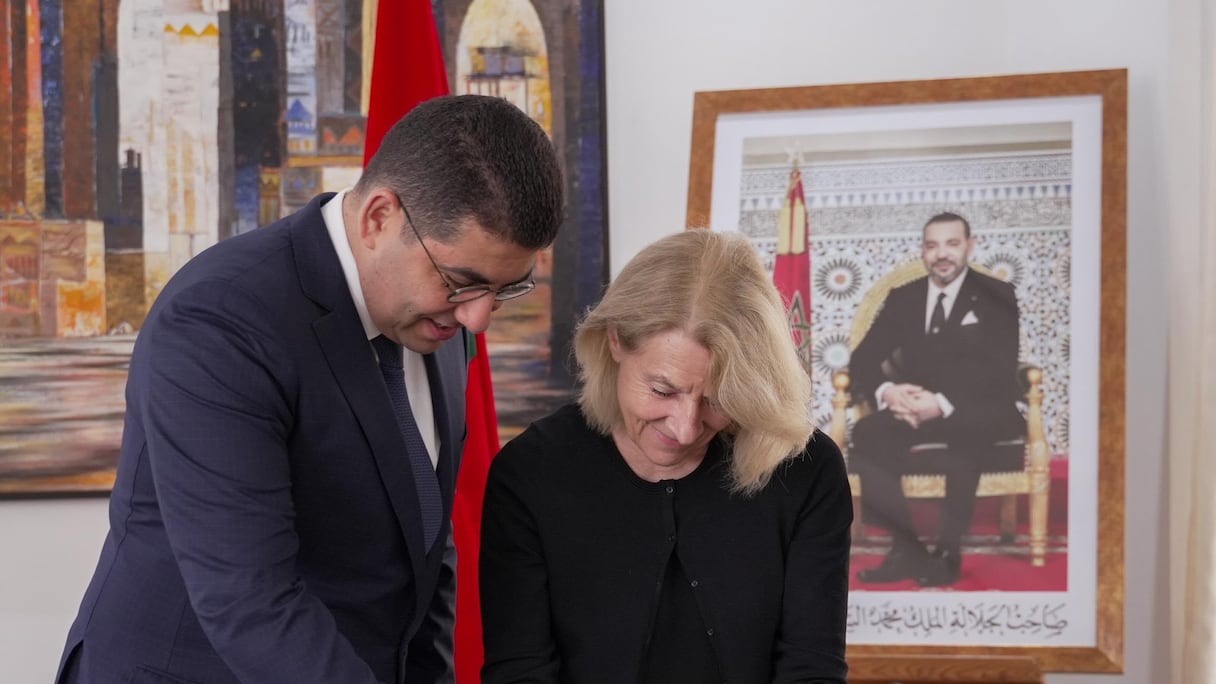
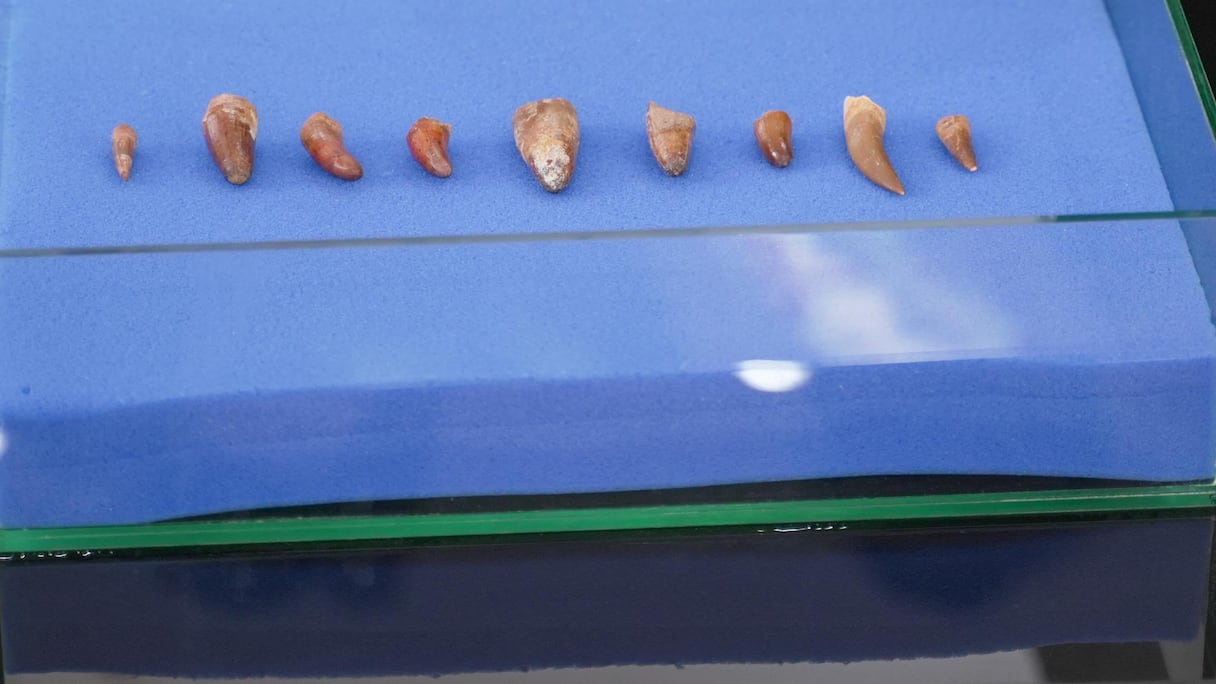
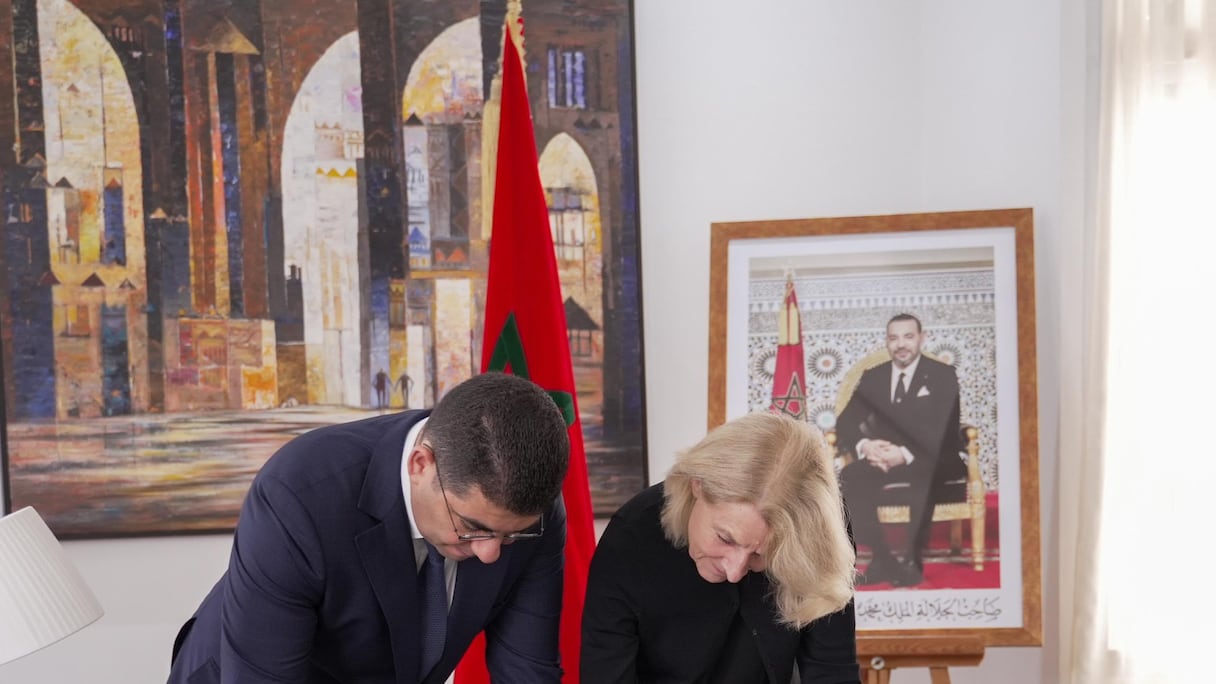
France returns nine Cretaceous reptile teeth to Morocco.
He also highlighted the role of UNESCO and explained that Morocco’s Directorate of Cultural Heritage serves as the national focal point responsible for overseeing repatriation cases.
Once returned to Morocco, fossils and other recovered artifacts are officially registered and assigned inventory numbers by the Directorate of Cultural Heritage. Depending on their nature, they are then transferred either to the National Foundation of Museums or to the National Institute of Archaeology and Heritage Sciences for scientific analysis if specialized expertise is required.
“If the recovered artifacts require scientific study, as is the case with the fossils returned from France, they will be transferred to the institute, where specialized researchers will examine them. The findings may also be published so that everyone can benefit from the new knowledge,” Bouzouggar said.
However, he does not believe legislation and border controls alone can solve the problem, arguing that protecting Morocco’s geological heritage also requires greater public involvement.
“We can adopt the strictest laws and strengthen controls at border crossings, but that will not be enough,” he said.
“What we also need is education and public awareness.”
He called for greater efforts to showcase recovered fossils and archaeological finds and explain their scientific and historical significance so that the public can better appreciate their value.
According to Bouzouggar, awareness campaigns can be carried out through traditional media, social media platforms, and even school curricula, helping introduce younger generations to Morocco’s heritage in all its forms.
“I cannot say that we will ever reduce illegal trafficking to zero, but I am convinced that education and public awareness will help curb it,” he said.
Bouzouggar stressed that protecting fossils is a shared responsibility that extends beyond the authorities responsible for law enforcement.
“We need everyone’s cooperation and a collective effort. Laws alone are not enough,” he said.
He added that publicizing the recovery of these artifacts, even when only a single fossil or a small fragment is involved, helps raise awareness of their importance while sending a clear message to those involved in illegal excavation and trafficking that these objects are not merely commodities but an irreplaceable part of Morocco’s natural heritage.
