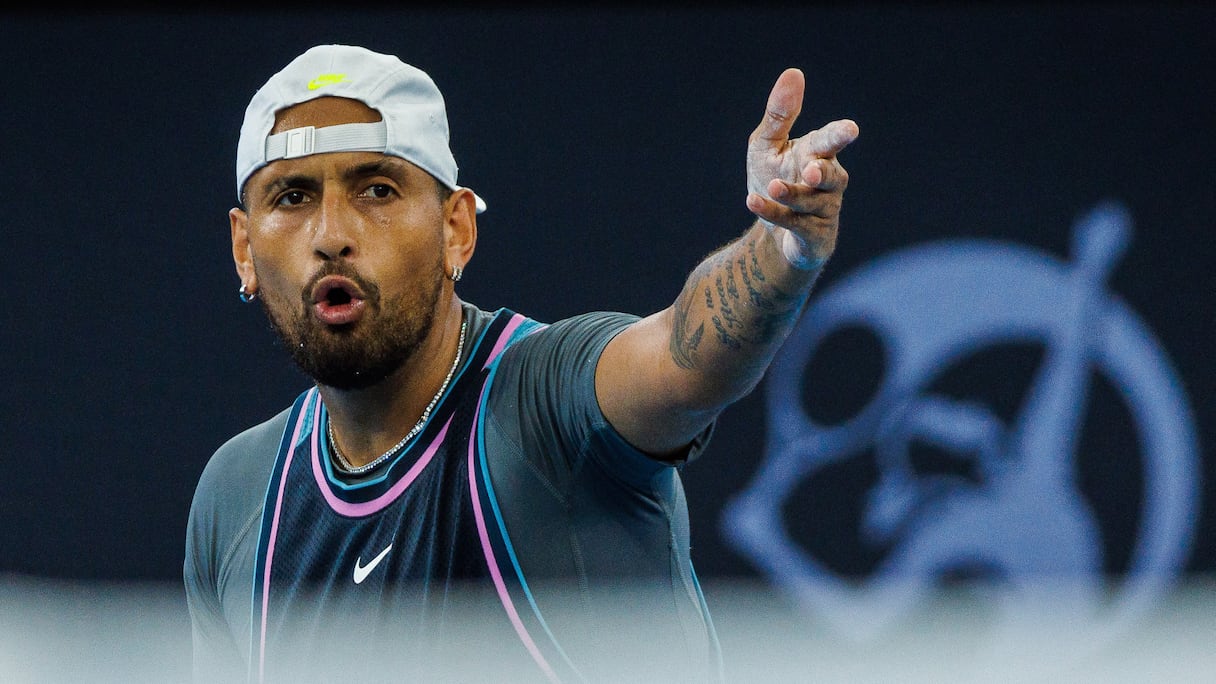
Australian tennis player Nick Kyrgios has been provisionally suspended after testing positive for benzoylecgonine, a metabolite of cocaine, at an ATP 250 tournament in Mallorca on June 22. The 31-year-old announced the failed test himself on Wednesday, saying he had made a “huge mistake” and would take full responsibility.
The International Tennis Integrity Agency (ITIA) confirmed the positive test and said Kyrgios has been provisionally suspended since August 4. He has not appealed the suspension. The length of any eventual ban will depend on whether the substance is found to have been taken in or out of competition, with a possible sanction ranging from three months to four years.
“I recently failed a drug test in Mallorca after testing positive for cocaine,” Kyrgios wrote. “I made a huge mistake and I take full responsibility for it.”
The Australian also apologised to his fans, family, sponsors and the children who follow him.
“Above all, I’m sorry to the kids who follow me. I know the example this sets and I’m deeply disappointed in myself,” he said.
The failed test comes at a difficult stage in a career that has been heavily disrupted by injuries. Kyrgios reached a career-high world ranking of No. 13 and became one of the most recognisable players of his generation, known for his powerful serve, unpredictable style and ability to challenge the sport’s leading names.
His biggest singles run came at Wimbledon in 2022, when he reached his first Grand Slam final before losing to Novak Djokovic. He also won the Australian Open men’s doubles title that year with compatriot Thanasi Kokkinakis.
Kyrgios has struggled to maintain that level of competition since then. A series of knee and wrist injuries kept him away from the ATP Tour for long periods, limiting his appearances over the past few seasons. He played only four official singles matches on the ATP Tour in 2026 before the suspension.
His most recent appearance came at Wimbledon in July, where he partnered Alexander Bublik in the men’s doubles. The pair lost in the first round.
Kyrgios has acknowledged how difficult the prolonged absence from competitive tennis has been for him, particularly as he has had to consider the possibility that his playing career could be nearing its end.
“The last couple of years of injuries have taken a huge toll on me, both physically and mentally,” he said. “My body hasn’t been able to do what my mind expects it to do, and coming to terms with being near the end of my career has been harder than I ever imagined.”
He said that his struggles did not excuse what happened.
“I’ve always said I didn’t choose tennis — tennis chose me,” Kyrgios said. “But letting go of something that has been my whole life is one of the hardest things I’ve ever had to face. At times I’ve felt helpless and alone. None of that excuses what I did.”
Kyrgios said the positive test had served as a “wake up call” and announced that he would step away from social media and public life for 28 days.
The case also brings attention to Kyrgios’ previous criticism of tennis’ anti-doping system, particularly his comments about world No. 1 Jannik Sinner.
Sinner twice tested positive for low levels of clostebol, an anabolic steroid, in March 2024. The Italian said the substance entered his system unintentionally after his physiotherapist used a product containing clostebol to treat a cut and later treated him without knowing that the substance could transfer.
An independent tribunal accepted that explanation and ruled that Sinner bore no fault or negligence. The World Anti-Doping Agency later appealed the decision before reaching an agreement with Sinner on a three-month suspension in February 2025.
Kyrgios was among the most vocal critics of the handling of Sinner’s case. Following the initial reports, he questioned why the Italian had been allowed to continue playing and argued that the circumstances should not change the application of the rules.
“Ridiculous — whether it was accidental or planned,” Kyrgios wrote at the time. “You get tested twice with a banned substance ... you should be gone for 2 years.”
After Sinner accepted the three-month suspension, Kyrgios described it as a “sad day for tennis” and added: “Fairness in tennis does not exist.”
The circumstances surrounding the two cases are different. Sinner’s case centred on an unintentional contamination that was accepted by an independent tribunal, while Kyrgios has acknowledged his failed test and said he takes “full responsibility” for his actions.
The ITIA will now determine the circumstances surrounding Kyrgios’ positive test and whether the cocaine metabolite was present as a result of use in or out of competition. That distinction will be important in determining the eventual sanction.
For now, the provisional suspension prevents Kyrgios from playing, coaching or attending tournaments sanctioned by the ATP or WTA tours, the Grand Slam tournaments and national-level tennis events.
The suspension leaves the future of a player whose career was already uncertain even before the failed test unclear. Kyrgios has not played regularly on the ATP Tour for several years, and after his first-round doubles defeat at Wimbledon, he suggested that he may not return to the tournament.
