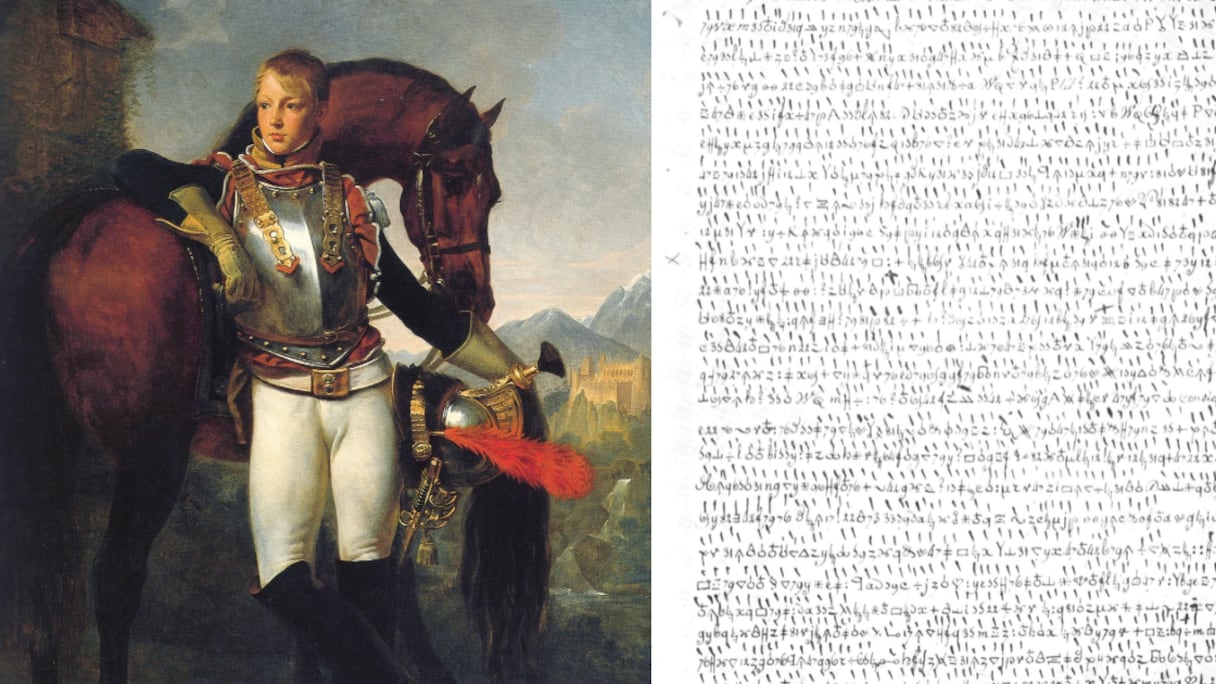
A 217-year-old military cipher has finally been cracked, and it took artificial intelligence about six hours to do it.
The document dates to March 1809, when Napoleon Bonaparte was preparing for a new war with Austria. It was not a letter written directly by Napoleon. Instead, Napoleon ordered his stepson, Eugène de Beauharnais, then Viceroy of Italy, to send the coded message to French General Auguste de Marmont, whose troops were stationed in Dalmatia, in present-day Croatia.
Carter Church, an AI engineer at cybersecurity company SentinelOne, used OpenAI’s GPT-6 Astra to transcribe and decipher the document from a single scanned image. Church said the complete process took about six hours.
The cipher had remained unsolved since the document was reproduced in a French military journal in 1969. The original key was lost, leaving researchers with the coded text but no way to reliably read it.
A message hidden in 1,300 symbols
The surviving document contains about 1,300 cipher units across 24 lines. It uses numbers, letters and hand-drawn symbols in a homophonic substitution cipher, a system in which the same letter can be represented by several different symbols.
That made simple frequency analysis difficult. The document also contains about 155 distinct signs, including more than 70 handwritten symbols with no standard printed equivalent.
Church began with a scanned reproduction of the letter published in the 1969 Revue historique des Armées. He also had access to a partial table of 33 known symbol values compiled by French cryptology historian Daniel Tant.
Astra first had to identify and transcribe the symbols in the image. It then worked through the cipher, wrote code to test possible solutions and compared the emerging French text with historical records.
Read also : OpenAI delays GPT-6.1 Astra release over safety concerns
Church published the full research record, including the reconstructed cipher table and code used to reproduce the result. Tokyo-based researcher Satoshi Tomokiyo, who maintains a database of historical ciphers, subsequently marked the Marmont cipher as solved.
What Napoleon wanted Marmont to know
The decoded message was a military briefing.
Napoleon had ordered Eugène on March 16, 1809, to tell Marmont where the main French and allied forces were positioned. The coded letter lists the same forces and troop numbers specified in Napoleon’s original order.
The message said the Duke of Danzig, Marshal François Lefebvre, commanded 40,000 Bavarian troops between Munich and Passau. Prince Józef Poniatowski had 30,000 Polish troops on the Vistula near Krakow, while Marshal Jean-Baptiste Bernadotte commanded the Saxon army near Dresden.
Marshal Louis-Nicolas Davout, identified by his title Duke of Auerstaedt, was said to have 80,000 French troops at Bayreuth. Marshal André Masséna, the Duke of Rivoli, had 60,000 men around Ulm and Donauwörth. General Nicolas Oudinot commanded another 40,000 troops around Augsburg and along the Lech.
The message also said Russian forces were moving against Austria and assured Marmont that Austria would face attacks from several directions.
The tone was confident. Marmont was told not to be intimidated by the troops in front of him and was warned that Austria was heading toward defeat.
The message was written at a tense moment.
Read also : Meta launches personal AI agent that can send emails, make payments and book travel
Austria had decided to go to war with Napoleon while many of France’s best troops remained tied down in Spain. Marmont’s forces were in Dalmatia, separated from the main French armies by Austrian territory. If Austria attacked, his position could become difficult.
The decoded document also allowed Church to correct the date attached to the letter in the 1969 publication. The journal had dated it to 1807, but the contents and Napoleon’s correspondence show that it was written in late March 1809, shortly before Austria launched its offensive on April 10.
The document therefore gives historians another piece of the correspondence surrounding the start of the 1809 campaign. Napoleon’s original March 16 letter to Eugène had already survived in published correspondence, including the instruction to send Marmont the military information in cipher. What had been missing was the actual message that reached Marmont.
AI has now supplied that missing piece.
