The sentence was handed down on Thursday, October 15, by a court in Dar El Beïda, Algiers: four years behind bars and a fine. Djelloul Slama, an economist and academic, had been charged with “spreading false information” liable to disturb public order and obstructing investment. Arrested on January 24, he spent nearly nine months in pretrial detention before coming before a judge.
What did he do? He spent a few minutes talking on television. Appearing on an economic affairs program on a private channel in January, Slama questioned the quality of the ore, the cost of extracting and transporting it, and whether a project hailed as the pride of the “new Algeria” could ever make economic sense. His conclusion was measured: profitability, he said, “was not guaranteed.” For that professional assessment, he will spend the next four years in prison.
Seventy years of unanswered questions
There was nothing fanciful about his doubts. They go back almost as far as the discovery of the deposit itself. The French geologist Pierre Gevin found it in 1952. Its reserves are vast: several billion tonnes of iron ore. Yet the deposit remained untouched for seventy years, and not because nobody wanted to exploit it. The problem is the ore’s high phosphorus content, which makes it expensive and technically difficult to process before it can be used to make steel. Algerian laboratories were still experimenting with ways to remove the phosphorus in 2015. Two years later, Algiers had got no further than signing a preliminary agreement with China’s Sinosteel to carry out feasibility studies.
And that is before considering the practical difficulties, which any mining engineer could recite from memory. The deposit lies deep in the desert, near Tindouf, 950 kilometers by rail from Béchar and considerably farther from the ports and steelworks of northern Algeria. Processing the ore requires vast quantities of water and energy, neither of which is readily available in the region. Hauling every tonne across such distances adds to costs, even as the mine must compete on price with the iron ore giants of Australia and Brazil.
To ask about these things is not to spread false information. It is to raise the very questions that geologists, engineers and economists have been wrestling with for decades. The regime’s answer is to put the questioner behind bars.
The regime’s own figures make the case
The timing makes the conviction more absurd still. On October 12, three days before the verdict, Algeria’s finance minister presented the draft 2027 budget to lawmakers. His own figures put the cost of Gara Djebilet at 963 billion dinars, or roughly $7.35 billion. The official ambitions remain extraordinary: annual output of 40 to 50 million tonnes from 2026, with the investment supposedly paying for itself by the end of the decade. In any normal country, figures and promises on this scale would be grounds for public scrutiny. In Algeria, they are grounds for keeping quiet.
An empty hole in the desert
On February 1, 2026, Abdelmadjid Tebboune and General Saïd Chengriha staged a lavish inauguration of the Gara Djebilet–Tindouf–Béchar railway and the start of mining operations. “A giant has awakened!” proclaimed the president. State television broadcast footage of a train carrying iron ore in… grain wagons.
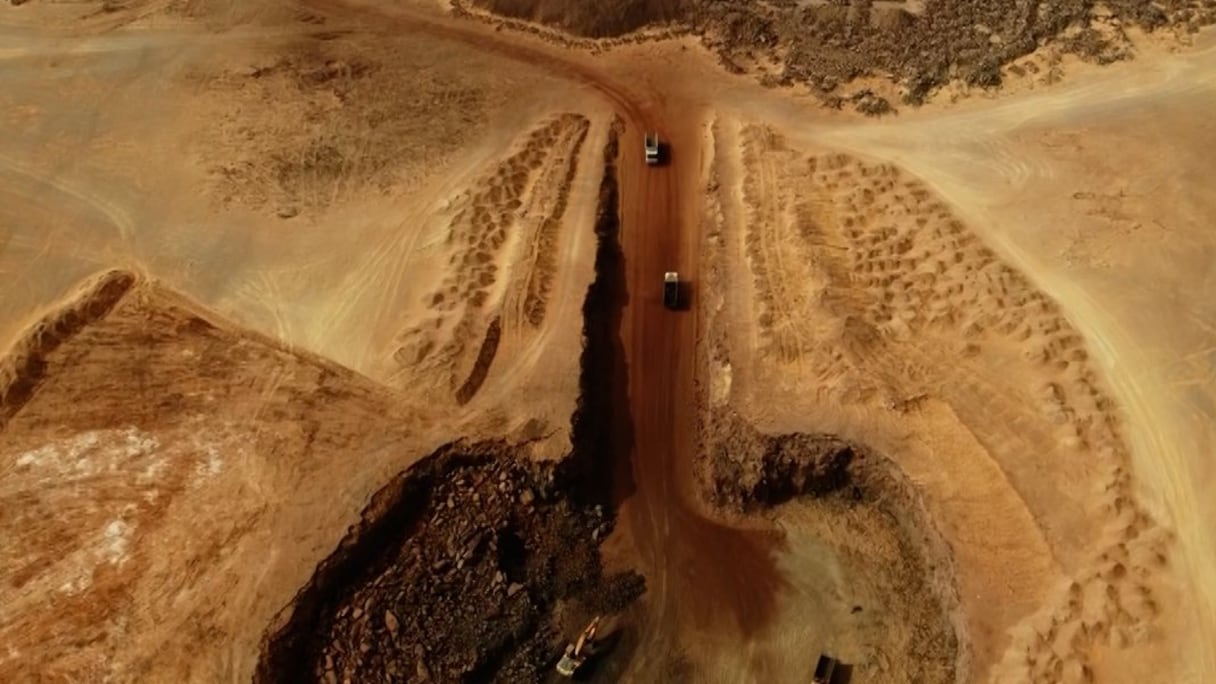
Four months later, the Qatari motorcyclist and influencer Khalid Al-Jaber rode from Oran through Béchar and Tindouf to Gara Djebilet, travelling between May 29 and June 5. The trip was meant to showcase the project. Instead, it exposed it. As Le360 reported on June 9, his footage showed an enormous crater in the middle of nowhere. No mining infrastructure. No machinery. No workers’ camp. No workers. Just a hole in the ground, ringed by posts and chains.
And the train? Along the 950-kilometer railway, not a trace of it. No footage of the “project of the century” being proudly shown off on state television. No glowing accounts from passengers whose lives have been transformed by the new service. Nothing. You would think state television was protecting a military secret. It is, after all, only a passenger train.
What Djelloul Slama had suggested might be the case, a foreign motorcyclist revealed in seconds of footage. One is in prison. The other was beyond the authorities’ reach.
In jailing the economist, the regime has done the project itself no favors. A profitable mine does not need to lock up its critics. It merely needs to produce ore. At Gara Djebilet, they are still waiting for the ore. They already have their prisoner.
