
The milestone was reached in 2025, when people aged 65 and over accounted for 10.5% of the world’s population, according to the U.S. Census Bureau’s An Aging World: 2025 report.
The shift is being driven by two long-term demographic trends: people are living longer while fewer children are being born.
The global population aged 65 and over is expected to grow from about 852 million in 2025 to nearly 2 billion by 2060. By then, older people are projected to represent almost 20% of the world’s population.
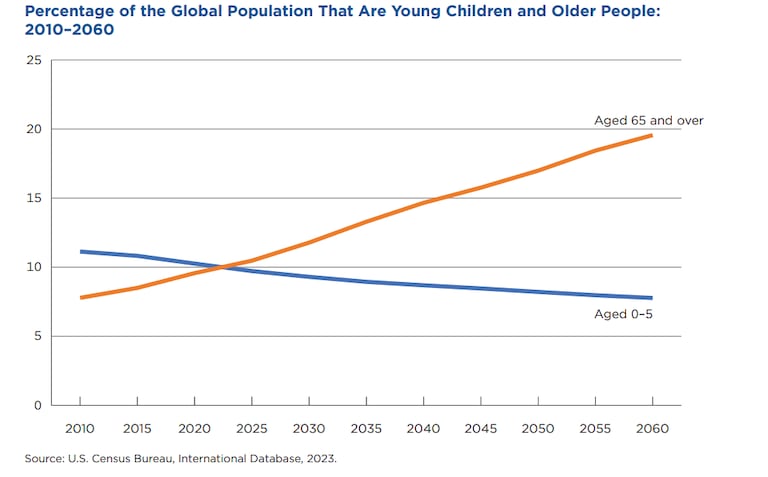
At the same time, fertility rates have fallen across much of the world. About 71% of the global population now lives in countries where fertility is at or below the replacement level of roughly 2.1 births per woman.
The report warns that prolonged low fertility can create what it calls a “fertility trap.” As fewer children are born, the number of potential parents eventually declines, making population aging and shrinkage increasingly difficult to reverse.
The trend is no longer limited to wealthy countries.
Africa, currently the world’s youngest continent, is expected to see its population aged 65 and over increase by 315% between 2025 and 2060, from 60 million to 249 million.
Read also : Morocco’s Baby Map: where families are still growing—and where birth rates are slowing
Asia will record the largest numerical increase. Its population aged 65 and over is projected to rise from 487 million to 1.24 billion over the same period.
Europe, meanwhile, will remain the world’s oldest region. The share of people aged 65 and over is expected to increase from 21% of the population to nearly 31% by 2060.
The global shift is expected to continue past 2060. By the late 2070s, people aged 65 and over are projected to outnumber children under 18 worldwide. By the mid-2030s, the number of people aged 80 and over is expected to surpass the number of infants.
Longer lives are a major part of the change. The Census Bureau projects global life expectancy to increase from 73.5 years in 2025 to 78.1 years in 2060. However, the report notes that healthy life expectancy is not expected to increase by as much as overall life expectancy. This could have implications for health and care needs in older age.
The demographic shift will put growing pressure on pension systems, health care and long-term care as the proportion of working-age people declines relative to the number of retirees.
The report also points to the need for countries to adapt workplaces, communities and health systems to older populations. It draws attention to emerging areas including the use of artificial intelligence in health care and employment, as well as the impact of humanitarian disasters on older people.
Read also : Foreign population in Morocco rises 76% in a decade to over 148,000, CESE report finds
Migration is also expected to play a growing role in countries facing low fertility and population decline. In several countries, immigration is already helping offset the effects of aging and shrinking populations.
The global population itself is not expected to stop growing immediately. The United Nations projects that it will reach around 10.3 billion in the mid-2080s before gradually declining.
But the age structure of that population is already changing, as older people now make up a larger share of humanity than its youngest children.