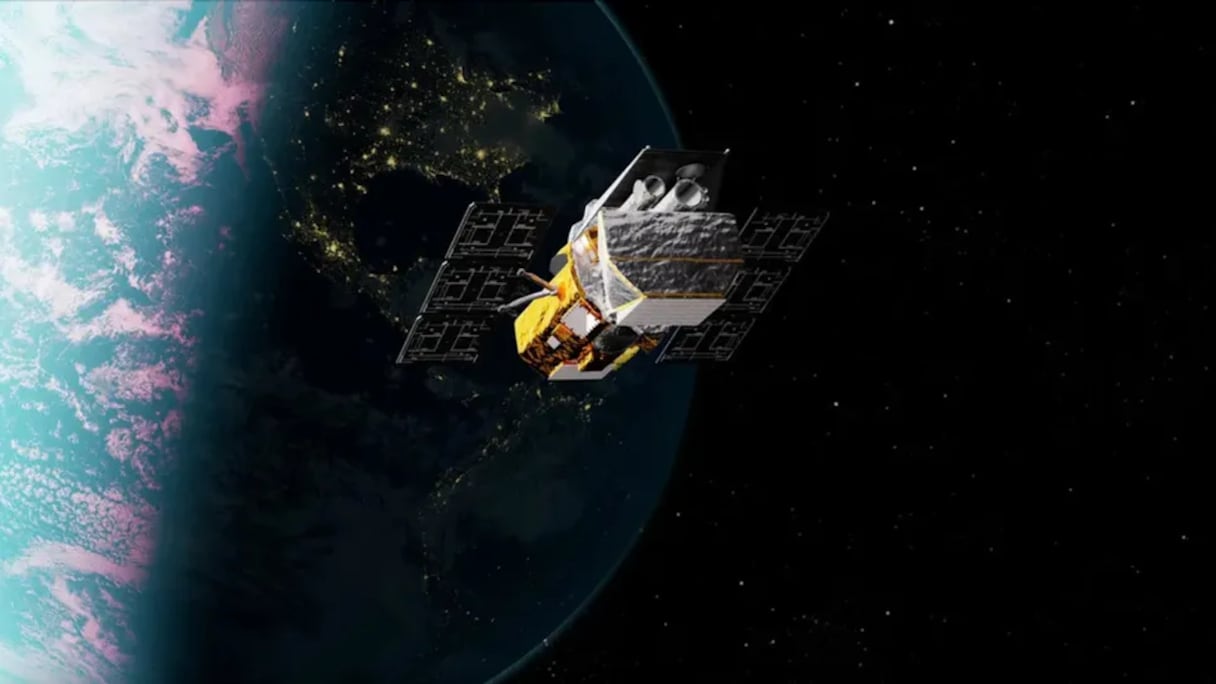
NASA said Swift had ended its science mission and was expected to re-enter Earth’s atmosphere within weeks. Most of the 1.5-ton telescope is expected to burn up during reentry, though some heavier components could survive, according to Brad Cenko, Swift’s principal investigator at NASA. Swift’s principal investigator at NASA. Any surviving debris is most likely to fall into the ocean.
The spacecraft’s orbit passes over parts of Africa, Australia, India, Southeast Asia and Central and South America. The US Space Force is monitoring its descent, while NASA has said the risk of anyone being harmed on the ground is low.
Swift, officially known as the Neil Gehrels Swift Observatory, was launched on November 20, 2004, to study gamma-ray bursts, some of the most powerful explosions in the universe. It was designed to detect these brief events and quickly direct its instruments towards them, allowing scientists and other observatories to study the explosions before their signals faded.
A failed attempt to save the telescope
Solar activity over the past few years accelerated the spacecraft’s orbital decay. Increased atmospheric drag at its lower altitude made it increasingly difficult for Swift to maintain a stable position for observations.
Read also : SpaceX targets first Starship orbital flight for September 22
NASA had been working on a rescue plan with US company Katalyst Space Technologies, which was contracted to raise the telescope into a higher orbit. The company launched its robotic spacecraft, Link, in July, but the operation ran into difficulties. The robot approached Swift to within roughly 7 to 9 miles but failed to reach it or carry out the planned manoeuvre.
Link subsequently reentered Earth’s atmosphere in September, leaving Swift without a way to regain altitude.
The telescope briefly resumed scientific observations after the rescue attempt was abandoned, detecting more gamma-ray bursts and other high-energy events. But its orbit continued to deteriorate. NASA said Swift carried out its final observation on October 20, when it was orbiting about 171 miles (275 kilometers) above Earth. At that altitude, atmospheric drag prevented its instruments from keeping their targets steady.
Its scientific operations were then brought to an end.
More than two decades of discoveries
During its 22 years in orbit, Swift detected more than 2,000 gamma-ray bursts and studied over 1,400 supernova explosions. It also observed stars being torn apart by black holes, monitored active galaxies and studied comets and asteroids.
The observatory carried three instruments: the Burst Alert Telescope, the X-Ray Telescope and the Ultraviolet/Optical Telescope. Together, they allowed scientists to detect cosmic explosions and observe them across different wavelengths.
Swift’s ability to turn quickly towards an event made it an important early-warning system for astronomers. Once it detected a gamma-ray burst, it could send its position to other observatories and redirect its own instruments to examine the event, often within about a minute.
NASA said the mission’s data has contributed to around 7,000 scientific papers. Its archive contains nearly 22 years of observations, including more than 1.5 million images from its Ultraviolet/Optical Telescope. The collection amounts to about 12 terabytes of data and will remain available to researchers.
The agency is now looking at ways to maintain rapid observations of cosmic events using existing space telescopes and future missions. Swift had played a key role in alerting observatories such as Hubble and James Webb to events requiring closer examination.
Read also : NASA discovers massive lunar crater formed by impact missed in real time
Most of the spacecraft is expected to disintegrate as it passes through the atmosphere. However, some dense and heat-resistant components could reach the ground.
Brad Cenko said that parts made from tungsten and some mirror components might survive. Aerospace experts quoted by Space.com also identified the telescope’s reaction wheels and certain optical components as possible survivors.
Swift’s orbit means that any debris would fall somewhere within a band extending roughly 21 degrees north and south of the equator. This area includes large stretches of ocean as well as populated parts of Africa, Asia and the Americas.
Experts say the likelihood of debris causing injuries or damage on the ground is very small. Most of the spacecraft should burn up, and any fragments that survive are expected to be small. Their exact landing location will remain unknown until the reentry takes place.
Swift was originally designed for a two-year primary mission. It remained operational for more than two decades, leaving behind a large archive of observations that NASA expects scientists to use for years to come.
