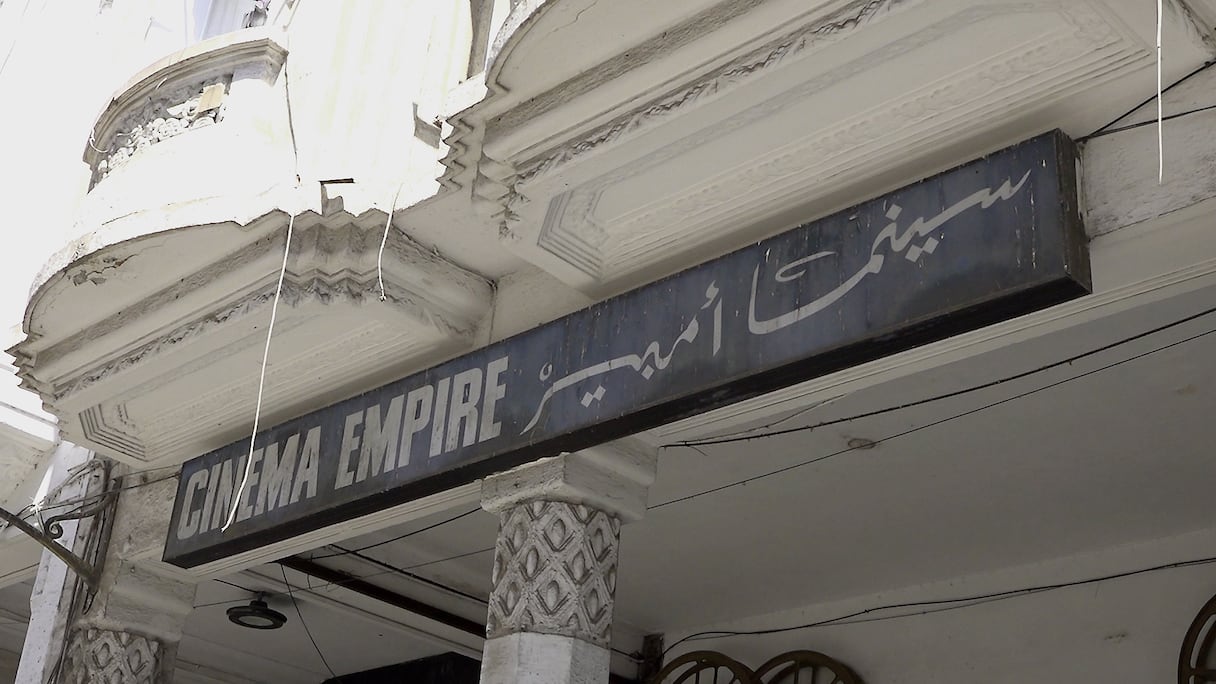
On Boulevard Mohammed V, just a few steps from the ABC cinema, stands the Empire. This venue, owned by a Moroccan Jewish family, has been closed since 2005 and is now set to reopen after two decades of abandonment. Its renovation is supported by a 4 million dirham grant from the Moroccan Cinematographic Center (CCM), with the total investment estimated at between €2.5 million and €3 million.
Seven partners are involved in the project, initiated by Mohamed Fakrane and Nabil Hattab, two childhood friends now based in France. For Fakrane, the Empire holds significant childhood memories. “I used to come here with my parents when I was very young. When I learned a few years ago that the cinema had been abandoned, I dreamed of taking it over. But I also knew that I could not take on a project of this scale alone,” he recounted.
The opportunity arose when Hattab expressed his desire to open a concert venue in Casablanca capable of accommodating 1,000 to 1,500 people. “I told him: ‘I have a gem, a real treasure. It isn’t mine yet, but I know it,’” Fakrane recalled.
Before returning to France, the two friends decided to visit the Empire and were immediately captivated. “We discovered it in the dark and decided almost immediately, without really thinking about it,” Fakrane said. They then contacted the real estate agency managing the building and accepted its terms, “without knowing exactly what we were getting ourselves into.”
The last screening had taken place in 2005. Inside, two decades had taken their toll. “We moved around using only the light from our phones, surrounded by twenty years of accumulated dust,” Fakrane recalled. Yet, beneath the dust lay remnants of the Empire’s history: old posters, archival documents, national identity cards, and period invoices. These items have been preserved and will be displayed in a small museum space at the entrance.
Built in 1927, the cinema will soon celebrate its centenary. This symbolic milestone is particularly important to its new operators, who hope to reopen the venue in the first quarter of 2027.
The Empire was acquired in February 2025, with renovation work commencing in September of the same year. “It took us about three months to realize that we actually had a cinema,” Fakrane said with a smile. After 20 years of closure, extensive renovation was essential. The seats, moldy and over half a century old, could not be salvaged. Only the building’s structure was preserved, while the entire venue is being brought up to current standards under the supervision of an engineering consultancy.
Originally designed by an Italian architect, the building is being restored to preserve its identity while adapting it to the requirements of a modern cultural venue. An interior architect and designer was brought in to redesign the space. Work is currently focused on exterior insulation to prevent water infiltration, following the reinforcement of the walls and balcony. Electrical and air-conditioning work will follow, before the installation of state-of-the-art technical equipment.
The Empire will retain its single-screen format. Rather than following the multiplex model, its promoters aim to transform it into a cultural venue in its own right, offering a niche film program that particularly highlights Moroccan cinema. Around 400 old films have already been collected from around the world to build a film archive, a concept inspired in part by Cinema Rif in Tangier.
Festivals, meetings with filmmakers, and film cycles dedicated to Bruce Lee, Bollywood, African, and Japanese cinema are also being considered. Partnerships with public schools are under discussion as well. The cinema will feature between 750 and 850 seats, with retractable seating in the main area allowing the space to be converted into a concert or performance venue.
This versatility is particularly important to Nabil Hattab. A live entertainment professional in France, he regularly organizes concerts at venues like La Cigale and the Olympia through Addictive Music, his company which has been active in the music industry for around 30 years. In Casablanca, he hopes to bring cinema, music, and stand-up comedy under one roof, with year-round programming featuring international artists and Moroccan talent.
For Hattab, the Empire also carries a family history: his father used to attend screenings there. “It’s a kind of circle coming full circle,” he said.
Hattab already has a dream for the reopening: “As a Moroccan, inaugurating the Empire with a group like Nass El Ghiwane would be a huge honor.” His mother is from Hay Mohammadi, the Casablanca neighborhood where the legendary group emerged, giving the idea a particularly personal meaning: a tribute to one of the defining chapters of Moroccan popular culture.
