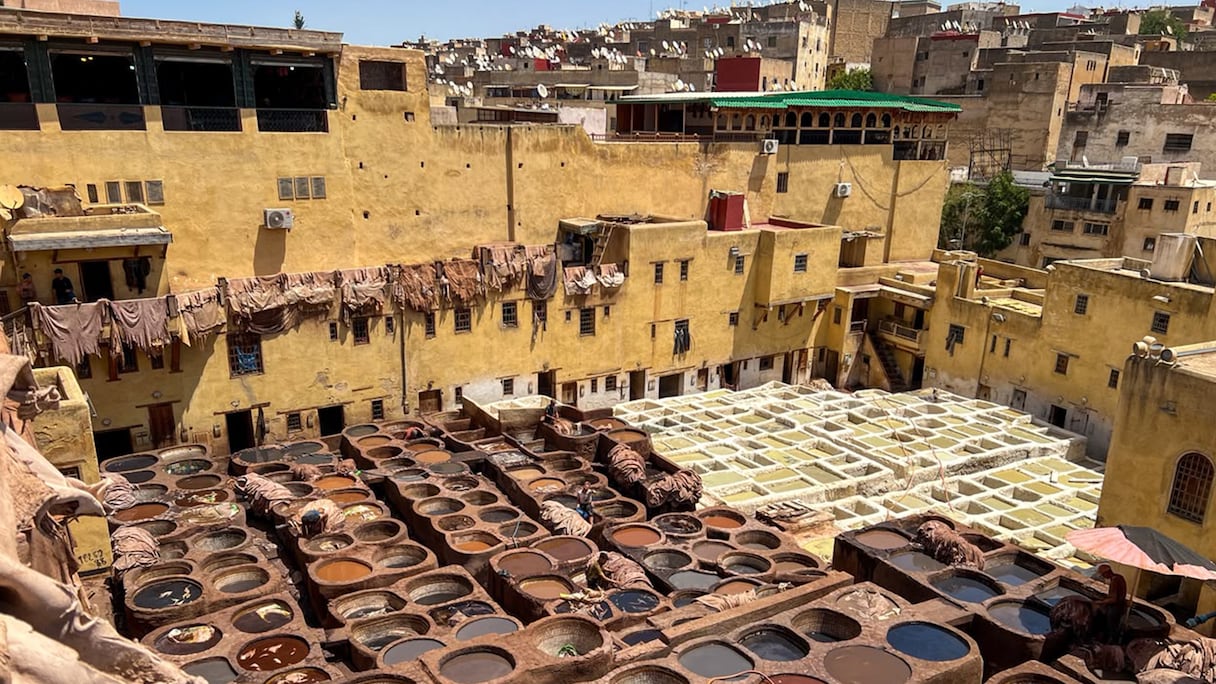
Just steps from the bustling alleyways of the Fez medina, the colorful Chouara vats immediately catch the eye. But behind this iconic scene lies painstaking, physically demanding work that still relies largely on traditional techniques. Here, each hide goes through a long process before becoming a leather product.
After arriving from the Aïn Nokbi market, the raw hide is first prepared before going through the various stages of tanning. It is immersed in a mixture of lime and pigeon droppings for up to two weeks. The hides are regularly stirred to help soften them and facilitate the removal of residual tissue.
“This first stage prepares the hide and makes it more supple for the work that follows. The job mainly requires experience because you have to know how long to leave the hide in each substance and how to handle it,” explains Larbi Iraqi Houssaini, an artisan at Dar Dbagh Chouara for nearly three decades.
Once this stage is complete, the hides move on to the coloring process. In the tannery’s vats, tanners use various natural materials to produce the distinctive colors of Fez leather. Red is obtained from roses, while brown comes from cedar wood. Saffron, meanwhile, gives the leather a particularly recognizable yellow hue. This color is especially associated with the making of the famous ziwania babouches, valued for their quality and distinctive color.
Behind every color, however, lies a precise dosage and treatment time that must be mastered. Temperature, the amount of material used and the length of immersion can all affect the final result. These are details found in no manual and learned by tanners mainly through practice. “You cannot learn this trade just through explanations. You have to watch, try and work alongside people who already have experience,” the artisan says.
Read also : Pan-African art residency in Morocco concludes after two weeks of creative exchange
At Chouara, passing the craft down through generations is one of the pillars of the trade. For decades, even centuries, tanner families have passed down the gestures, techniques and finer secrets of the craft, allowing the trade to survive changing methods of production. “In many families, children learn the trade from their fathers and then carry on the work themselves,” says the artisan, who has known the profession for around 30 years.
After tanning and coloring, the hides are removed from the vats and laid out in the areas surrounding the tannery to dry. They are then sent to artisans who turn them into babouches, bags, wallets, belts and other leather goods. The tanner’s work is therefore one of the first stages in a broader artisanal chain, in which each craft successively transforms the raw material and gives it a new life.
Read also : Morocco reinforces Ouarzazate’s place on the global film map
It is worth noting that Chouara’s history cannot be separated from that of water. Water is essential to several stages of the hide treatment process, which explains why tanneries were historically established near waterways and canals in the medina. “The presence of water has always been essential to working with hides. That is also why the tanneries were established near waterways,” explains the artisan. Their location reflects the medina’s centuries-old organization, where artisanal activities were planned around the resources needed to sustain them.
For Mohcine Chelfi, another Chouara artisan, the tannery’s value lies not only in its age, but above all in the continuity of a craft that has become increasingly rare. “What makes Chouara special is that it has preserved a way of working that has survived across several generations,” he says. “Even though techniques and production methods have evolved elsewhere, some of the same gestures are still used here,” he adds.
Read also : More than 120,000 attend Ifrane’s annual international cultural festival
This continuity has helped make Chouara one of Fez’s most iconic landmarks. From the terraces overlooking the tannery, visitors can watch the colorful vats, hides being processed and tanners at work. The activity attracts visitors from many countries every year. Americans, French, Germans and Italians, among others, come to see behind the scenes at the tannery and observe a working method that has gradually disappeared in many other places.
For the artisans, this international interest contrasts with the sometimes more limited number of Moroccan visitors. They believe younger generations would benefit from getting to know these places and the trades that help preserve the country’s artisanal heritage. “We receive visitors from all over the world, but we would also like to see more Moroccans come and discover this place, because it is part of our history and our collective memory, and something that must continue to be passed down,” the artisan concludes.
