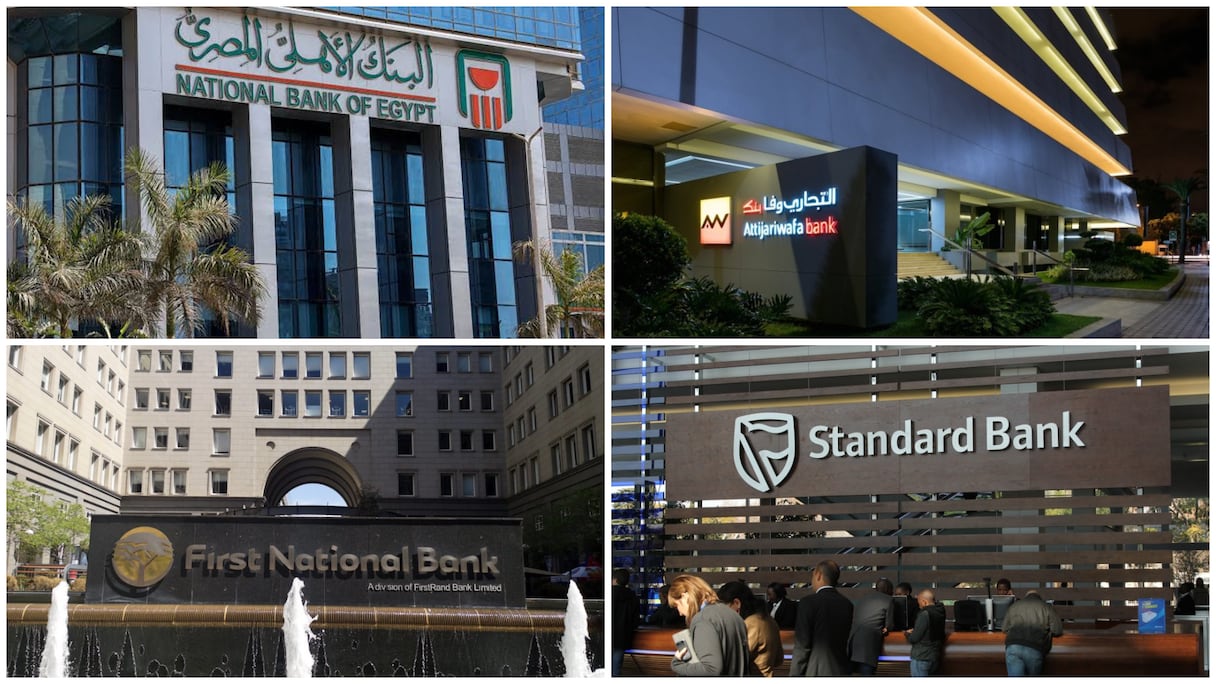
The ranking, compiled by African Business, measures banks’ financial strength based on Tier-1 capital, which includes common equity, reserves, retained earnings and carried-forward results after regulatory deductions.
Tier-1 capital is a key measure of a bank’s financial strength because it indicates its ability to absorb sudden losses without disrupting its operations.
African banks have generally strengthened their capital bases in recent years through capital increases, public offerings and other fundraising operations.
Read also : Bank Al-Maghrib and UAE Central Bank sign two memoranda to strengthen banking and financial cooperation
According to data compiled by African Business, the combined Tier-1 capital of Africa’s 100 largest banks increased by 23% in 2025 from the previous year to $155 billion, up from $126.1 billion. This was a record level, surpassing the previous high of $135.3 billion recorded in 2022.
Compared with 2019, Tier-1 capital in 2025 was 50% higher than the $101.6 billion recorded in the year before the COVID-19 pandemic.
The banks’ combined assets also rose 16% to $1.8 trillion, including $830 billion held by North African banks.
North African banks were by far the strongest in terms of combined Tier-1 capital, at $70.5 billion, up 21% from $58 billion in 2024. The remainder came from sub-Saharan African banks, with lenders from southern Africa accounting for the largest share.
South African banks drove a 17% increase in Tier-1 capital among southern African lenders, taking the total to $47.8 billion against net assets of $648 billion. These were the strongest performances recorded by African banks.
The increase reflects efforts by bank management teams to strengthen their institutions’ capital positions, as well as improved economic growth across the continent. Sub-Saharan African economies grew by 4.5% in 2025.
Improved bank profitability, easing inflation, with average inflation at 3.4%, and the appreciation of several African currencies against the US dollar also contributed to the increase, given that the ranking measures banks in dollars.
The ranking’s use of Tier-1 capital expressed in US dollars means that favorable exchange-rate movements can also boost a bank’s measured financial strength and its position in the continental ranking.
Read also : Banque Populaire launches Morocco’s first numberless bank card
South Africa, Egypt and Morocco dominate
South African, Egyptian and Moroccan banks account for the largest share of the continent’s top 100 lenders by Tier-1 capital.
South Africa has six banks in the top 100, all among the continent’s 14 largest institutions by the measure, with four making the top 10. Together, they hold $39.56 billion in Tier-1 capital.
Egypt has 20 banks in the top 100, with combined Tier-1 capital of $31 billion, up from $22.6 billion a year earlier.
Morocco has nine banks in the top 100, including three in the top 10: Attijariwafa bank, Banque Centrale Populaire and Bank of Africa. The combined Tier-1 capital of Moroccan banks rose from $20.3 billion to $23.3 billion, an increase of 14.8%.
The top 10 reflect this geographic concentration, with four South African banks, three Moroccan lenders, two Egyptian banks and one Algerian bank.
The four South African banks in the top 10, Standard Bank, FirstRand, Absa Bank and Nedbank, have combined Tier-1 capital of $34.3 billion.
Standard Bank, which is more than 160 years old, remains Africa’s largest bank by the measure. Its Tier-1 capital increased 19% to $15.7 billion, while its assets reached $217.7 billion.
The increase was driven by management’s capital-strengthening policy, net profit of $3.4 billion and a 13% appreciation of the South African rand against the US dollar in 2025.
Read also : Bank Al-Maghrib seen holding the line at 2.25%
In the first half of the year, the bank posted net profit of $1.60 billion, up 10%, and a return on equity of 22%.
Standard Bank operates in 21 African countries, including Angola, Ghana, Kenya, Mauritius, Nigeria, Tanzania, Uganda and Zambia.
National Bank of Egypt (NBE) retained second place in Africa after increasing its Tier-1 capital by 43.83% in one year to $10.5 billion. Its total assets reached $160.1 billion, while the bank posted a profit of $2.6 billion.
Morocco’s Attijariwafa bank retained third place among Africa’s strongest banks, with Tier-1 capital up 22.88%.
The increase reflected the group’s continued efforts to strengthen its capital base, its 2025 financial results and an 11% appreciation of the Moroccan dirham against the US dollar.
In 2025, the group posted consolidated net profit of $1.33 billion and a return on equity of 23.80%.
Morocco’s largest banking group operates in 27 countries, including 15 African markets, and has 12 million customers.
FirstRand of South Africa followed with $6.542 billion in Tier-1 capital, ahead of Absa Bank of South Africa with $6.486 billion, Morocco’s Banque Centrale Populaire with $5.874 billion, South Africa’s Nedbank with $5.525 billion, Egypt’s Bank Misr with $4.910 billion, Morocco’s Bank of Africa with $3.837 billion and Algeria’s Banque Extérieure d’Algérie with $3.761 billion.
The 10 strongest African banks by Tier-1 capital
| Rank | Bank | Country | Tier-1 capital ($ billion) |
|---|---|---|---|
| 1 | Standard Bank | South Africa | 15.705 |
| 2 | National Bank of Egypt | Egypt | 10.494 |
| 3 | Attijariwafa bank | Morocco | 7.676 |
| 4 | FirstRand | South Africa | 6.542 |
| 5 | Absa Bank | South Africa | 6.486 |
| 6 | Banque Centrale Populaire | Morocco | 5.874 |
| 7 | Nedbank | South Africa | 5.525 |
| 8 | Bank Misr | Egypt | 4.910 |
| 9 | Bank of Africa | Morocco | 3.837 |
| 10 | Banque Extérieure d’Algérie | Algeria | 3.761 |
Source: African Business
Nigerian banks boosted capital but remain outside the top 10
The absence of Nigerian banks from the top 10 stands out despite a sharp increase in their combined Tier-1 capital, which rose from $10.3 billion to $15.2 billion.
The 47.6% increase was largely driven by reforms introduced by the Central Bank of Nigeria, which set minimum capital requirements for banks.
The requirements prompted lenders to strengthen their capital through capital increases, public offerings and other fundraising operations.
United Bank for Africa (UBA), for example, climbed five places in the top 100 to 15th, with Tier-1 capital rising from $1.7 billion to $2.7 billion, an increase of 58.82%.
Nigerian banks’ absence from the top 10 is largely explained by the sharp depreciation of the naira against the US dollar. Successive devaluations have erased more than 70% of the currency’s value since 2023, reducing the dollar value of Nigerian banks’ balance sheets.
