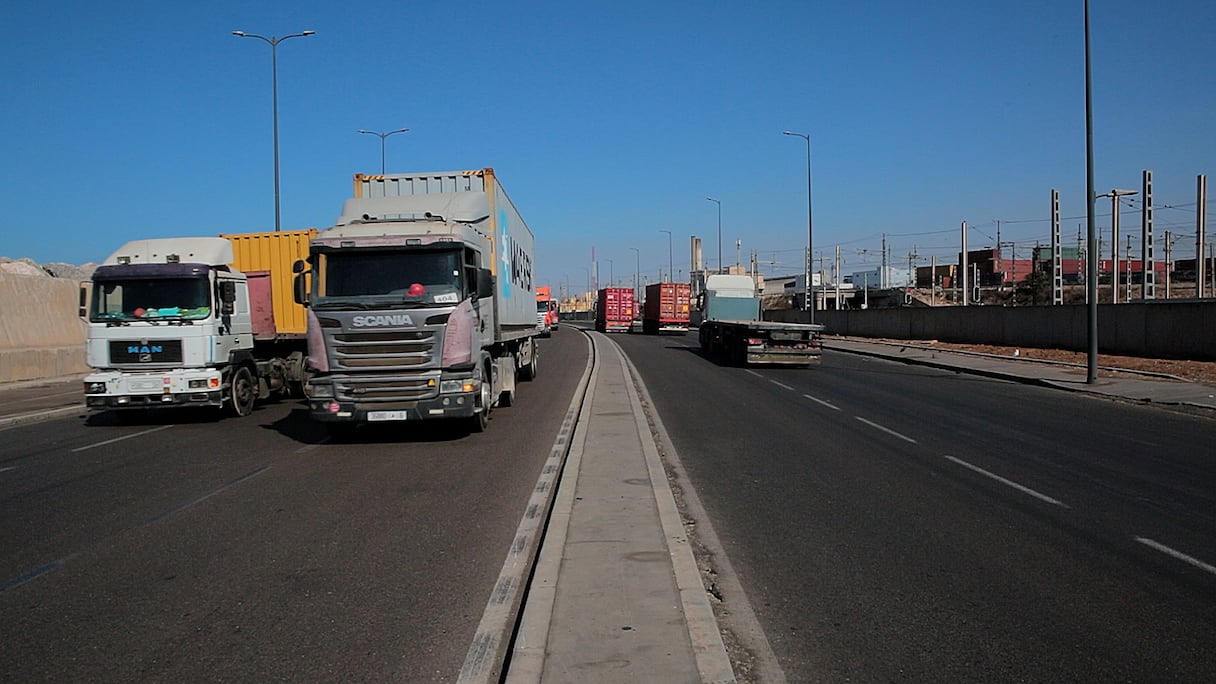
Two trips were possible per day yesterday, but only one today. Congestion that has affected the Port of Casablanca for several months continues to disrupt road transport operations, with professionals now turning their attention to a meeting scheduled for October 15.
According to transport sector professionals interviewed by Le360, the port has been under considerable logistical pressure due to a massive influx of goods and vessels, compounded by tensions affecting port infrastructure.
The situation has nevertheless eased on the maritime side compared with the spring, when around 60 vessels were waiting at anchorage and delays reached 10 to 15 days, particularly for grain carriers, bulk carriers and container ships. By mid-September, the number of vessels waiting had fallen to between 10 and 15, according to Mohamed El Jaouadi, president of the Association of Shipowners of Morocco.
The main difficulties are now concentrated on land, where heavy trucks continue to face lengthy waits for handling operations, inspections and the various formalities required before goods can leave the port.
The port is handling exceptional volumes while loading and unloading operations continue to fall behind schedule. Adil Dahouki, deputy president of the Federation of Road Transport and Ports, said this has significantly reduced the number of trips trucks can make each day. “We can make only one trip where we used to make two,” he said.
Dahouki said the platform could handle between 2,800 and 2,900 outbound containers per day if operations were sufficiently fluid. Current disruptions can reduce that capacity to 1,000, 900 or even 800 containers per day.
When a heavy truck remains stuck at the port for several hours, it cannot make any additional trips that day. For transport operators, longer waiting times therefore directly translate into lower productivity and reduced revenue.
Professionals have reported waiting times of up to 12 hours for certain container exit operations, with another five to seven hours sometimes required at control points. Inside the port itself, some trucks can remain immobilized for eight to nine hours before recovering their cargo.
The situation prompted a strike on September 14 to draw attention to working conditions inside the port. The mobilization was followed by discussions with the authorities, including regional Governor Mohamed Mhidia and the Ministry of Interior, in coordination with the National Ports Agency and port operators.
One of the first measures to emerge from those discussions was the nighttime opening of Gate 4. Since September 18, the gate has operated from 21:00 to 07:00 every night, extending the window available for heavy trucks to enter and leave the port.
Gate 4 had initially been opened at night from midnight to 07:00 on June 1, 2026. The extension from 21:00 was introduced to spread truck movements more evenly and reduce daytime traffic.
The measure has been welcomed by transport operators, with Mohamed Riahi, president of the Moroccan Federation of Road Transport to Ports, estimating that it has reduced daytime traffic by around 20% to 25%.
“We can speak of a 20% to 25% reduction during the day because the traffic is shifted to the evening. It has nevertheless helped with congestion outside the port,” he said.
The improvement, however, has had little impact on operations inside the facility. “It has not changed anything in terms of the truck unloading time,” Riahi said, pointing to slow administrative and customs procedures as well as recurring breakdowns of handling equipment.
“Between customs and administrative procedures and crane failures, there are still many constraints,” he added.
Riahi said the extended opening hours have effectively doubled the period available for trucks to exit the port. “Instead of having 12 hours for trucks to exit, we now have 24 hours,” he said, while stressing that longer operating hours alone cannot resolve the structural problems inside the facility.
He also pointed to failures affecting handling equipment, saying that most of the cranes needed to move containers are out of service and are severely slowing operations.
Riahi further questioned the management of operations by some parties involved, arguing that the number of trucks handled under satisfactory conditions remains far below the volumes of goods that need to be cleared.
The resulting delays are directly affecting transport companies, whose trucks are now often limited to one daily trip instead of two, reducing both productivity and revenue.
Other solutions are being considered, including an appointment system for transport operators designed to spread arrivals more evenly and regulate traffic at terminal access points.
Professionals are now waiting for the October 15 meeting to assess the measures already implemented and address the problems that continue to affect operations inside the port.
