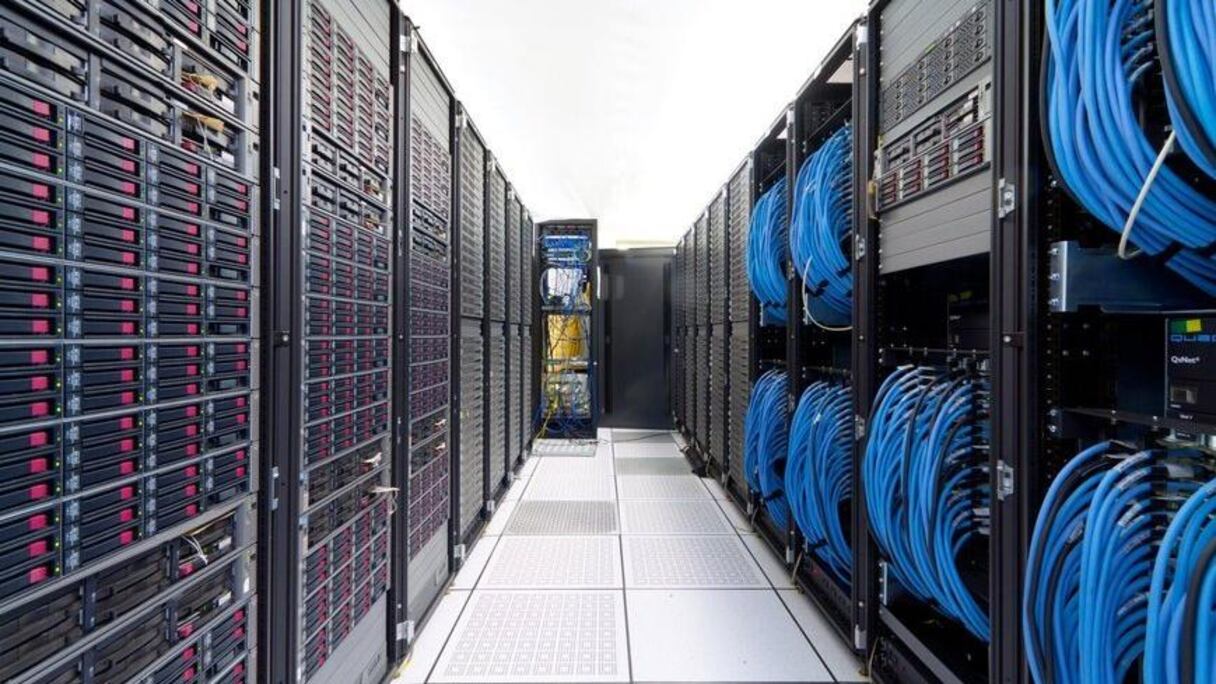
Morocco’s data center market is still in its early stages, but a growing pipeline of projects points to significant expansion in the coming years.
That is the conclusion of a new report by BMI, a Fitch Solutions company, which says Morocco currently has 14 data centers with just 1.5 megawatts (MW) of operational capacity as of the second quarter of 2026.
The picture is expected to change dramatically once projects currently under construction, representing 140 MW of capacity, and another 400 MW already in the planning phase come online.
According to BMI, demand is being driven by three converging factors: data sovereignty requirements, the digitalisation of public services and national artificial intelligence strategies.
The report also highlights the growing role of international investors, pointing to large-scale AI-related projects near Casablanca and Tetouan.
These developments position Morocco as a low-latency regional platform capable of serving both European and African markets.
BMI notes, however, that the sector continues to face challenges linked to electricity infrastructure and project execution. Those constraints are partly offset by the ability to generate renewable energy for self-consumption, an option that an increasing number of operators are seeking to exploit.
Supply concentrated in two regions
Morocco’s existing data center capacity remains concentrated in two of the country’s main economic regions.
Casablanca-Settat hosts six facilities, while Rabat-Salé-Kenitra has four, making them the country’s two main data center clusters, according to BMI.
The report attributes this concentration to strong fibre connectivity, dense telecommunications infrastructure and sustained demand from businesses and public institutions, according to the economic research and international market risk analysis firm.
BMI also notes that Morocco had 59.1 million mobile subscribers at the end of 2025, with mobile penetration exceeding 150%. According to the international firm, the figure partly reflects operators’ reluctance to deactivate inactive SIM cards belonging to tourists and migrant workers, as well as the widespread use of secondary SIM cards by individuals and businesses for lower-cost international calls.
Casablanca-Settat is expected to remain Morocco’s leading colocation hub thanks to its urban connectivity, fibre network and proximity to major corporate and government clients.
Even there, however, electricity constraints are beginning to affect expansion.
BMI cites the example of a $1.2 billion AI-focused data center project near Casablanca, which turned to independent energy solutions through a partnership with Emirati energy company TAQA to secure a direct supply of renewable electricity and avoid delays.
Over the longer term, the report expects rising pressure on land availability and electricity capacity in traditional hubs to encourage developers to move towards regions offering greater access to renewable energy and available land.
That shift is already beginning.
BMI points to Tetouan, where Iozera plans to invest $500 million in a 386 MW data center, developed in partnership with the Moroccan government. Designed to expand access to advanced AI computing resources, the facility is expected to become operational in the second half of 2026.
Demand driven by public policy and AI
BMI says Morocco’s data center demand is underpinned by the convergence of several public policies, data sovereignty requirements and the rapid adoption of artificial intelligence.
The report notes that regulations introduced in 2021 require all sensitive data to be hosted within Morocco, creating predictable demand for compliant domestic infrastructure.
That trend has been reinforced by the country’s digital transformation agenda.
In January 2026, Morocco unveiled its “Morocco AI 2030” roadmap, building on the broader “Morocco Digital 2030” strategy launched in 2024.
Together, the two programs aim to create around 240,000 digital jobs, contribute roughly $10 billion to GDP by 2030 and improve Morocco’s international ranking in AI readiness.
The public sector is expected to remain a major source of demand, as the digitalisation of government services under “Morocco Digital” 2030 requires their migration to sovereign cloud infrastructure.
Meanwhile, data-intensive industries such as financial services are expected to provide a stable source of demand, reducing the risks associated with more speculative AI-driven growth.
BMI notes that much of Morocco’s planned hyperscale capacity is intended to serve latency-tolerant European workloads. A stronger domestic customer base would therefore help maintain utilisation rates and reduce the risk of excess capacity.
The report also noted that Morocco’s national digital initiatives provide greater visibility and predictability for both domestic and foreign investors in the sector. Cloud spending in Morocco is projected to reach $981 million by the end of 2026, before rising to nearly $2.7 billion by 2031, representing an average annual growth rate of 23.3% over the period.
An increasingly competitive market
According to BMI, Morocco’s competitive landscape combines established telecommunications operators, specialised local providers and an increasing number of global hyperscalers.
The market’s historical leaders include Maroc Telecom and inwi, alongside specialist operators such as Medasys and N+One.
Orange Morocco has also emerged as one of the country’s major players through a strategy centred on data sovereignty and enterprise colocation.
In November 2025, the company inaugurated “Orange Tech,” a Tier III, 1.5 MW facility in Casablanca, complementing its existing sites in Casablanca, Rabat and Tangier as part of a multicloud strategy involving AWS and Microsoft.
International investment is entering the market through both direct construction projects, such as Iozera’s Tetouan facility, and colocation services used by hyperscalers including Microsoft Azure, Google Cloud and Oracle to establish cloud regions.
At present, Oracle Cloud is the only provider with an active presence, with cloud zones planned in Casablanca and Settat.
The largest AI-focused international investment comes from South Korea’s Naver Cloud.
The company leads a consortium that includes Nvidia, Nexus Core Systems and Lloyds Capital to build a 500 MW AI hub powered by renewable energy near Casablanca, targeting customers across Europe, the Middle East and Africa.
The project’s first phase will deploy 40 MW of Nvidia Blackwell GB200 GPUs before expanding to its full 500 MW capacity under a renewable power purchase agreement with TAQA Morocco.
BMI says the site’s location was chosen primarily because of Morocco’s proximity to Europe rather than domestic demand.
A supportive regulatory framework
BMI says the “Morocco Digital 2030” strategy provides a favourable framework for attracting technology investment through regulatory reforms aimed at simplifying business registration, reducing administrative procedures and strengthening investor protections.
The report says those reforms are already translating into concrete investment commitments.
Among them is the AI Data Hub project near Casablanca, which has secured regulatory approvals and entered the detailed design and procurement phase.
Valued at $1.2 billion, the project combines hyperscale data centres, AI-optimised computing infrastructure, modular construction and integrated solar and wind energy.
Located near major submarine cable landing stations, the facility is designed to provide low-latency connectivity between Africa and Europe.
Naver Corporation is leading the technological development, while Nvidia will supply the AI hardware.
Construction is scheduled for 2027 and 2028 and will include advanced cooling systems, redundant infrastructure and dedicated power substations.
BMI also notes that Morocco’s flexible rules governing private electricity generation and self-consumption give operators a significant competitive advantage by allowing them to bypass congestion on the public grid through on-site solar generation and energy storage.
Finally, the report says electricity demand from data centers is expected to grow more gradually in Morocco than in some other markets because historically high distribution losses have constrained overall consumption.
As those issues are addressed, BMI expects electricity demand to increase more rapidly over the forecast period, supported by macroeconomic growth and new electrification uses that will boost both baseline and peak consumption.