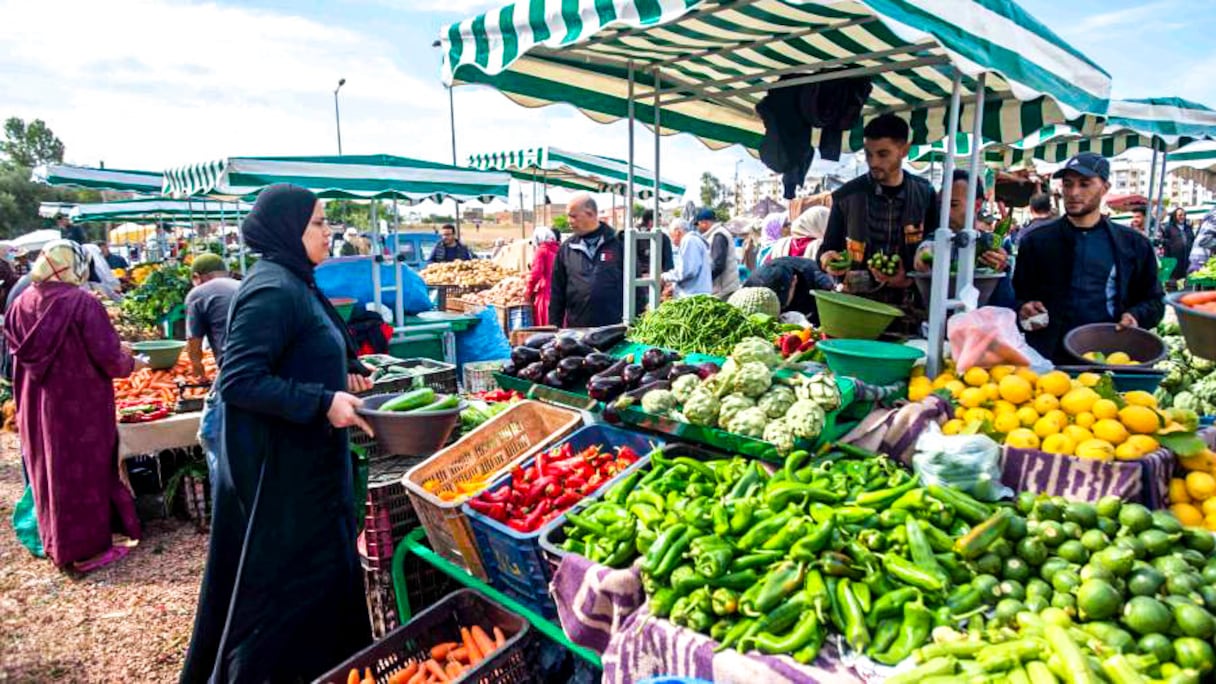
Officially, inflation remains moderate in Morocco. The Consumer Price Index (CPI), the main measure used to track changes in prices and the cost of living, rose by an average of 0.3% over the first eight months of 2026. Bank Al-Maghrib (BAM) expects inflation to reach 0.7% for the full year before rising to 1.5% in 2027, driven in part by underlying inflation. On the ground, however, consumers continue to report a high cost of living, particularly for basic necessities.
The apparent contradiction is largely explained by the difference between the inflation rate and the price level. Inflation measures how much prices change over a given period, while the price level reflects what households actually pay. In other words, low inflation means prices are rising slowly. It does not mean they have returned to the levels seen before previous price increases.
Inflation expectations also remain well anchored, according to Bank Al-Maghrib. Financial-sector experts surveyed by the central bank in the third quarter of 2026 expect average inflation of 2.1% over the next eight quarters and 2.2% over the next 12 quarters.
Read also : Morocco’s foreign exchange reserves to exceed $55 billion by end-2026
To understand why the official inflation rate can remain moderate while some consumer prices stay high, Le360 spoke to economist Khalid Doumou. He said it is first necessary to look at how inflation develops and how it is measured.
Two mechanisms drive inflation
Khalid Doumou identifies two main drivers of inflation. The first is demand-pull inflation, which occurs when demand for a good, service or input outpaces available production capacity. When supply cannot keep up, prices rise. Economists often sum up the mechanism as “too many dollars chasing too few goods” or, in Morocco’s case, too many dirhams chasing too few goods.
The second is cost-push inflation. This occurs when companies face higher production costs, particularly because of rising raw-material, energy or wage costs. Businesses may then pass some of those additional costs on to consumers to protect their profit margins.
To understand inflation properly, the economist also points out that it refers to a generalized and sustained increase in prices. Two main indicators are used to track this trend: the Consumer Price Index (CPI) and the Producer Price Index.
The CPI tracks price changes for a basket of goods and services consumed by households, including food, energy, transportation and housing. It is therefore the main reference for measuring changes in the cost of living and, consequently, household purchasing power.
CPI through August 2026 (source: HCP).
| Product groups | Through August 2025 | Through August 2026 | Change |
|---|---|---|---|
| Food products | 131.4 | 129.2 | -1.7% |
| Food products and non-alcoholic beverages | 130.9 | 128.4 | -1.9% |
| Alcoholic beverages and tobacco | 144.6 | 150.1 | 3.8% |
| Non-food products | 112.1 | 114.0 | 1.7% |
| Clothing and footwear | 116.8 | 117.9 | 0.9% |
| Housing, water, electricity and other fuels | 109.2 | 110.3 | 1.0% |
| Furnishings, household goods and routine household maintenance | 112.7 | 113.7 | 0.9% |
| Health | 101.4 | 101.6 | 0.2% |
| Transport | 116.8 | 121.1 | 3.7% |
| Communication | 104.0 | 103.7 | -0.3% |
| Recreation and culture | 105.0 | 104.9 | -0.1% |
| Education | 121.8 | 124.4 | 2.1% |
| Restaurants and hotels | 120.9 | 123.5 | 2.2% |
| Miscellaneous goods and services | 116.5 | 120.4 | 3.3% |
| Overall | 119.7 | 120.0 | 0.3% |
The Producer Price Index, meanwhile, tracks the prices of goods and services as they leave factories or farms, before they enter the distribution chain. It helps monitor changes in costs faced by businesses that can eventually feed through into consumer prices.
In Morocco, the High Commission for Planning (HCP) is responsible for calculating these indicators. The current CPI uses a 2017 base of 100 and tracks changes in the prices of a basket containing 546 items and 1,391 product varieties consumed by Moroccan households.
The index is divided into different categories of consumption. In August 2026, the CPI for “Health” stood at 101.70, compared with 122.70 for “Education” and 125.80 for “Transport,” against the 2017 base of 100. This structure makes it possible to track how the different categories of household spending change over time.
The CPI basket is divided into two main groups, food and non-food products, which are themselves broken down into 12 major divisions: food and non-alcoholic beverages; alcoholic beverages, tobacco and narcotics; clothing and footwear; housing, water, gas, electricity and other fuels; furnishings, household goods and routine household maintenance; health; transport; communication; recreation and culture; education; restaurants and hotels; and miscellaneous goods and services.
Read also : New land tax rates swell municipal coffers, bills climb for some owners
This breakdown reflects the wide range of expenses faced by households, Doumou said. Each household makes choices between food, housing, transport, healthcare, education, consumption and savings depending on its income and needs.
But it is the cumulative rise in prices that best explains why low inflation in 2026 does not mean prices have returned to the levels seen before the sharp increases of recent years, he said.
According to figures cited by the economist, Morocco’s average overall cost-of-living index reached around 121 between 2017 and 2026, representing a cumulative increase of about 21%. Food and transport were the main drivers. The combined effects of drought and a global surge in raw-material prices pushed up the cost of several food products between 2022 and 2025. The food index exceeded 132 points in early 2025, representing cumulative inflation of more than 32% for the food basket in less than four years.
The transport price index also reached 125 points. For households, the impact of these cumulative increases is directly visible in everyday spending, even when the annual inflation rate becomes low.
Meat, fruit, vegetables…
Red meat is one of the clearest examples of the gap between inflation and the actual price level, Doumou said. He noted that beef prices rose from around 65-75 dirhams a kilo in 2021 to 120 dirhams in 2026, with prices reaching as much as 200 dirhams in some high-end butcher shops during the summer.
The economist attributed much of the increase in meat prices to the effects of several years of drought on Morocco’s livestock herd. He also recalled King Mohammed VI’s June 2025 call for Moroccans to forgo the Eid al-Adha sacrifice, the first such appeal in 29 years. The measure was aimed at protecting a livestock herd severely weakened by six consecutive years of drought and containing a surge in prices that had become increasingly difficult for Moroccan households to absorb.
In a normal year, Moroccan demand for Eid al-Adha stands at around 5.5 million to 6 million animals, mostly male sheep, meeting the needs of nearly 87% of households in the country, he said. In 2026, although authorities counted an overall supply of nearly 8 million animals, actual demand remained subdued as households faced declining purchasing power and soaring prices.
Average prices frequently exceeded 5,000 dirhams per animal and reached 75-85 dirhams a kilo for live weight. The sharp increase prompted many lower-income households to give up on buying an animal or opt for cheaper alternatives, such as goats or smaller lambs.
Read also : What Morocco’s 2027 Finance Bill proposes
The government has also introduced measures to support the livestock sector, Doumou noted, citing a package worth 13.1 billion dirhams for 2022-2026, or 464 million dirhams according to the government. Sheep imports, notably from Spain and Australia, were accompanied by a 500-dirham subsidy per head, as well as the removal of VAT and customs duties through the end of 2026.
Despite those measures, the expected impact on prices paid by consumers has not fully materialized, the economist said. He also pointed to the role of intermediaries, commonly known as “chennaqa,” as well as transport costs and the way wholesale prices are set.
The same gap can be seen in fruit and vegetable prices, Doumou said. Although Morocco remains a major agricultural exporter, the country recorded high levels of imports in 2025 and 2026 to address shortages in the domestic market.
Imports include bananas from Costa Rica, Ecuador, the Canary Islands and Madeira; pears from Spain and Portugal; and apples from France, Italy and Spain. Morocco also imports tropical fruit, including mangoes and pineapples from Costa Rica, as well as kiwis from Senegal, Burkina Faso and Côte d’Ivoire. Kiwi imports reached 21,900 tons in 2025.
Why some price increases are felt more than others
The structure of household spending also helps explain why some price increases are much more noticeable than others, beyond the overall CPI, Doumou said. Food accounts for 38.2% of the average Moroccan household consumption basket, meaning that any significant increase in this category has a direct impact on day-to-day spending.
Fresh products, particularly meat, fish and vegetables, are especially vulnerable to price swings. The water stress Morocco has experienced in recent years has affected agricultural and livestock supply, while changes in input and transport costs also feed into final prices.
Public-service price adjustments are another factor, Doumou said. The direct social assistance reform is accompanied by a gradual reduction in price subsidies, including phased increases in the price of butane gas cylinders and adjustments to sugar prices. Because households use these products directly or indirectly, changes in their prices can reinforce the perception that living costs are rising, he explained.
For urban middle-class households, pressure is also coming from private services. Some families spend significant amounts on private education, school transport and private medical consultations and treatment, particularly when public services do not meet their needs, he added.
The feeling that life has become more expensive therefore cannot be explained by changes in the CPI over a short period alone. It also reflects the cumulative price increases recorded over several years and the share of essential expenses in household budgets, according to the economist.
Read also : World Bank: Morocco makes its ‘great leap’ in industry despite limited Maghreb integration
The question now is whether the current low inflation rate will last. Bank Al-Maghrib expects headline inflation to rise to 1.5% in 2027. Expectations gathered from financial experts in the third quarter of 2026 also point to higher levels than those currently recorded, at 2.1% over the next eight quarters and 2.2% over the next 12 quarters.
Underlying inflation is therefore an important indicator, Doumou said. It captures the underlying trend in prices by stripping out some temporary or one-off changes linked to factors such as weather conditions, exceptional events and geopolitical tensions.
To calculate it, the overall CPI is adjusted to exclude certain volatile-price categories as well as public or regulated prices that are not determined directly by supply and demand.
According to central bank projections, underlying inflation is expected to accelerate from -0.2% in 2026 to 2.2% in 2027. Several factors could continue to affect prices, including international geopolitical tensions and weather conditions.
Morocco is also emerging from a prolonged period of drought, Doumou noted. The year 2026 was marked by exceptional rainfall and cereal production of 93 million quintals, following several years of low precipitation.
The risk of an overheated economy
For the economist, future price trends will also depend on the economy’s ability to absorb the numerous investments and major projects currently under way across the country. Preparations for the 2030 World Cup, urban redevelopment, upgrades to transport infrastructure, roads, highways, railways, ports and airports, as well as investment in hospitals, aircraft fleets, schools and the energy and digital transitions, along with completion of the country’s advanced regionalization program, could all boost demand.
This raises the risk of an overheated economy, Doumou said. In macroeconomic terms, this occurs when overall demand significantly exceeds a country’s production capacity. Such an imbalance can put additional pressure on prices.
Managing that dynamic will therefore also depend on expanding supply alongside investment and demand. The challenge is to prevent an excessive acceleration in demand from creating new price pressures.
Purchasing power remains closely tied to the cost of essential expenses. When food, housing, energy, education and transport consume a large share of household income, even a low annual inflation rate can coexist with a persistent sense that life is expensive.
The debate over living standards is therefore not just about the inflation rate published each month. It is also about the price level that has become established after years of increases, the composition of household consumption and the evolution of real incomes.
