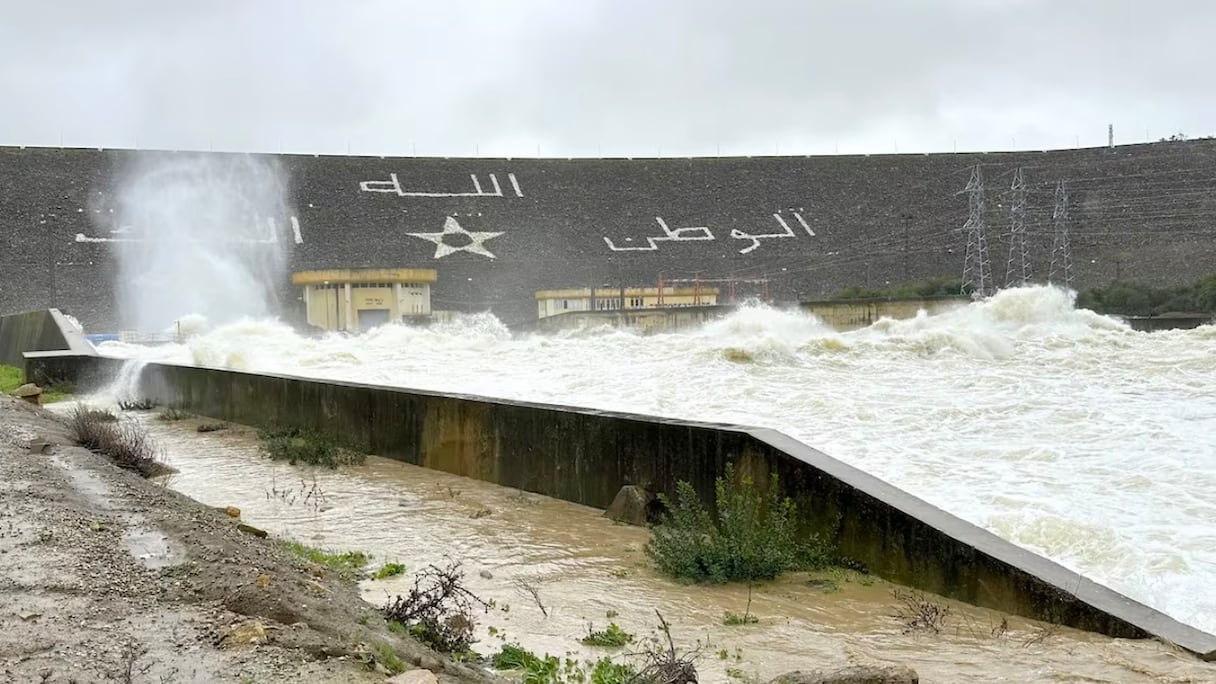
As the rainy season approaches, dams in northern Morocco are undergoing reinforced inspections, with several facilities recently subjected to water evacuation tests and technical checks to ensure their equipment is ready to operate in the event of heavy inflows.
Since the beginning of September, the Loukkos Hydraulic Basin Agency has been closely monitoring conditions at dams and other hydraulic structures across its territory. The aim is to anticipate periods of heavy rainfall and adjust reservoir management when necessary according to expected water volumes.
The preparations follow a particularly significant hydrological year in northern Morocco. Data provided to Le360 show that the Chefchaouen, Nakhla and Charif El Idrissi dams in Tetouan province reached 100% capacity during the previous hydrological season.
Each year, as the rainy season approaches, the agency conducts tests on the main hydromechanical equipment at the dams to prepare for potential periods of heavy rainfall. These checks focus in particular on bottom outlets and spillways, whose proper operation must be ensured before significant volumes of water arrive.
The tests are generally carried out during September and October. They make it possible to assess the condition of the equipment and ensure that it can be activated quickly if reservoir levels rise sharply.
In the event of heavy rainfall, the agency cross-checks weather forecasts with available hydrological data. This allows it to simulate changes in inflows and reservoir levels and, when conditions require it, anticipate certain water-release operations.
The objective is to gradually regulate reservoir levels according to expected inflows while reducing flood risks for downstream areas and maintaining the safety of the hydraulic structures.
Figures from the previous hydrological season illustrate the scale of the water volumes these dams had to handle. Between September 2025 and May 2026, inflows reached around 380 million cubic meters at Charif El Idrissi Dam, 49 million cubic meters at Chefchaouen Dam and 86 million cubic meters at Nakhla Dam.
As these large volumes of water entered the reservoirs, their levels rose significantly. Part of the water was released through spillways, with approximately 237 million cubic meters discharged at Charif El Idrissi, 30 million cubic meters at Chefchaouen and 80 million cubic meters at Nakhla.


Oued El Makhazine Dam raises discharge rate to 794 cubic meters per second after filling rate reaches 160%
Bottom outlets were also used during the period. According to data provided to Le360, around 100 million cubic meters were released through the bottom outlets at Charif El Idrissi Dam, compared with 16 million cubic meters at Chefchaouen.
These operations helped manage the substantial inflows recorded during the previous hydrological season and adjust reservoir levels according to changes in water volumes while taking into account conditions in downstream areas.