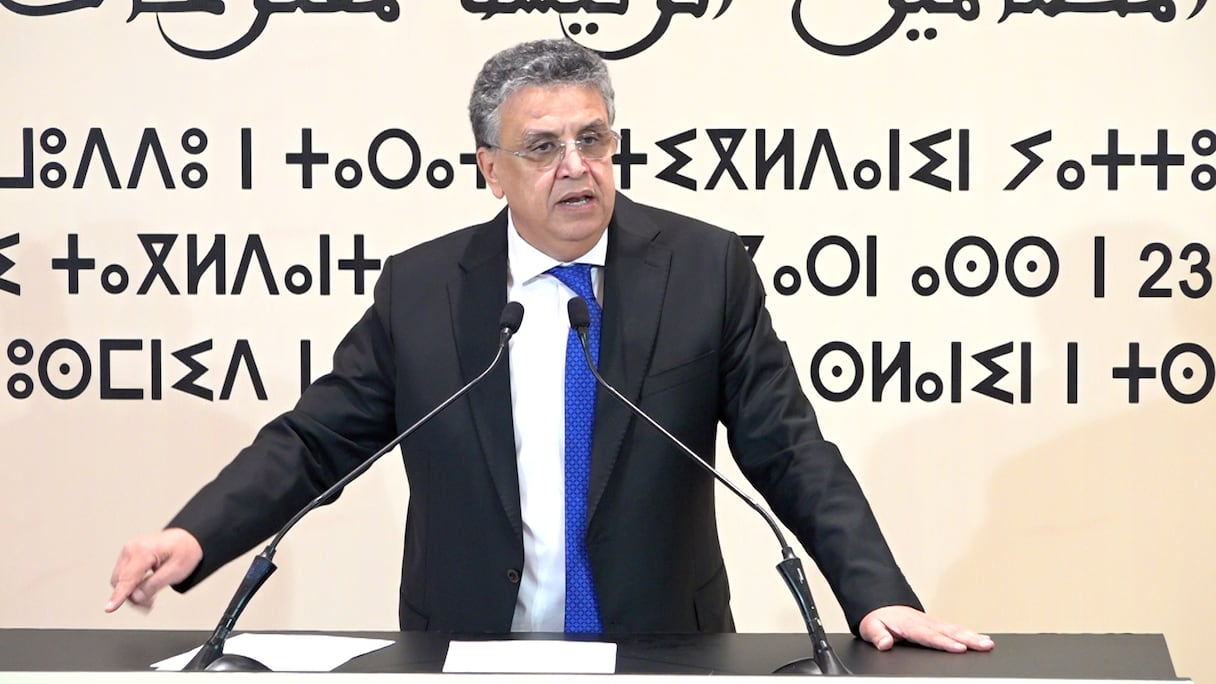
Ouahbi is part of the government led by Fatima Ezzahra El Mansouri, whose coalition brings together the PAM, Istiqlal, the Socialist Union of Popular Forces (USFP) and the Party of Progress and Socialism (PPS). Announced on Monday, October 12, the alliance holds 207 seats in the House of Representatives, nine above the 198 required for an absolute majority.
Ouahbi and El Mansouri have known each other for years through the PAM. When he became party leader in February 2020, she was president of its National Council, the party’s parliamentary body.
In 2021, he included her among the figures tasked with renewing the party’s structures. At the time, she was mayor of Marrakech before joining Aziz Akhannouch’s government as housing minister.
Born on July 28, 1961, in Taroudant, Ouahbi grew up in a family of 11 children born to two different mothers. His father was a prominent local figure in the Souss region. Like many children in the area at the time, he first attended a m’sid, a traditional Quranic school, before moving on to formal schooling.
The family home regularly hosted figures from the nationalist movement, particularly members of the National Union of Popular Forces (UNFP), the predecessor of the USFP.
After completing high school, Ouahbi moved to Rabat to study law. He was already active in the USFP’s youth organization, the Chabiba, where he remained a member from 1976 to 1991.
Read also : Abderrahim Chahid, a socialist at the helm of employment policy
A legal career shaped by Ahmed Benjelloun
Ouahbi became a lawyer at the age of 28. The late Ahmed Benjelloun, who had left the USFP to establish the Democratic and Socialist Vanguard Party (PADS), recruited him into his law firm. Ouahbi followed his mentor into the PADS, where he was active from 1991 to 2010.
In the mid-1990s, he represented clients in numerous trials linked to the anti-corruption campaign. He worked between the Rabat Court of Appeal and the Special Court of Justice (CSJ). He later opened his own law firm in Rabat’s Orangers district, where several lawyers worked.
In 2010, Ouahbi left the PADS for the PAM, founded in 2008. He ran in the Taroudant-North constituency and won a seat in Parliament in 2011, retaining it in 2016.
At the House of Representatives, he chaired the Standing Committee on Justice and headed the PAM parliamentary group. One issue he championed was the repatriation to Morocco of the wives and children of people who had joined the ranks of Islamic State (Daesh).
Read also : Fouzi Lekjaa, Morocco’s new finance minister, faces the test of public-sector performance
PAM secretary-general from 2020 to 2024
On February 9, 2020, Ouahbi became the PAM’s sixth secretary-general at the end of its fourth national congress. Five other candidates withdrew before the vote, including former secretary-general and former health minister Mohamed Cheikh Biadillah. At the time, the PAM was the country’s second-largest political force, with 102 seats in the House of Representatives.
Ouahbi launched a drive to restructure the party and renew its leadership. His approach to the Party of Justice and Development (PJD) was more conciliatory than the stance the PAM had taken in its early years.
In the September 8, 2021 legislative elections, the PAM won 87 seats, placing second behind Aziz Akhannouch’s National Rally of Independents (RNI), with 102 seats, and ahead of Nizar Baraka’s Istiqlal, with 81.
The PAM joined the government with six ministerial portfolios. Ouahbi took Justice, Fatima Ezzahra El Mansouri was appointed Minister of Territorial Planning, Urbanism, Housing and City Policy, Mehdi Bensaid took Youth, Culture and Communication, Younes Sekkouri was named Minister of Economic Inclusion, Small Business, Employment and Skills, Leila Benali took Energy Transition and Sustainable Development, and Abdellatif Miraoui was appointed Minister of Higher Education, Scientific Research and Innovation.
Ouahbi now returns to a ministry he already knows, this time in a government led by his own party.
