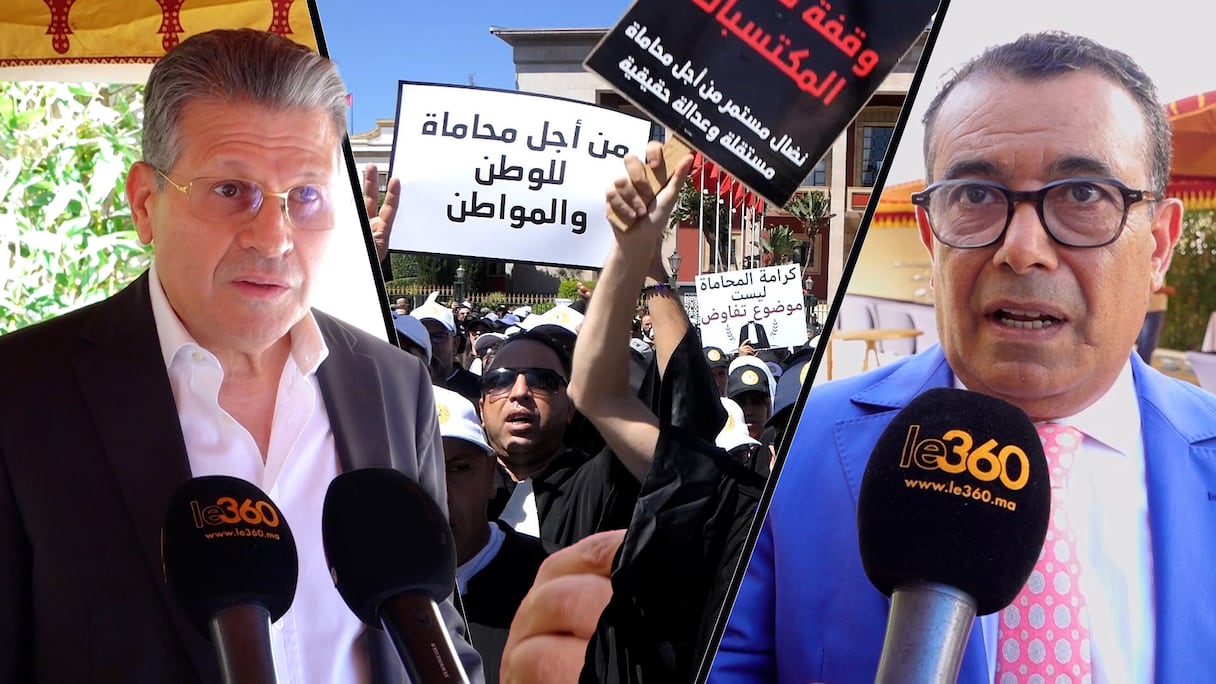
Lawyers could return to court after four months of strike action, with the profession’s national decision-making body meeting in Rabat on Thursday to decide whether to extend the walkout or change course now that the disputed law governing the bar has entered into force.
The National Decision-Making Council of the Association of the Bars of Morocco (ABAM) began its extraordinary session at the Lawyers Club in Souissi behind closed doors, with a statement expected once deliberations conclude.
Two positions are competing within the profession. One camp wants the indefinite strike to continue, arguing that Law No. 66.23 still contains provisions that warrant sustained opposition. The other is pushing for a return to court while keeping pressure on for amendments, potentially through fresh talks with the government that emerges from the September legislative elections.
For supporters of a return to work, the law’s publication in the Official Gazette has changed the terms of the standoff. Their position is that lawyers can resume representing litigants without abandoning their campaign to have disputed provisions revised.
Months of strike action have disrupted court proceedings, with lawyers’ absence affecting hearings and litigants while the dispute with the Justice Ministry has dragged on.
Ziani: ‘We were victims of a political conflict’
ABAM President El Houcine Ziani told Le360 that Thursday’s deliberations would extend beyond the substance of Law No. 66.23 to the circumstances surrounding its adoption and entry into force.
He described as “strange and bizarre” the circumstances in which the Constitutional Court declared itself unable, on procedural grounds, to rule on the law’s constitutionality.
“That is why today we must discuss not only the law, but also the context in which it was adopted. We will also have to debate what preceded it and the speed with which it took effect,” Ziani said.
He linked that sequence to the political climate ahead of the legislative elections and rivalries between political parties.
“We were victims of a political conflict. Consequently, this law contains provisions that undermine the independence of the bar and the identity of the lawyer,” he said.
Rabat Bar President Aziz Rouibah, an active ABAM member, also described the law’s entry into force as the start of a different phase for the profession.
“We are now at a new stage, facing a new challenge,” Rouibah told Le360.
The profession’s “moral, professional and activist” responsibility, he said, was now to hear the Council’s position before deciding how to proceed.
Read also : Rabat bar chief vows to fight ‘unjust’ lawyers’ law
Independence of the bar at heart of dispute
Lawyers’ objections to Law No. 66.23 center on what they see as an erosion of the profession’s independence and the autonomy of elected bar bodies.
Among the contested provisions are those governing relations between lawyers and clients, legal fees, the handling of professional funds, training, entry into the profession and disciplinary procedures.
Lawyers have also challenged powers assigned to the public prosecutor’s office and the Justice Ministry, arguing that they could weaken the authority of bar associations and their elected bodies.
Read also : Morocco: Controversial lawyers’ law gazetted as nationwide strike nears 100 days
The new framework for the oversight and management of funds linked to legal practice is another point of contention, while professional representatives have raised objections to provisions governing foreign lawyers and foreign law firms operating in the country.
The Justice Ministry’s role in training and access to the profession has likewise drawn opposition.
