Morocco has climbed three places to 27th in the RepCore Nations 2026 study, retaining its position as the highest-rated African and Arab country in the international reputation study.
The improvement comes as perceptions of the Kingdom increasingly extend beyond long-established strengths such as culture, hospitality, cuisine and natural appeal, with gains recorded in technology, public governance and international sporting achievements.
The shift is also translating into greater interest in the country. Intent to visit Morocco rose by 2.5 points, while intent to invest increased by 1.9 points and intent to buy Moroccan products gained 2.5 points, according to Fernando Prado Abuín, Managing Partner of Reputation Lab.
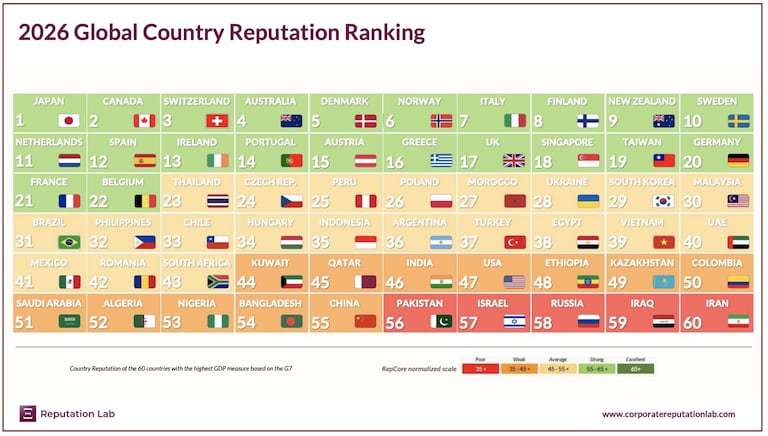
The 2026 study assessed 74 countries through 124,014 online evaluations conducted across 36 countries. Its published ranking covers the world’s 60 largest economies by GDP based on perceptions among respondents in G7 countries.
RepCore measures the admiration, respect and trust generated by countries across 22 attributes spanning economic, political, social, cultural and environmental factors.
“Reputation has become a strategic asset for countries,” Reputation Lab said, pointing to its role in attracting tourists, investment and talent at a time when international perceptions of countries are broadly deteriorating.
New strengths emerge
Reputation Lab has tracked Morocco’s international image for more than a decade in collaboration with the Royal Institute for Strategic Studies (IRES).
Over that period, Morocco has retained strong scores for its natural environment, hospitality, cultural richness and cuisine while building strengths in areas including economic development, institutional quality and international credibility, according to Prado Abuín.
He described that evolution as “a very interesting success story.”
The 2026 results show stronger perceptions of Morocco as a technologically advanced country and improved assessments of how public resources are managed. International sporting achievements have also contributed to the gains, including the impact of hosting the Africa Cup of Nations.
For IRES, the longer-term shift is particularly visible in the balance between Morocco’s traditional image and perceptions of its institutions.
“Between 2015 and 2018, our reputation relied more on emotional factors than rational ones. We now see significant progress at the institutional level, with better perceptions of ethics, transparency, and the level of development,” said Issam Lotfi, IRES Chief Strategy Officer.
Lotfi attributed the improvement to reforms carried out under King Mohammed VI.
He also pointed to perceptions of stability, credibility and reliability, as well as the Kingdom’s foreign policy, international cooperation and role in regional and global affairs, as factors supporting trust in Morocco abroad.
