When investigative journalism abandons factual rigor in favor of sensationalism and assumptions, fabrication collapses. Sometimes sooner than expected. And, in a delicious twist, even the characters conjured up to feed and sustain the narrative eventually rebel against it. The treatment of Morocco by part of the Spanish press regularly provides textbook examples. The latest episode pits the conservative Madrid daily ABC against the facts. By turning a man facing fraud charges—Mehdi Hijaouy—into a “super-spy” on the strength of a document as dubious as it is obsolete, the newspaper has tripped over its own transparently contrived narrative.
In its eagerness to feed a line hostile to Moroccan institutions, journalist Ketty Garat plunged headlong into a shaky spy story that was quickly swept aside by the facts, methodically dismantled by experts and observers—including hostile ones—and denied by the man at the center of it.
On Wednesday, September 9, 2026, the Paris law firm Bourdon & Associés, representing Mehdi Hijaouy, issued a press release formally and categorically denying the allegations circulated by Ketty Garat and ABC. The statement dismantles, point by point, the narrative of a supposed massive data leak orchestrated for the benefit of the “Jabaroot” hacker group.
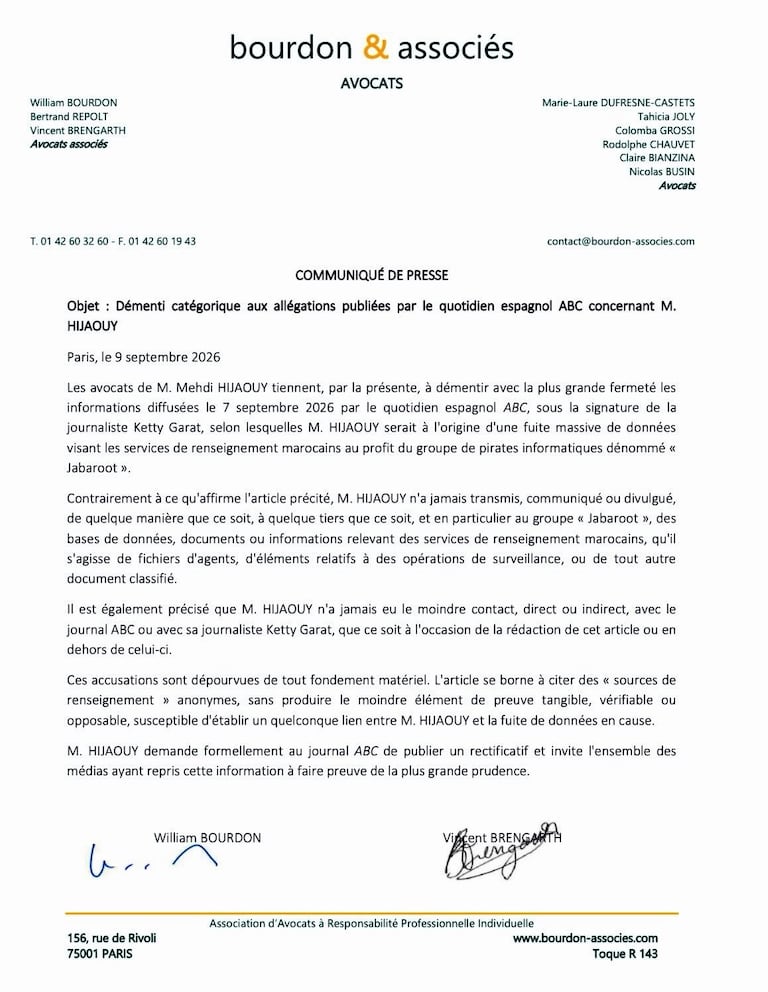
“The lawyers of Mr. Mehdi Hijaouy hereby wish to deny in the strongest possible terms the information published on September 7, 2026, by the Spanish daily ABC, under the byline of journalist Ketty Garat, according to which Mr. Hijaouy was behind a massive data leak targeting the Moroccan intelligence services for the benefit of the hacker group known as Jabaroot,” the statement reads.
The statement stresses that the journalist produced no material evidence and merely relayed speculation. “Contrary to what is asserted in the aforementioned article, Mr. Hijaouy has never transmitted, communicated or disclosed, in any manner whatsoever, to any third party whatsoever, and in particular to the Jabaroot group, databases, documents or information belonging to the Moroccan intelligence services...” the law firm writes. It also states that Hijaouy has never had the slightest contact, direct or indirect, with ABC or its journalist Ketty Garat, “whether in connection with the preparation of this article or outside it.” The irony, indeed.
Read also : ABC’s Mehdi Hijaouy spy thriller falls apart under scrutiny
Denouncing accusations “devoid of any material basis” and resting on vague “anonymous intelligence sources,” the defense is demanding formal corrections.
When Fiction Replaces the Facts
Ketty Garat’s investigation in ABC reads more like geopolitical fiction than verified investigative journalism. The Madrid daily presents Mehdi Hijaouy, despite his being the subject of an international wanted notice over fraud offenses, as the key figure in a state conspiracy of unprecedented proportions.
The ABC article thus claims to have obtained an “exclusive”: “Former No. 2 in Moroccan intelligence leaks ‘sensitive information’ to Jabaroot hackers. ABC says it has obtained exclusive access to Mehdi Hijaouy’s identification document within Morocco’s foreign intelligence service.” Enough, apparently, to make him “the man behind the security breach that exposed 70,381 Moroccan spies.”
To give her article an international dimension, the journalist pushes the extrapolation as far as attributing to Hijaouy the hacking of the phones of European leaders, including Spanish Prime Minister Pedro Sánchez. “Morocco does not know his current whereabouts and is desperately searching for the man who was the comptroller general [...] of the DGED, the agency that directed the espionage operation against European leaders and infected the mobile phones of Pedro Sánchez and Emmanuel Macron using Pegasus spyware.”
Confronted with the fact that Mehdi Hijaouy is being prosecuted for ordinary criminal offenses, the journalist attempts to sidestep the problem by portraying those proceedings as nothing more than an institutional smokescreen. “The regime’s official press tried to conceal his role in the secret services by portraying him as an ordinary criminal posing as a spy. That is why the identity document revealed today by ABC is so important...”
She goes so far as to credit him with possessing major state secrets. “He is said to possess material extracted from phones hacked with Pegasus spyware and data relating to clandestine corruption operations in the European Parliament...”
A Theory That Falls Apart
As soon as the article appeared, the fragility of these claims prompted immediate reactions, including from quarters hardly known for being sympathetic to Morocco. Spanish journalist Ignacio Cembrero, despite being known for his highly critical positions toward Rabat, quickly took to X to point out major chronological and institutional inconsistencies. “Only Morocco’s domestic intelligence agency (DGST) had access to Pegasus, which it used extensively. [...] The foreign intelligence agency (DGED) did not touch the malware, although it may have indicated targets to spy on. Mehdi Hijaouy was the DGED’s No. 2 until 2014. The DGST began using Pegasus in 2017...” he wrote.
Faced with these reservations, Ketty Garat dug in, replying that Hijaouy had supposedly been an “adviser to the monarch from 2017 to 2022,” attempting to justify her bargain-basement scoop through possession of “previously unseen documents” rather than by producing verifiable evidence.
It was, however, Moroccan academic and lawmaker Lahcen Haddad who provided the most detailed analysis of the logical flaws in ABC’s article on the same social network. Point by point, he dismantled the chain of speculation. The document brandished by the newspaper is a professional ID card that has been invalid since 2014. As Lahcen Haddad points out, “the ‘previously unseen document’ published by ABC is a professional ID card that expired in 2014. Even if it were authentic, at most it would establish a former affiliation and rank within the DGED. It does not demonstrate that he was the No. 2 of the entire service, that he continued to have access to operational information years later or that he leaked data to Jabaroot.”
Regarding the accusations over the hacking of Pedro Sánchez’s phone, Haddad points to the journalist’s logical leap. “Claiming that Hijaouy subsequently held an advisory position does not resolve anything either. It would have to be demonstrated that this role gave him access to the DGST’s operational system, to data extracted through Pegasus and, specifically, to the contents of Sánchez’s phone. No published technical record, document, message or independent testimony establishes that.” “The Audiencia Nacional closed the investigation without having been able to identify the perpetrators. [...] It has not been judicially established that the DGST, the DGED or the Moroccan state infected Pedro Sánchez’s phone,” he demonstrated.
On the attribution of the Jabaroot group’s data leak, Haddad points to a crude conceptual confusion. “It is misleading to turn a database of 70,381 records, mainly linked to DGSN personnel, into a list of 70,381 spies. The DGSN is a vast police administration. Not all its police officers, civil servants and administrative employees are spies,” the analyst noted.
The ABC-Hijaouy affair illustrates almost to the point of caricature the excesses of a certain segment of the Spanish press, quick to validate the most extravagant narratives whenever they fit a prism unfavorable to Morocco. By turning an expired ID card and the claims surrounding a man facing fraud charges into an affair of state—one now denied, moreover, by the very man concerned—the daily has produced a textbook case of sensationalism, in which the piling up of hypotheses took precedence over the duty to verify.
