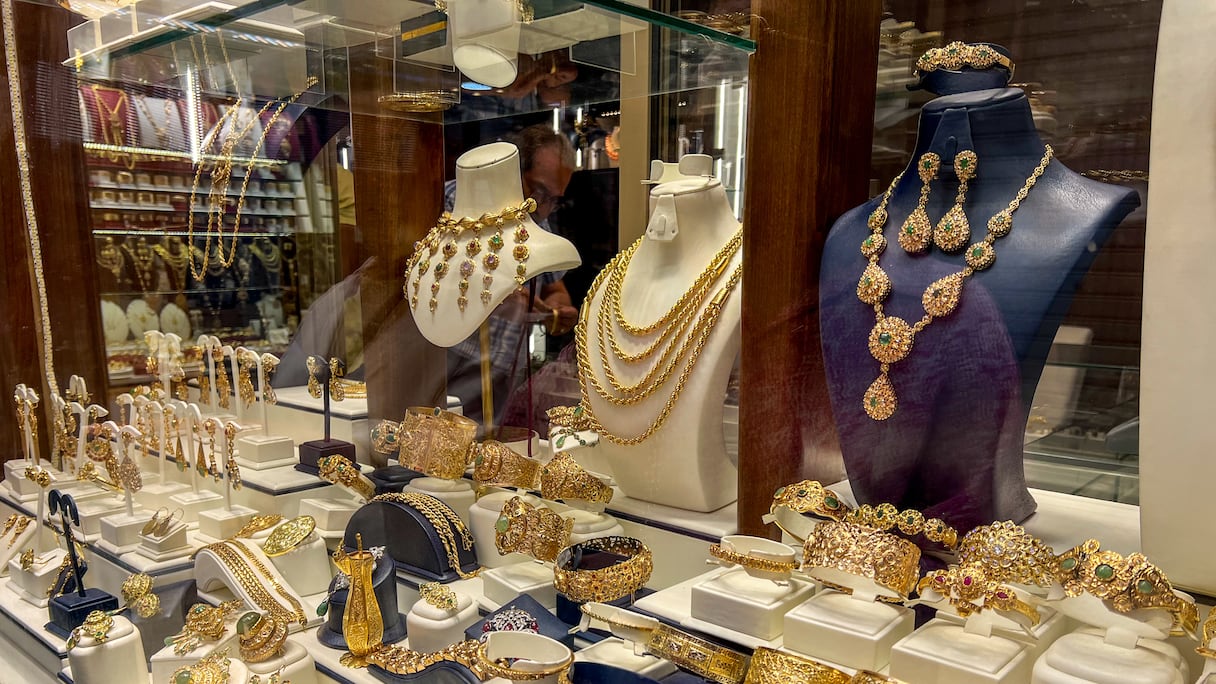
Long regarded as both a safe-haven asset and a preferred form of savings for many Moroccan households, gold is struggling to regain its traditional appeal.
Although international gold prices have continued to fall, the decline has only been partially reflected in Morocco’s domestic market. A significant gap remains between local retail prices and global market rates, limiting the impact of lower prices on consumer demand.
As a result, industry professionals say buying habits have shifted, with consumers becoming more cautious and less willing to invest in high-value jewelry.
“Gold prices have indeed declined on international markets. But in Morocco, there is still a gap of between MAD 120 and MAD 150 per gram compared with global prices,” said Idriss El Hazzaz, president of the Moroccan Federation of Jewelers.
According to him, 18-karat gold—the country’s most commonly traded standard—is currently selling for between MAD 995 and MAD 1,000 per gram.
Jewelers had hoped that falling prices would revive sales during the summer, traditionally one of the busiest periods for the industry.
“We expected lower prices to trigger strong demand for gold. Instead, exactly the opposite has happened,” El Hazzaz said.
Rather than buying, many customers are postponing their purchases in the hope that prices will fall further, reinforcing a wait-and-see attitude that continues to weigh on the market.
Shrinking purchasing power
The slowdown has taken a heavy toll on the sector.
“The industry has lost nearly one-third of the capital held by traders and artisans because of the decline in gold prices,” El Hazzaz said, adding that transaction volumes have dropped sharply this year.
He attributed the slowdown to several factors, chief among them the erosion of household purchasing power.
After spending on Eid al-Adha, summer holidays and preparations for the new school year, many families no longer view jewelry purchases as a priority.
Demand from Moroccans living abroad has also weakened.
“Younger generations no longer see gold as a preferred form of savings,” El Hazzaz said.
Farmers, once among the sector’s most important customers, have also become far less active buyers.
The trend is particularly evident in Fès, Morocco’s leading center for traditional jewelry craftsmanship.
“Demand is very weak. The most sought-after products today are lightweight pieces weighing just two or three grams,” El Hazzaz said, noting that heavier jewelry has become increasingly difficult to sell.
Supply constraints persist
Beyond weak demand, the industry also faces supply challenges.
According to the federation president, gold and silver mined in Morocco rarely reaches local jewelers.
“Domestic mines do not supply the sector, while almost all production is exported,” he said.
As a result, jewelers rely largely on recycled gold, which covers only a small share of demand, as well as official imports that the industry considers insufficient.
“Without parallel supply channels, the sector would be completely paralyzed,” El Hazzaz said.
He believes gold prices could begin rising again in the coming months.
“Gold prices remain closely tied to geopolitical tensions. Whenever uncertainty increases, investors turn to gold as a safe haven, pushing prices higher,” he said.
