Morocco is turning its attention to raising the standard of its domestic league to match the rapid rise of its national teams before the Kingdom co-hosts the 2030 FIFA World Cup.
The message came from Royal Moroccan Football Federation (FRMF) president Fouzi Lekjaa, who used two high-level meetings this week to call for sweeping reforms across Moroccan football, arguing that the country’s clubs have failed to keep pace with the international success of its national teams.
The first meeting brought together the FRMF Executive Committee to review preparations for the 2030 World Cup, which Morocco will co-host with Spain and Portugal. Lekjaa urged football institutions, professional leagues and regional bodies to improve governance, raise performance standards and align their efforts behind the federation’s long-term roadmap.
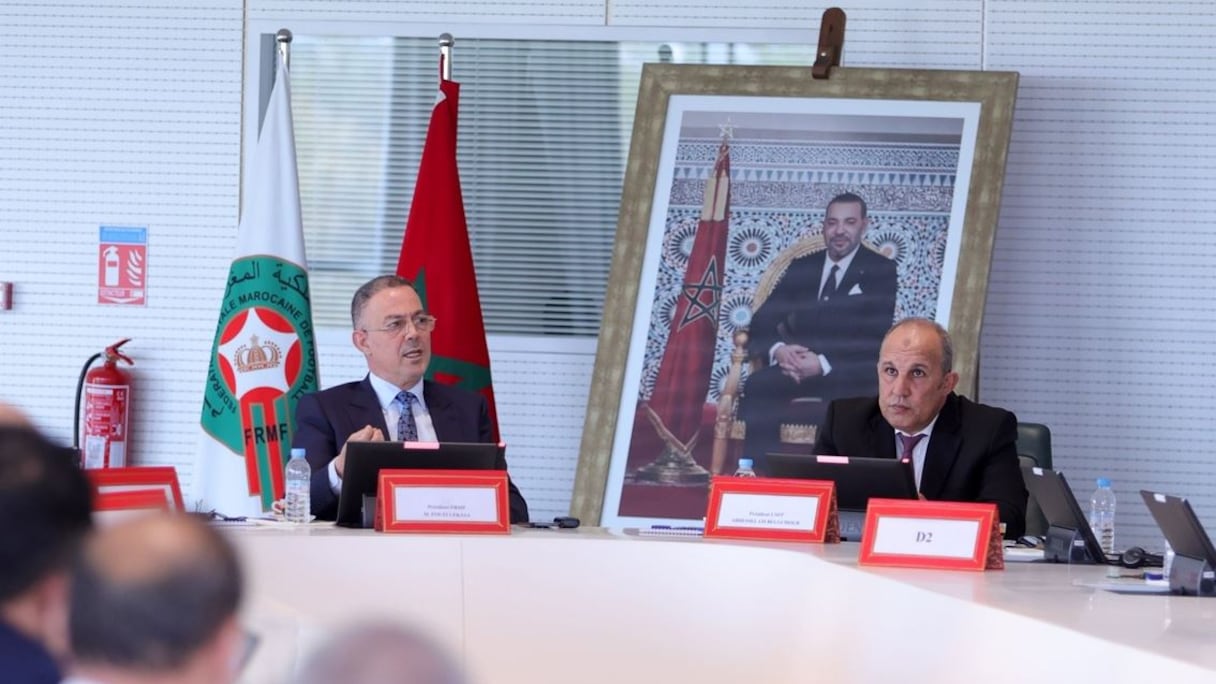
Days later, Lekjaa met with Professional Football League (LNFP) president Abdeslam Belkchour and coaches from top-flight clubs at the Mohammed VI Football Complex in Maâmora, where discussions focused on what he described as “the widening gap” between Morocco’s domestic championship and its increasingly successful national teams.
According to Lekjaa, Morocco’s clubs are no longer producing enough players capable of breaking into the senior national team despite the country’s growing international stature.
“What we have observed today is that a gap is widening between the national teams—the 25 men’s and women’s national teams, as well as futsal—and domestic football,” he said.
Lekjaa noted that while Morocco recently reached the quarterfinals of the 2026 FIFA World Cup, virtually no outfield players developed in the Botola Pro featured in the squad.
“We have just played in a World Cup with two or three reserve goalkeepers from the domestic league, but not a single outfield player developed in the national championship,” he said.
He contrasted the current situation with Morocco’s squad at the 1998 FIFA World Cup, when domestic clubs supplied the majority of the national team’s players.
“In terms of institutions and organizing the World Cup, we have progressed quickly, and the national teams followed that progress,” Lekjaa said. “But in other areas, we may have gone backwards.”
The FRMF president also argued that Morocco must accelerate the development of young talent if it hopes to remain competitive at the highest level.
“Football is played at 17 and 18 years old. The team that won the World Cup fielded several young players, including two or three who had also played at the Paris Olympic Games. We need to change our perception of age.”
He also warned that Morocco must prepare the next generation to ensure continuity at an international level.
“We’ve just come back from a World Cup where one of our reserve goalkeepers is nearing the end of his career, and two other players are not far from that stage as well.”
Lekjaa called for a technical assessment of the domestic game to understand why Morocco continues to produce internationally competitive national teams while struggling to develop elite-level players through its professional clubs.
“Our domestic football has problems, but it also has many strengths,” he said. “We are playing, but we are not managing to reach the elite level. Why is that? Where are we losing energy and talent? Why? These are questions that must be answered professionally and with expertise.”
He added that Moroccan football stakeholders must now commit to the roadmap leading up to 2030, which was presented during the recent executive committee meeting.
“We have a position, a collective ambition, and a responsibility. We are club presidents, coaches, regional league presidents, and officials. We all have a responsibility.”
The LNFP also confirmed these measures in a statement announcing the creation of a dedicated development and research unit focused on sporting matters.