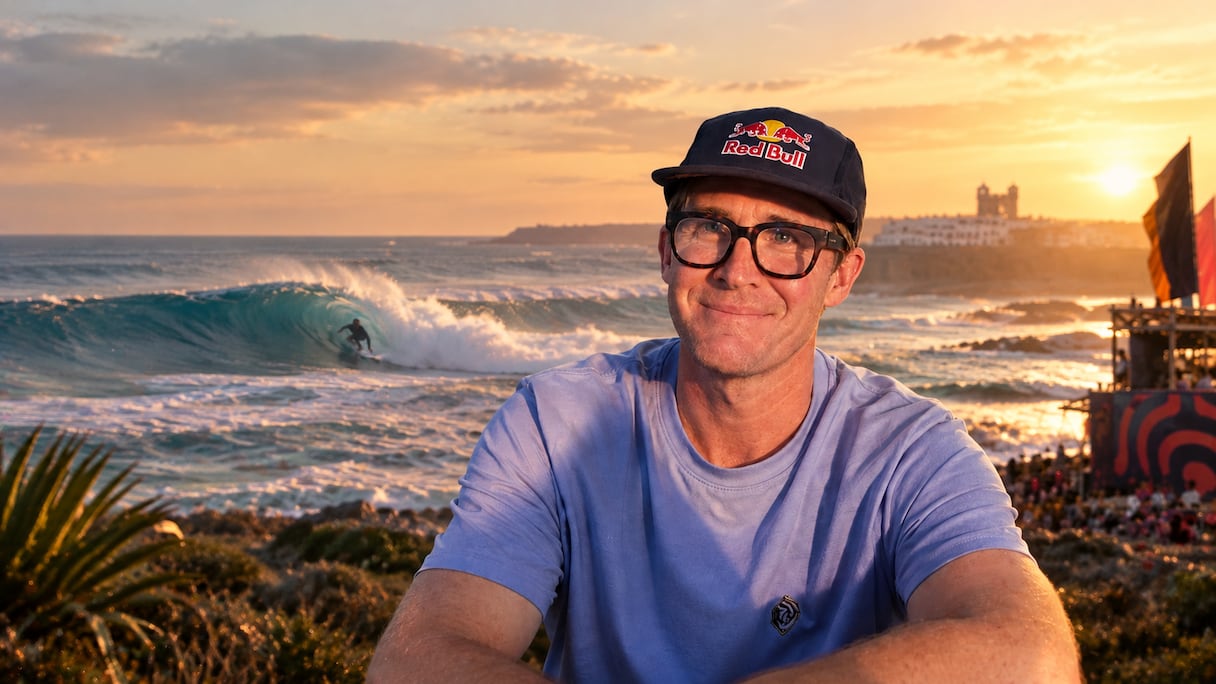
Cotton made his name surfing the giant waves of Nazaré, known for producing some of the world’s tallest surfable waves. Originally from Devon, England, he also knows the dangers they pose. In November 2017, a fall on a giant wave left him with a fractured back. Yet he eventually returned to the water.
This October, he was among the speakers at the MOGA Festival in Essaouira, where he spoke about surfing, mindset and risk management to an audience largely unfamiliar with big-wave surfing. He also led a workshop on mindful breathing and breath-holding. A regular visitor to Morocco’s coast, he comes during the winter to escape the cold in Europe. He spoke to Le360 about what big waves have taught him.
Le360: You are in Morocco for MOGA, an electronic music festival. What convinced you to accept the invitation?
Andrew Cotton: Surfing is still a niche sport. This invitation gave me a chance to share my journey with an audience that may not surf and knows little about the world of big waves. Surfing has taught me a great deal about myself, especially about mindset. Being able to pass those lessons on and connect them to my sport is a rare opportunity. When I was asked, I didn’t hesitate.
How would you define fear? Should we try to get rid of it or learn to live with it?
For me, fear is healthy. You need to understand it and learn how to use it. It may sound like a cliché, but my best moments have come on the other side of fear, after I’ve worked through it.
It’s a delicate balance. Fear can protect you, but it can also leave you deeply disappointed. I learned that the hard way. Every time I’ve given up on something because of fear or anxiety, I’ve regretted it, whether the next day, the following week or a year later. By contrast, whenever I’ve pushed through, I’ve had some of my best experiences.
The key is to see fear for what it is, face it and put it to the test. You don’t necessarily defeat it. You test it.
In 2017, you suffered a serious wipeout in Nazaré, Portugal. What made you return to the water, and how did the accident change your relationship with risk?
In sport, especially extreme disciplines such as big-wave surfing, injuries and traumatic experiences are part of the reality. I know the risks and the dangers. But these sports are driven above all by passion. It’s not about money. Every surfer will tell you they do it because they love it.
Big waves have never made me unhappy, and you don’t simply turn your back on something you love. Above all, I’ve always enjoyed pushing my limits. We only live once, and regrets can be difficult to carry. Continuing to challenge myself and overcoming injuries, accidents and fears is deeply rewarding.
Could you share a stress-management technique our readers could start using tomorrow?
What’s interesting is that the things that stress me out aren’t always the same. These days, certain situations, such as public speaking, can make me more anxious than they used to.
As a surfer, I’ve found that controlled breathing helps me overcome fear and anxiety. It slows the heart rate and helps me regain focus. My go-to technique is 3-10 breathing: inhale through the nose for three seconds, then exhale slowly through the mouth for 10 seconds.
If I can return to that rhythm, even when stress is at its peak, I can calm myself down and usually get through the situation. The challenge is remembering to do it. I still forget sometimes! But in the ocean, where I feel most at home, this is the breathing technique I turn to.
Read also : Souhaila Ettahiri on Roberto Carlos, their marriage, Morocco and the story behind the conversion rumors
You led a breathing workshop during the festival’s OFF program. What did you ask participants to do, and what stood out in their reactions?
We simply practiced mindful breathing and some breath-holding exercises. The results were impressive: one participant held their breath for three minutes and 10 seconds, while another reached three minutes and 30 seconds.
What strikes me, and this applies to me too, is how often we tell ourselves we won’t be able to do something before we’ve even started. We almost set ourselves up to fail. But with proper guidance and group practice, people can really surprise themselves.
Last week, during a session with athletes, some participants could initially hold their breath for only 20 or 30 seconds. After 40 minutes of training, we doubled or even tripled their breath-hold times.
Progress that quick is extremely motivating, both for your mindset and your self-confidence. You start thinking, “I can do this!” We all doubt ourselves. We tell ourselves we’re not capable or not good enough. We simply need to remind ourselves that we are. With the right preparation, we can do far more than we think.
This isn’t your first visit to Morocco. What do you think of its waves?
The coastline has incredible waves, including some really impressive big waves, which might surprise quite a few people. The people are wonderful, and the weather is great, too!
Morocco is one of my favorite winter destinations when I want to escape the cold in Portugal, England or Ireland. It’s a real getaway, and I appreciate it a lot.
