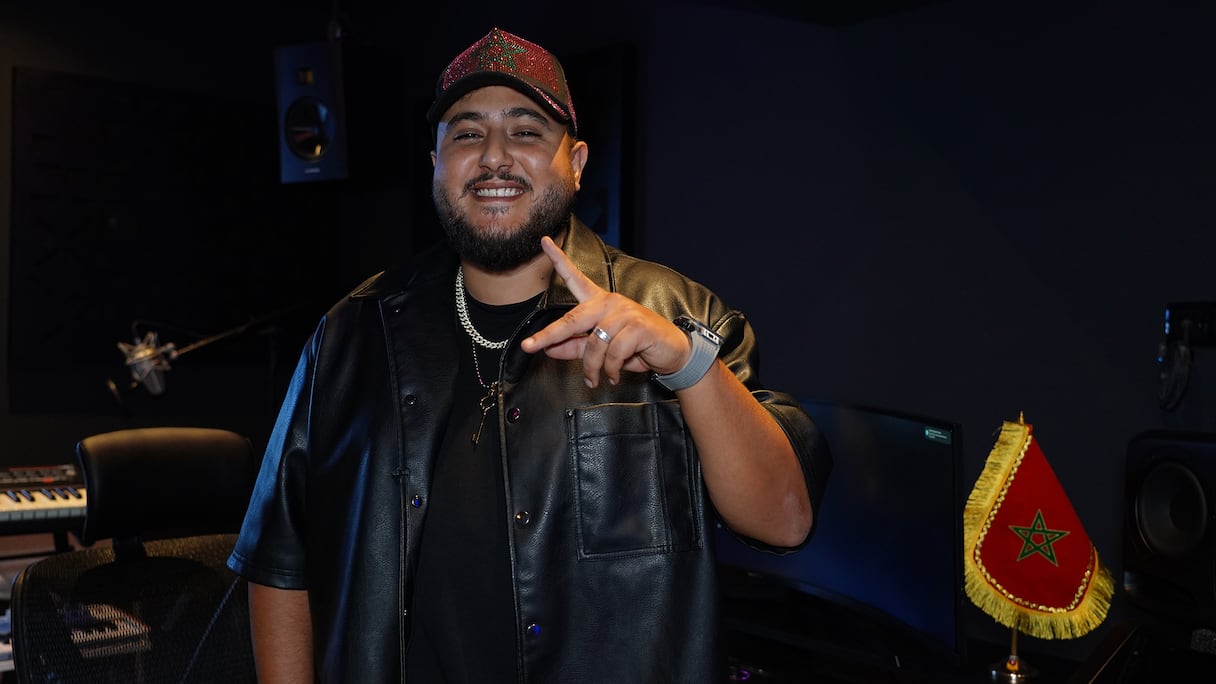
At the Worldwide Music studio, where many of the Moroccan music scene’s hits have been created, Abdelilah Arraf, better known as Beathoven, welcomes us with ease into the same studio where the music video for “Allez Allez” was filmed. After nearly 20 years spent producing, composing and shaping other artists’ projects, Beathoven is now stepping into the spotlight with Jocker, a debut solo album that reflects his journey, doubts and convictions. We sat down with him to talk about his career, creative choices and vision for Morocco’s evolving music industry.
Le360: You recorded “Allez Allez,” a track from your debut album “Jocker,” at your own studio under your own label, Worldwide Music. After spending so many years behind the scenes helping build the careers of other artists, what made you decide to take the leap and release music under your own name?
Beathoven: I’m passionate about music. I’ve had many dreams since I was 13. I spent a long time working behind the scenes, particularly in artistic direction and music production. I had been working on this album since 2023, and when I launched my label, I thought it was the right time to put something more personal and more sincere out there. “Allez Allez,” the album’s first single, is a very positive track that reflects my personality quite well.
How did “Allez Allez” come about? How did you build its musical universe?
Every song reflects the atmosphere of the moment when we come together in the studio. I started working on “Allez Allez” with Bilal The Chef in Bouznika, where we laid down the first foundations of the track. Di Vinci then joined us and we developed the song together.
Every track has its own universe. Some may sound very bright even though the lyrics are darker. I always give myself the freedom to create whatever I feel like creating. I follow what I enjoy and what I’m passionate about. “Allez Allez” was composed at the end of 2022, and even today, when I listen to it, I feel like it was recorded yesterday. That’s what convinced me to include it on the album.
Your debut album is called “Jocker.” Why did you choose that title?
In life, everyone is the joker in their own story. We make choices, we make decisions and we try to manage our lives as best we can. For me, you have to know how to be that “joker.”
«I’m a child of Hay Mohammadi. My passion for music started when I was 13. Between 2005 and 2008, I grew up listening to Dr. Dre and the great figures of American hip-hop. In Morocco too, many artists were helping rap emerge, and there was an incredible amount of talent.»
— Beathoven
Through this album, the audience will discover different sides of Beathoven: the joyful moments, but also the wounds, disappointments and difficult experiences. It reflects life’s highs and lows. Deep down, we don’t control very much. We put our trust in God, and every hardship transforms us while making us stronger.
Jaylann, your wife, is the leading artist in the Beathoven universe. What role has she played in your journey?
Jaylann is my life, my wife. Khaoula (her real name) and I have been through a lot together. People see the results, but they don’t know everything it took to get here. We started with nothing, or even less than nothing. That story is what makes us strong.
Over the years, we found our balance. She always encouraged me to release a solo album, but I would tell her that the time would come when it was right. Today, I felt that the moment had arrived.
You spent many years behind the scenes. Who is Beathoven, really?
My real name is Abdelilah. Only my mother and my wife call me that. I come from hip-hop culture, where everyone chooses a stage name. I really liked an album by Black Mozard produced by Bryan Resley, and that inspired me. I simply changed “Beethoven” into “Beathoven.”
I’m a child of Hay Mohammadi. My passion for music started when I was 13. Between 2005 and 2008, I grew up listening to Dr. Dre and the great figures of American hip-hop. In Morocco too, many artists were helping rap emerge, and there was an incredible amount of talent.
With the internet, we discovered new artists and wanted to know who was producing their tracks and who was working on them in the studios. That world drew me in. I started spending time in studios, meeting artists and collaborating with them.
Who was the first artist you worked with?
At the time, there were many of us just starting out. We were producing tracks for 200 dirhams. I worked with Casacrew and Hablo, among others. Since I started so young, I was lucky enough to work alongside several generations of artists.
«In my view, we’re only at 7% of what a real music industry could be.»
— Beathoven
Today, I mainly produce pop, but my roots are still in rap. My sound is a mix of rap, hip-hop and pop.
Your music moves across several genres. Why did you choose that approach?
When you walk into a studio, you never say, “We’re going to make something like this artist or that artist.” What matters is finding your own identity. That takes time, self-confidence and the right people around you.
Sometimes an artist is still finding their sound or experimenting with different directions. That’s part of the process. The important thing is to remain yourself while respecting other people’s work.
You have experienced a different era of the music industry. How do you see its evolution in Morocco?
When there is a need, there is inevitably work to be done. But in my view, we’re only at 7% of what a real music industry could be.
You realize that when you work abroad. There, an entire ecosystem supports artists and makes their work easier. Here, there is still a lot to build and invest in.
Where exactly does Morocco stand, in your view?
Honestly, I wouldn’t know how to say. It’s not very clear yet. That’s why I prefer to focus on my work. I spend most of my time in my studio, where I try to pass on what I know and gradually help the artists I work with grow.