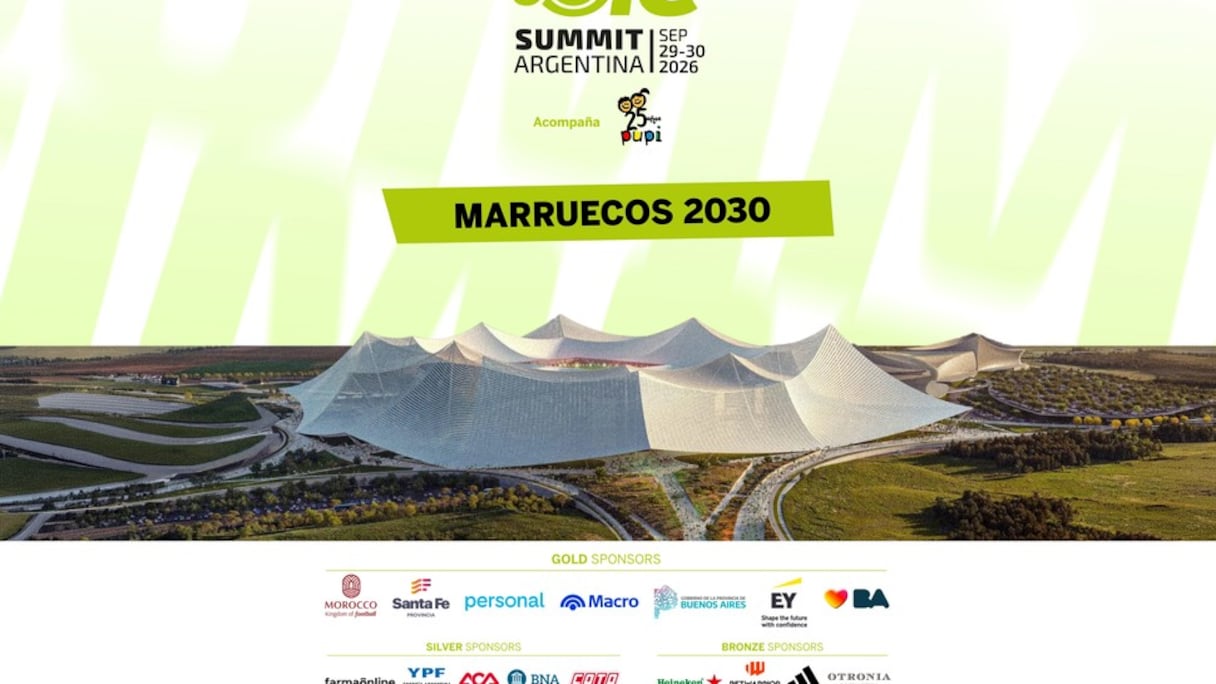
Morocco presented its vision for the 2030 World Cup on Tuesday at the fifth edition of the Olé Summit in Buenos Aires, where it was the guest of honor.
The country will co-host the tournament with Spain and Portugal, with preparations forming part of a broader strategy focused on development, infrastructure modernization and international outreach.
Morocco’s ambassador to Argentina, Fares Yasser, presented this vision alongside Othmane Badssi, a project officer at the Morocco 2030 Foundation, and Jihane Bijjou, head of customer journey at the same institution. The summit brings together professionals from sports, media, technology, innovation and the entertainment industry.
Speaking to a packed audience with a strong presence of young people, the three speakers stressed that Morocco’s World Cup ambitions are part of King Mohammed VI’s vision, which places sport at the heart of human, social and territorial development, as well as youth inclusion and personal development.
Yasser highlighted the unprecedented nature of the 2030 edition, which will connect three continents: Africa through Morocco, Europe through Spain and Portugal, and South America, where centenary commemorative matches are scheduled to take place in Argentina, Uruguay and Paraguay.
The ambassador also stressed that the World Cup forms part of Morocco’s broader transformation, particularly in transport, infrastructure, tourism and renewable energy.
The goal, Yasser said, is to ensure that investments linked to the 2030 tournament leave a lasting legacy that contributes to the country’s development.
Badssi recalled that preparations for the World Cup are part of a process that began years ago, from the 2008 National Sports Conference and the creation of the Mohammed VI Football Academy one year later to the development of high-level sports infrastructure.
This process includes the modernization and construction of stadiums, the development of training facilities and the expansion of airport, rail and hotel capacity, in an approach that goes beyond the immediate needs of the tournament.
He also emphasized the importance of the tournament’s legacy and its role as a catalyst for economic and territorial transformation.
Bijjou focused on the human dimension of the project, stressing the place of football in Moroccan society and the way the passion for the sport is passed on to younger generations.
From academies and clubs to neighborhoods, beaches and public squares, football is part of everyday life in Morocco, she said, adding that the legacy of 2030 will also be measured by the ability to expand participation in the sport and bring more young people closer to it.
Organized by Olé, the sports newspaper of Clarín, one of Argentina’s leading media groups, the summit is being held at Usina del Arte in Buenos Aires and continues on Wednesday.
This year’s edition coincides with the media outlet’s 30th anniversary, marking three decades during which it has established itself as a leading source of sports news in Argentina.
