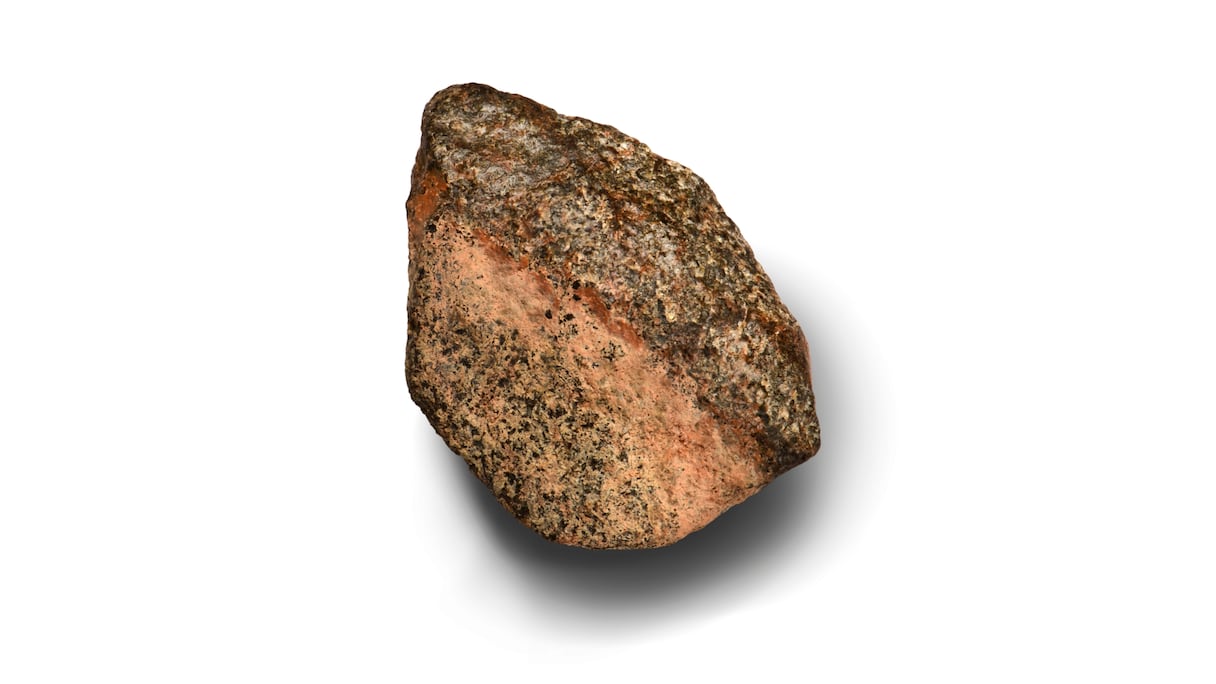
Named Teghaza 001 after the salt plain where it was found in 2022, the rose-colored rock weighs around 800 grams and formed more than 4.1 billion years ago. Its age and unusual mineral composition set it apart from most Martian meteorites recovered on Earth.
NASA’s Jet Propulsion Laboratory detailed the findings on October 29, following a study published in the journal Science. Researchers used a new dating technique to examine individual mineral grains in the meteorite, allowing them to establish its age while preserving much of the rare sample for future research.
Teghaza 001 is one of roughly 435 meteorites identified as originating from Mars. It is also among the three oldest Martian meteorites known to have reached Earth.
A rare sample of Mars’ early crust
Most Martian meteorites provide only limited information about the planet’s geological history. Teghaza 001 contains a wider mix of volcanic minerals, offering a more detailed record of how parts of Mars’ crust formed from cooling magma and were later altered by water beneath the surface.
Read also : NASA discovers massive lunar crater formed by impact missed in real time
Its mineral composition resembles material observed by NASA’s Mars Reconnaissance Orbiter in the planet’s heavily cratered southern highlands. Researchers have identified 13 possible locations on Mars that match the meteorite’s mineralogy and chemistry, although its exact place of origin cannot be established.
The sample was initially classified as a shergottite, the most common type of Martian meteorite. Its unusual mineral textures, however, prompted NASA planetary scientist Yang Liu and her colleagues to examine it more closely.
The team identified zircon crystals, minerals that preserve information about the conditions and timing of a rock’s formation. Their analysis revealed that Teghaza 001 formed more than 4.1 billion years ago, making it one of the earliest samples of Martian crust available to scientists.
The meteorite is comparable in age to another ancient Martian rock, ALH84001, but offers a different geological record. Unlike that sample, which is composed almost entirely of one mineral, Teghaza 001 contains a variety of minerals that provide a more complete picture of early volcanic activity on Mars.
New clues to water on ancient Mars
The research also offers evidence of water interacting with the planet’s rocks at an early stage in its history.
Analysis showed that parts of the meteorite had been altered by water around 4.1 billion years ago. This means the rock itself must have formed even earlier.
The findings add to evidence that Mars once had a more active water cycle than the planet’s dry surface might suggest today. Mineral textures, oxygen isotopes and chemical composition all provide clues to the interaction between water and rock.
A separate study published in Science Advances in June examined the meteorite’s water content and offered further information about how water affected the early Martian surface.
Researchers say the sample could also preserve traces of the planet’s atmosphere during a period when Mars was losing much of its water. Further analysis will be needed to determine what the meteorite can reveal about these processes.
A new way to date planetary samples
The team used an in-situ rubidium-strontium dating method developed by researchers at the California Institute of Technology. Rather than dissolving and analyzing an entire sample, the technique examines individual mineral grains directly.
The method requires only a very small amount of material, allowing scientists to obtain precise age measurements while preserving rare meteorites for future studies.
Caltech researcher François Tissot, who worked on the study, said the technique could eventually be used to date other Martian meteorites and samples collected from planets, moons and asteroids.
Read also : A piece of the Moon in Morocco: A rare meteorite on display in Agadir
Scientists cannot determine exactly where Teghaza 001 was ejected from Mars. Like other Martian meteorites, it was blasted off the planet by an impact before travelling through space and eventually reaching Earth.
Its mineral and chemical composition can be compared with measurements collected by NASA missions, including the Viking landers and the Curiosity and Perseverance rovers. This allows researchers to narrow down possible origins on Mars.
The discovery adds a valuable sample to the relatively small collection of Martian material available for laboratory study. Researchers expect further investigations of Teghaza 001 to provide more information about the planet’s early geological history and the role water played in shaping it.
