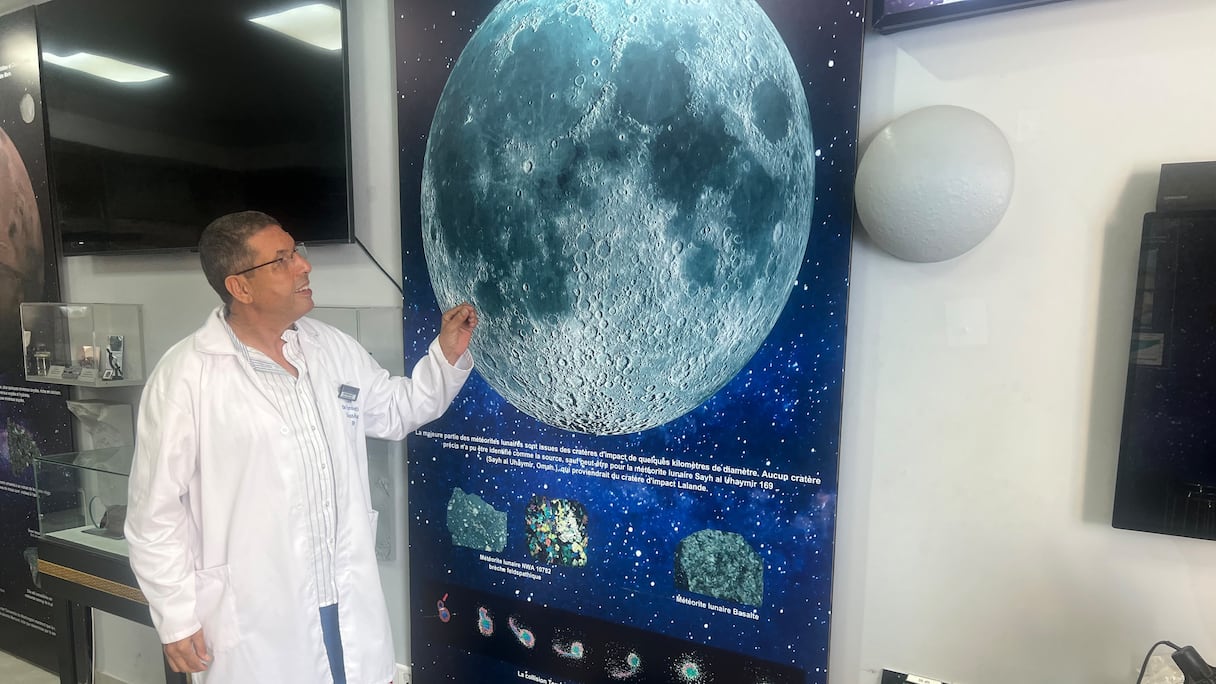
Agadir’s University Meteorite Museum has become a major attraction for researchers, space enthusiasts and specialists, thanks to its collection of rare specimens. One of its most remarkable pieces is a rare lunar meteorite that has drawn considerable interest from members of the public eager to discover this scientific treasure.
Professor Abderrahmane Ibhi said the lunar specimen, named “Northwest Africa 5406,” joined the museum’s collection through a meteorite enthusiast who acquired it in the Ouarzazate region in 2008. He added that the Moon acts as a living record of the sporadic collisions that also strike our planet.
Traces of cosmic impacts
“The hundreds of thousands of craters scattered across the Moon allow scientists to trace the history of impacts on its surface,” Professor Ibhi told Le360. The exhibited sample consists of black basalt and contains, among other features, glass spherules left by these collisions. Studying them helps researchers better understand how new crystals form.
According to Professor Ibhi, research on the sample also provides insight into the composition of the lunar surface, which features vast basaltic plains known as “maria,” as well as mountainous regions marked by impact craters.
Read also : NASA discovers massive lunar crater formed by impact missed in real time
He noted that the Moon lacks major mineral resources, but stressed that its importance lies in its potential to serve as a platform and a welcoming base for future space stations launched from Earth toward distant planets.
Where the magic of poetry meets scientific rigor
On the public response to the discovery, the museum’s head said acquiring the rare lunar specimen had turned the institution into a popular destination, drawing dozens of visitors eager to examine its features, composition and history up close. He attributed this enthusiasm to the Moon’s powerful symbolic place in the collective imagination, its captivating beauty whenever it appears in the sky, and its enduring role as a source of inspiration for Arab poets and artists, who have celebrated it in literary and cultural works.
Professor Ibhi also highlighted the sample’s contribution to the mineralogical characterization of lunar crystals and to understanding how they form. The research has resulted in publications in peer-reviewed international scientific journals. It has also strengthened research activity at the laboratory and expanded the museum’s science outreach work, helping advance planetary science in Morocco.
