On February 1, 2026, in Tindouf, Abdelmadjid Tebboune waved off the first trainloads of ore from Gara Djebilet, the official news agency APS reported. No tonnage was given that day. None has been given since.
The only figure ever released for the mine dates back to December 2025: 75,000 tonnes of raw ore blasted loose in a single detonation, according to a statement from the state-owned Sonarem group cited by TSA. Blasted loose, not extracted, let alone transported. The statement promised “monthly” blasts. Eleven months on, there has been no report of a second.
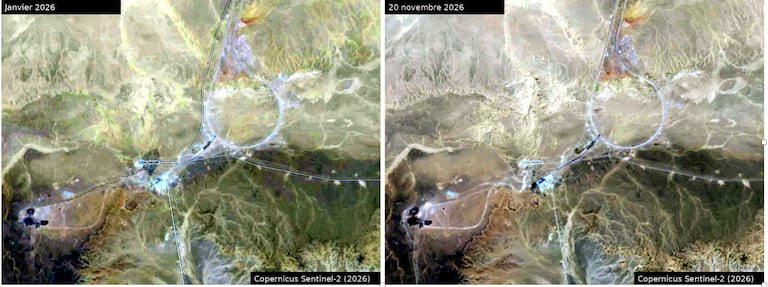
The skies, however, issue no press releases. Images from Europe’s Sentinel-2 satellite show the railway terminus in January 2026, before the inauguration, and again on November 20. In ten months, the site’s footprint has remained unchanged: the same railway loading loop, the same patch of disturbed earth to the north, the same facilities. No new pit, no stockpile of ore, no visible expansion of mining operations.
From two trains a day to three a week
The railway has had one progress report. Just one. On March 24, the Tindouf stationmaster told Horizons that some 6,000 passengers had travelled on the line since it opened, with “two trains operating daily.” On June 17, Ennahar published a new timetable: overnight trains, three times a week in each direction. In the space of three months, the “desert train” went from two departures a day to three overnight departures a week. Since then, nothing: no timetables, no passenger figures, no word of a single wagonload of ore. The official press, which had devoted weeks of front-page coverage to this 950-kilometer railway, supposedly destined to carry tens of millions of tonnes a year, no longer mentions it. If the train is still running, it is running in silence. The likeliest explanation is that the much-vaunted train of the “project of the century” has come to a standstill.
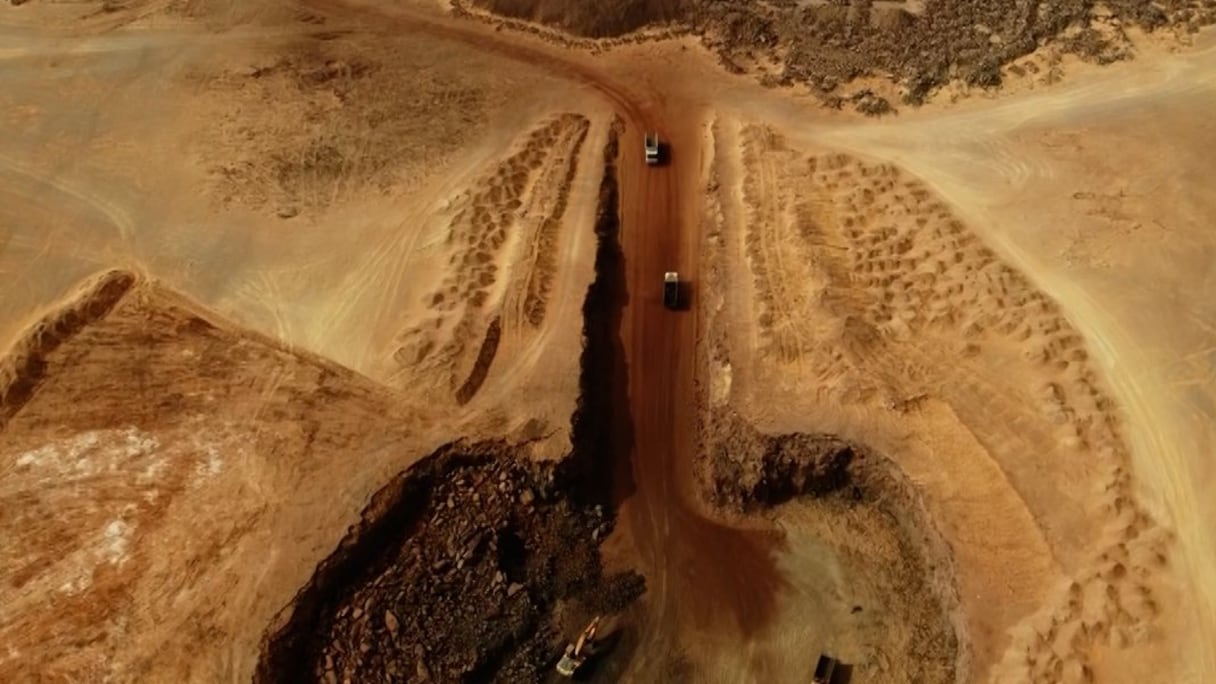
The only footage to emerge outside official channels was taken by a Qatari motorcyclist who visited the site in June: a bare pit, with neither machinery nor workers in sight, as Le360 revealed. As for the economist Djelloul Slama, who had ventured to question the deposit’s profitability on television, he was sentenced on October 15 to four years behind bars. In Algeria, questioning the value of a mine carries a higher price than the ore itself.
Bled El Hadba: the ever-receding phosphate project
Now it is phosphate’s turn. On November 24, following a working meeting, the presidency announced that phosphate concentrate would enter “the commercialization phase in the first quarter of 2027,” according to APS. The $5.3 billion project (717.7 billion dinars earmarked in the draft 2027 Finance Bill) promises annual output of 10 million tonnes of phosphate and 6 million tonnes of fertilizer and an end to all fertilizer imports in 2028, according to TSA.
The history of the project offers some indication of what its deadlines are worth. In March 2022, Sonatrach announced the formation of an Algerian-Chinese joint venture, with Wuhuan and Tian’an holding a combined 44% stake, for an investment of “around seven billion dollars.” In November 2024, the Chinese partners were dropped for lacking the “necessary financial capacity.” The price tag came down to $6 billion, with production due to begin in “early 2027.” Two years later, the figure stands at $5.3 billion, the mine is due to begin production in “late 2027,” and the first-quarter deadline has been whittled down to a promise concerning phosphate concentrate alone.
Abdelmadjid Tebboune, for his part, has not changed his tune. On October 3, speaking to state television journalists, he was already promising “the end of the first quarter of 2027.”
Seven weeks later, the date has been repeated, not brought forward. The price tag shrinks, the deadline slips, the Chinese partner has evaporated. Only the press release arrives on schedule. We already know how the rest of the story goes. It has a name: Gara Djebilet.
Gara Djebilet was supposed to produce 40 to 50 million tonnes of iron ore a year “as early as 2026.” The “project of the century” has swallowed up 963 billion dinars, or more than $7 billion, according to figures presented to MPs by the finance minister himself, not counting the 950 kilometres of track laid across the desert. Ten months after the fanfare of its inauguration, not a single tonne of ore has emerged for which anyone has published a weight. The official press, which sang its praises week after week, no longer utters its name. The project of the century has become the taboo of the century. Djelloul Slama learnt that the hard way: four years in prison for asking a question on television. Mention Gara Djebilet at your peril.
Bled El Hadba is next in line, with the same promises, the same billions written into the Finance Act and the same receding timetable. In two years, we shall know whether it has joined its predecessor on the list of forbidden subjects. In Algeria, mines do not produce ore. They produce press releases, then silence.
