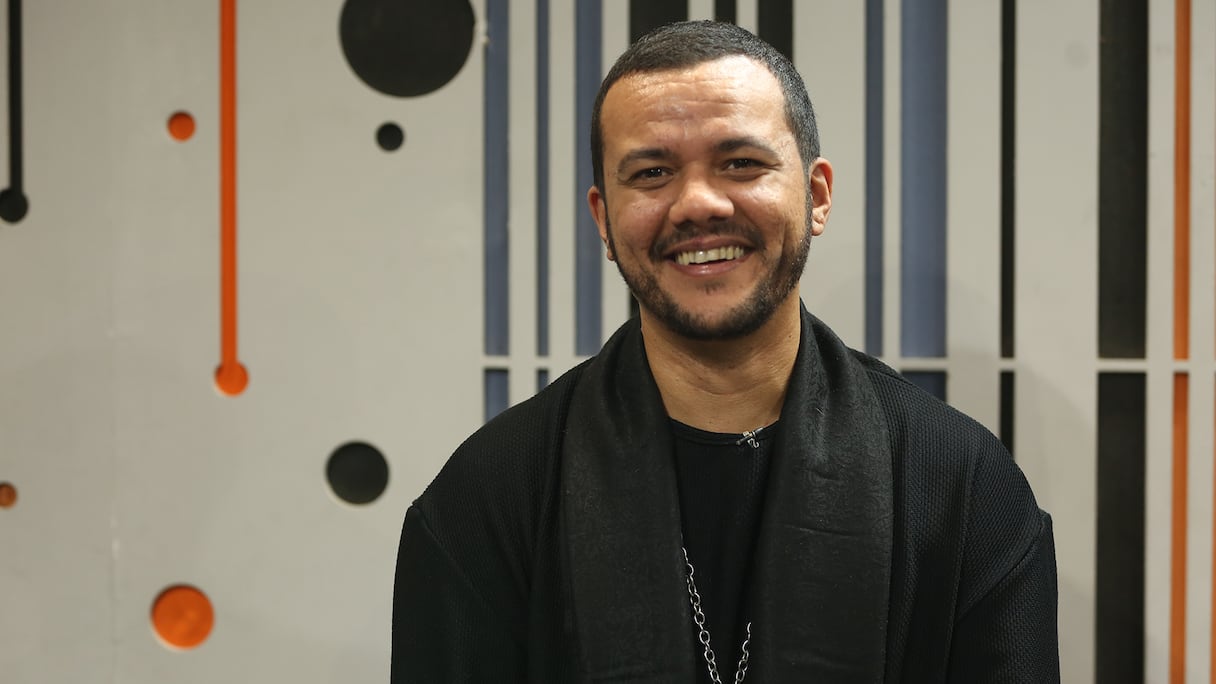
Omary grew up surrounded by classical Arabic and Moroccan music performed by members of his family. His father taught him music before he turned to electronic sounds and played his first DJ set in Casablanca in 2008.
In November 2022, he released his debut album, “Soul of Winds,” which explored musical traditions from Africa, the Middle East and Asia through wind instruments from different countries, including the ney, bansuri and saxophone.
With “Tourat,” he returns to the Moroccan heritage that shaped his childhood. He says he spent years preparing the album, working alongside traditional musicians and singers to understand the codes and nuances of the styles he wanted to bring into electronic music.
Le360: “Tourat” means heritage. What does the word represent for you, and why did you choose it as the album title?
Omary: It refers first to Morocco’s heritage, the country I come from, but also to my own heritage, the culture I grew up with. From a very young age, I listened to classical Arabic and classical Moroccan music. Both identities are part of me, and it was time to express them through the music I make today: electronic music. That is why I chose this title.
The album opens with the rhaita. What image or childhood memory comes to mind when you hear this instrument?
Eid al-Adha and Eid al-Fitr, the country’s two major religious holidays. The rhaita is often played to celebrate these occasions, as well as at weddings. It accompanies moments of joy. Opening the album with it was therefore essential to me. It introduces listeners to the richness of Morocco’s musical heritage.
How did you balance the energy of electronic music with the depth of traditional vocals?
I grew up listening to traditional music, so I didn’t have to adapt to it. It is part of my roots. When you listen to it for years, your ear develops, and translating it into a new style such as electronic music becomes natural. But you have to respect its codes. Listening to a tradition is one thing; understanding it is another.
I spent time with many traditional musicians and singers, working across Moroccan music and classical Arabic music to understand the distinctive sounds and meanings of each tradition. I have been working on this for years, which is why producing the album took so long.
Read also : Meet Beathoven, the man behind the scenes who finally steps into the spotlight with “Jocker”
The album features 12 tracks and a series of collaborations with artists including Khalid Elhamri, Nourani, Aziz Ozouss, Badr Sabry and Yasser Radif. How did you choose them?
Passion played a part, and sometimes it was simply coincidence. I didn’t know most of them at first. People introduced us, or we crossed paths at venues where I was working at the time. They would come in to sing, and we would say we should make something together.
I remember Badr Sabry’s case very well. He wasn’t even supposed to be the vocalist on that project initially. A few years ago, we were both very active on Rabat’s events scene. Wherever I was DJing, he was singing, and sometimes the other way around. We played at almost every restaurant and nightlife venue in the city.
He is well known there for his aïta songs and traditional repertoire, so eventually we sat down and thought, “Why not work together?” He was the right person for this style because bringing aïta into electronic music is no easy task.
Yasser Radif had performed this style during the first season of Starlight. I often follow talent shows to discover new artists, but I make my choices early. I don’t wait until the end to decide whom I want to work with. From the first few episodes, I might spot someone and think, “This is going to work.” He didn’t win the show, but I found my winner. He is a very good singer.
For me, Khalid Elhamri is one of the few truly great beldi singers. He has a refined style that is hard to find today. He writes lyrics, composes music and masters a repertoire that is rarely heard in Morocco anymore. He had to adapt to my electronic sound. It wasn’t easy, but he rose to the challenge.
Aziz Ozouss is a maestro of Amazigh music. He plays the rabab, the lute and string instruments in general, and he is a gifted vocalist as well. Working with him was a pleasant surprise because he wasn’t originally part of the album.
I had been in Dubai for several months and was missing Morocco. I wanted to reconnect with that Moroccan sound, so I started creating tracks inspired by our musical heritage to play at the venues where I was DJing there. I told him, “Aziz, I need something purely traditional and Amazigh, something that takes us back to our roots.” That is how it happened.
The album features DJs as well as singers. I know all my collaborators very well. I didn’t impose anything on anyone, and nobody imposed anything on me. The collaborations grew out of a good personal and artistic connection.
Read also : Back from a broken back: Andrew Cotton on returning to the waves after a near-fatal wipeout
On “Horasan,” you turn toward Turkey, while much of the album draws on your Moroccan and Arab roots. What does this say about your definition of heritage?
Turkey wasn’t a random choice. It was the first foreign country I visited, including for professional reasons, and the experience remains one of the most memorable of my life. Turkey has an exceptionally rich history that has always inspired me.
I had already dedicated a track to Turkey, “Sufi,” on my first album, so it felt natural to return to it for this second release. This time, however, I went further: the track draws inspiration from an old Turkish legend. I wanted to bring that cultural dimension into the album.
On “Diwane,” your father, Abdo, sings about who you are and the person you have become. How did that come about?
To be honest, this song was written alongside me during the most difficult period of my personal and professional life. My father was singing, and we didn’t even know what we would do with the recording. But I told him, “You’re my father, you’re singing, we’re having fun, and you’re the one who taught me music. Of course you have to be on my album.”
Why didn’t you include your father on your first album?
That was the original plan, but we went through some family difficulties, as happens in any family, and I felt it wasn’t the right time. So we postponed the project. That was five years ago.
When I saw him again, I told him, “I’m releasing my second album, and ‘Tourat’ is really me. It’s Omary in his most authentic form. Whatever the circumstances, this song will be released.”
We recorded it under terrible conditions, spontaneously, in my home office, making do with whatever equipment we had. Even so, I was determined to include it on the album.
Read also : Souhaila Ettahiri on Roberto Carlos, their marriage, Morocco and the story behind the conversion rumors
What did you feel the first time you heard your father singing those words over your music?
It was very moving. He was the one singing, but the lyrics were entirely mine. The track tells the story of who I am and what I represent, so it was obvious that it had to be on the album. Hearing your father sing lyrics about you is deeply touching.
After “Tourat,” what do you hope to convey to listeners?
We would need three interviews like this one to answer that! My priority is to share the richness of our culture. It is a daily struggle.
As a DJ and producer, it would be easy to avoid all this, not complicate my life and make electronic music like everyone else, using a piano, a guitar and a computer. I have done that. But just look at what is happening around the world. Every artist, whether a producer, a DJ or someone working in another discipline, wants to express what they feel, who they are and where they come from. Those three things are essential to me.
The world’s best-known DJs all share something rooted in their origins. French artists constantly talk about the French Touch, while South African artists fight to promote African music, the continent’s history and what is happening there today.
As an artist, I have to be proud of my Moroccan culture. I travel around the world today, and I am proud to consider myself an ambassador for Moroccan music. Every day, I work to take the richness of Moroccan culture to audiences around the world.
