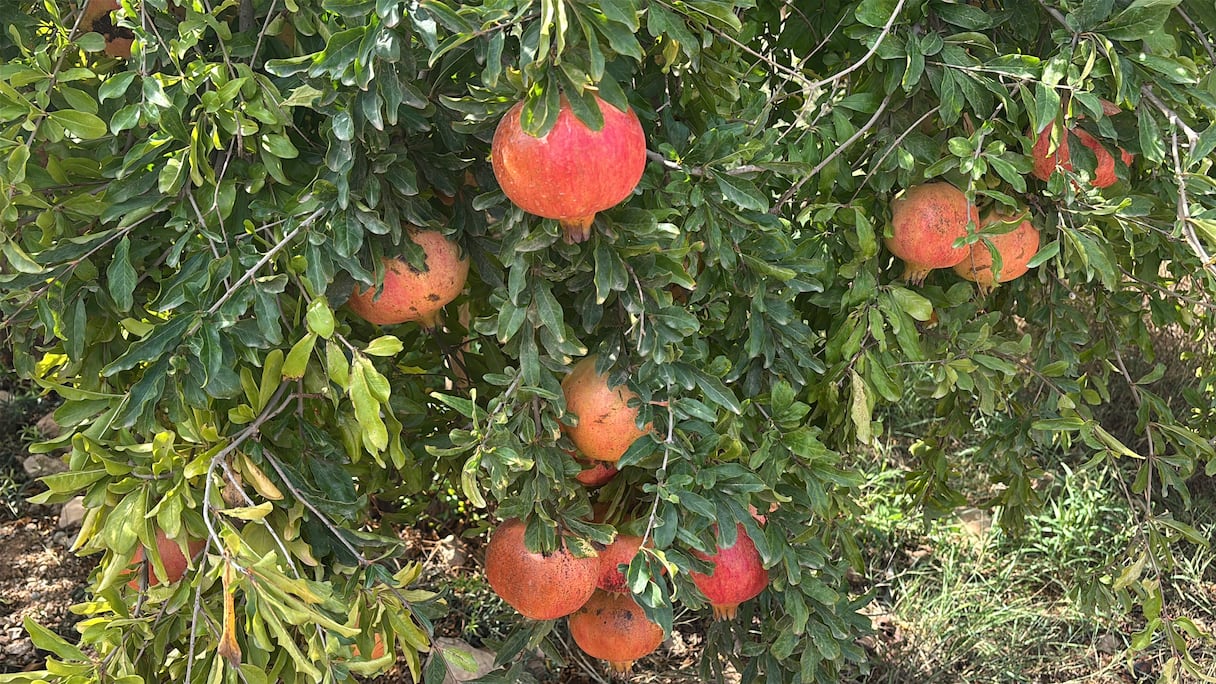
Harvesting began in early October, with growers anticipating a larger crop than last season. Across the area covered by the Moulouya Regional Agricultural Development Office (ORMVAM), production is forecast to reach around 26,000 tonnes.
Pomegranate cultivation has expanded in recent years, benefiting from suitable local conditions and growing interest among farmers. The crop was incorporated into the regional agricultural plan as a product characteristic of Berkane province, said Maria Toufiq, an agricultural engineer with ORMVAM.
Pomegranate orchards cover around 2,500 hectares across the region. About 76% of that area falls within ORMVAM’s jurisdiction, while Berkane province alone accounts for nearly 80% of the region’s total pomegranate-growing area.
The crop’s appeal lies partly in its profitability compared with certain other agricultural activities and its relatively modest water requirements. It also provides a significant source of rural employment.
“Pomegranate cultivation generates more than 150,000 workdays a year,” Toufiq said.
Among the most widely grown varieties are Sefri and Merssi, locally known as Oujdi. Farmers also grow varieties such as Admi and Oujdi, which some producers call Dondo.
Read also : Good rains put Morocco’s apple harvest on course for 1 million tons
Rainfall and irrigation support fruit quality
Agricultural support programmes have helped farmers establish orchards and convert irrigation systems to drip irrigation. The technique currently covers around 40% of the cultivated area, with the aim of improving yields while using water more efficiently.
Water management remains important as the fruit matures. Excessive irrigation at this stage can cause pomegranates to crack and reduce their quality.
This season’s rainfall, combined with favorable weather and regular irrigation, has helped improve both production volumes and fruit quality, according to Toufiq.
Early results are encouraging in the commune of Chouihia, where one farmer expects to harvest between 90 and 100 tonnes from a 2.5-hectare farm. Picking began in early October and covers several varieties, including Admi and Oujdi.
“The rainfall recorded in the region, along with the availability of irrigation water supplied by the Moulouya Regional Agricultural Development Office, has helped increase both the quantity and quality of the fruit,” the farmer said, adding that production had improved compared with the previous season.
Read also : In Pictures: Northern olive harvest could surge up to 80%, pushing oil below MAD 35 a liter
Sun damage and marketing remain challenges
Despite the favorable outlook, growers still face losses caused by sun exposure, which damages some fruit and reduces the share that can be sold. Farmers also need greater technical support and better-organized marketing channels.
One grower called for the creation of specialized cooperatives to structure sales, reduce losses and increase the proportion of fruit reaching the market. Such organizations could also help producers explore export opportunities for Moroccan pomegranates.
For Berkane’s growers, a strong harvest is only one part of the challenge. Better technical support, improved marketing and more effective ways to sell the fruit will be important in ensuring that favorable growing conditions translate into lasting economic benefits for farmers and the region.
