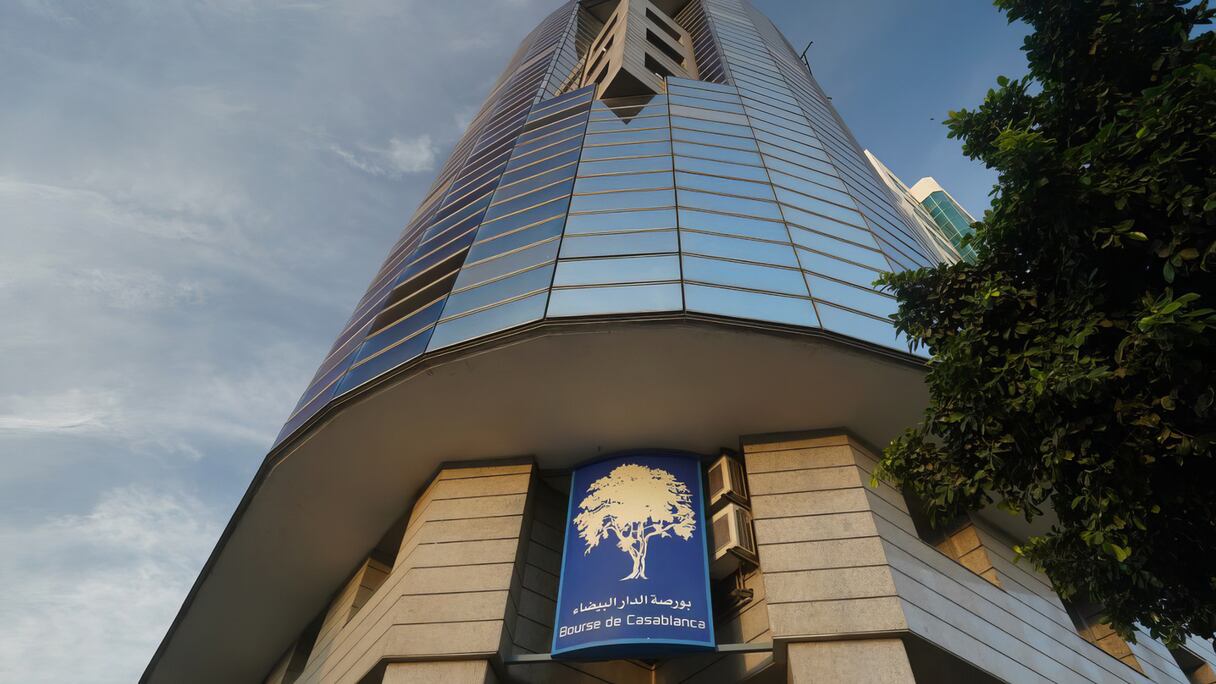
Following several years of exceptional performance, the Casablanca Stock Exchange seems to be entering a more measured phase. However, the technical correction observed in 2026 does not overshadow a broader trend that remains firmly positive.
The current slowdown comes after three outstanding years during which the benchmark MASI index rose by 12.8% in 2023, 22.2% in 2024 and 27.6% in 2025. Against this backdrop, the decline recorded since the beginning of the year appears more like a healthy consolidation after significant gains than a genuine reversal in trend. “Although global geopolitical uncertainty and renewed investor caution have amplified this downward movement, the Moroccan market’s fundamentals continue to rest on a solid microeconomic foundation,” Finances News Hebdo noted.
The sharp increase in the overall profitability of listed companies, from 28.6 billion dirhams in 2021 to 50.9 billion dirhams in 2025, suggests that higher valuations are supported by real value creation rather than speculation alone. Profitability remains the market’s main strength, especially as Morocco’s macroeconomic environment continues to show encouraging signs.
Economic growth is projected at 5.2% in 2026, driven by the recovery of the agricultural sector, household consumption and investment, against a backdrop of controlled inflation and monetary stability. Morocco also stands to benefit from the expected return of the Treasury to investment-grade status, a development likely to attract foreign capital.
Forecasts by BMCE Capital Global Research reinforce this cautiously optimistic outlook. Aggregate revenue for the Scope 40 is expected to increase by 13.6% in 2026 to reach 352.2 billion dirhams, before rising to 376.6 billion in 2027. Operating profit is projected to exceed 95.9 billion dirhams, up 6%, reaching 103.6 billion in 2027.
“While gross profit generation is expected to amount to 49.7 billion dirhams in 2026, the underlying growth in net income attributable to the group—adjusted for exceptional items linked to the historic operator Maroc Telecom—would still post robust growth of around 13%,” the publication reported.
This positive momentum is broadly shared across sectors, although finance, extractive industries and insurance continue to lead the way. Banks are benefiting from stronger net banking income, tighter cost management and a gradual stabilization of risk costs. Industrial companies, meanwhile, continue to benefit from the resumption of major infrastructure projects. The insurance sector is undergoing significant restructuring, with the merger between Allianz and Sanlam boosting premiums and profitability.
Beyond corporate earnings, several structural factors continue to support the market. The Casablanca Stock Exchange’s total capitalization has surpassed the symbolic threshold of 1.028 trillion dirhams, providing the market with unprecedented depth. Trading activity has also benefited from improved liquidity and a stronger concentration on the central market.
“The enthusiasm generated by recent initial public offerings, combined with the prospect of major projects linked to the 2030 World Cup, points to favorable long-term prospects for the construction, financial and services sectors,” Finances News noted.
That said, some challenges remain. The market continues to be exposed to climate-related risks, energy price volatility and geopolitical tensions. In this changing environment, portfolio management requires greater discipline and more selective investment choices, without losing sight of the Casablanca Stock Exchange’s underlying growth potential.