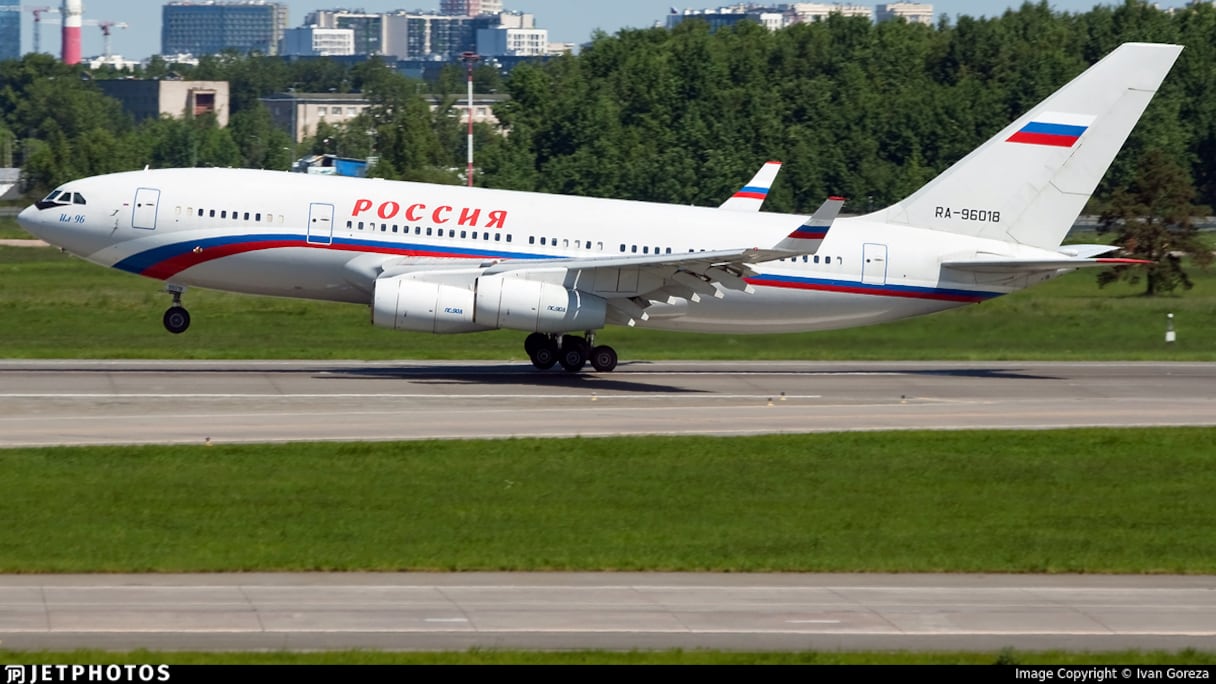
The flight-tracking data are publicly available. According to Flightradar24, the Ilyushin Il-96-300 registered RA-96018, part of the Russian government’s aircraft fleet, left Moscow on the morning of October 29 and landed in Casablanca after an eight-and-a-half-hour flight. It departed that same evening for Atlanta, completing the Atlantic crossing in nine hours and 13 minutes. The return journey followed the same route: departure from Atlanta on October 31, arrival in Casablanca in the early hours of November 1, then takeoff for Moscow two hours later.
The explanation is primarily geographical. To reach the United States, the Russian minister’s aircraft must avoid the airspace of 49 countries Moscow classifies as “unfriendly,” including almost all of Europe. The outbound journey therefore took more than 20 hours and required a refueling stop, as Rossiyskaya Gazeta explained. The aircraft flew over the Black Sea, Turkey and the Mediterranean before heading out across the Atlantic. Morocco is not on Russia’s list of “unfriendly” countries. Casablanca offers a convenient stop before the ocean crossing.
Read also : Russia’s veto, or the unintended favor it did Morocco
The timing, however, is rather less innocuous. Lavrov was travelling to Atlanta for the G20 foreign ministers’ meeting on October 30 and 31, chaired by US Secretary of State Marco Rubio. The customary group photograph was scrapped after some Western diplomats refused to pose alongside him, according to Radio Free Europe. On October 30, in New York, Russia’s representative vetoed the American draft that would have extended MINURSO’s mandate by one year and made Morocco’s autonomy plan the sole basis for negotiations. Russia’s foreign minister was therefore Washington’s guest on the very day Moscow brought down its resolution. And his aircraft refuelled in Morocco on both the outward and return journeys.
Nor was this the first time. In February 2024, returning from a G20 meeting in Rio de Janeiro, Lavrov’s aircraft spent three hours on the tarmac in Casablanca. The Moroccan stopover has become a familiar feature of Russian journeys to the Americas.
Yet Casablanca was hardly the only option. The Russian aircraft could have refueled in Algeria, either in Algiers or Oran, a few hundred kilometers from the Strait of Gibraltar and the Atlantic. Algeria is not among Moscow’s “unfriendly” countries; it is one of Russia’s principal partners in the region. It is also the country that pulled every diplomatic lever to secure Russia’s veto. On the eve of the vote, its prime minister, Sifi Ghrieb, was still at the Kremlin. Yet Lavrov chose Morocco on both legs of the journey, just as he had in February 2024. The country that sought the veto did not get the stopover; the country targeted by it got two. Rabat, for its part, did not turn its airport into a diplomatic weapon: an official Russian aircraft could land there and depart again just hours after a hostile vote in New York.
Algiers got its veto; Casablanca got the stopover. The Algerian regime has turned its airspace, gas supplies and trade into political weapons: closing its skies to Moroccan aircraft, shutting down the Maghreb-Europe gas pipeline in 2021, freezing trade with Spain in 2022 and waging a trade war against France. Morocco, by contrast, keeps its airports open, even to those who vote against it.
