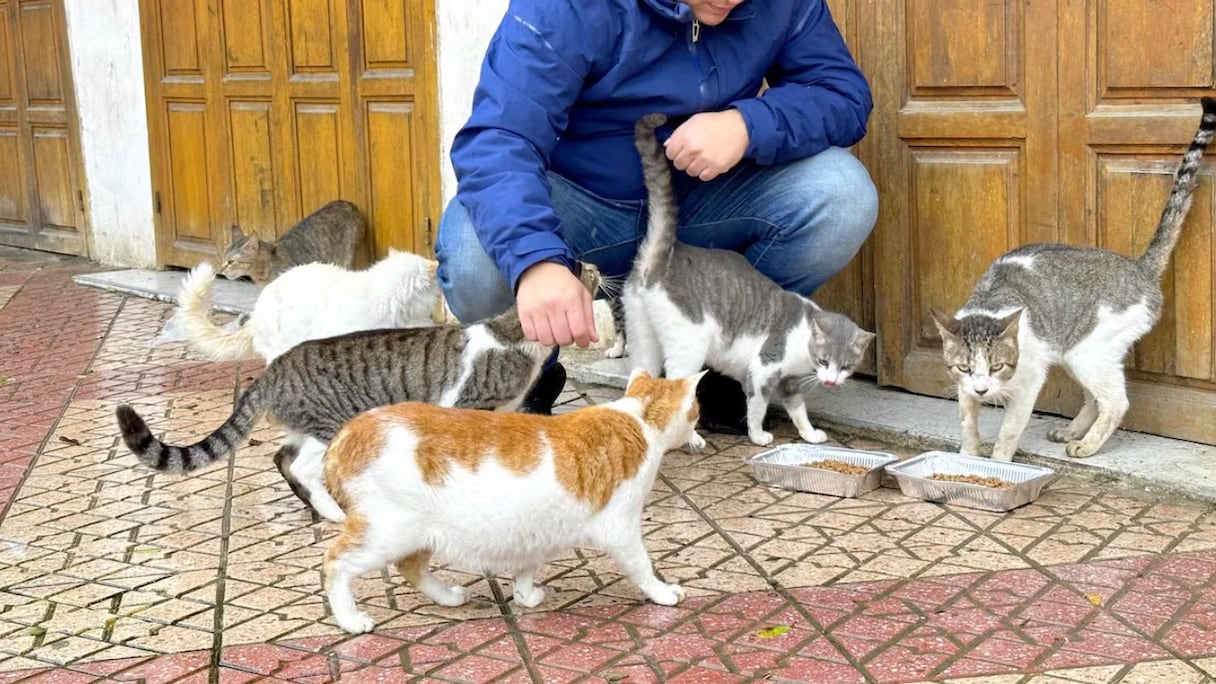
Morocco’s new law on stray animals has officially entered into force, but one question in particular has been causing confusion: Can you really be fined for feeding a stray cat or dog?
The short answer is that the law does introduce a fine of between 500 and 2,000 dirhams for feeding, housing or treating a stray animal in certain public spaces in violation of the law.
But that is not the same as saying that anyone who feeds a stray animal anywhere in Morocco will automatically be fined.
So what does Law No. 19.25 actually say, and what changes for animal owners, volunteers and people who regularly care for stray animals?
Here is a closer look at the new rules.
First, the law is officially in force
Law No. 19.25, concerning the protection and care of stray animals and the prevention of risks associated with them, was promulgated by Dahir No. 1.26.55 dated July 28, 2026.
It was published in Official Gazette No. 7533 on Aug. 10, bringing the law into force.
The legislation aims to establish a national framework for dealing with stray animals, combining their protection and care with measures intended to prevent risks to public health and safety.
Importantly, the law does not deal only with stray dogs. It defines a stray animal as an animal found temporarily or permanently in a public space, including streets, shared residential buildings or places open to the public, without the control or supervision of its owner or keeper.
So, can you be fined for feeding a stray animal?
This is where things become more nuanced.
Article 5 states that no person may care for a stray animal — including by housing, feeding or treating it — except in accordance with the law and its implementing regulations.
Article 44 then sets a fine of between 500 and 2,000 dirhams for anyone who houses, feeds or treats a stray animal in a public space, including a street, shared residential building or place open to the public, in violation of Article 5.
In other words, the law does not simply state that feeding a stray animal is, in itself, a crime.
The restriction concerns the care of stray animals in public spaces and is linked to the framework established by the law.
This distinction matters, especially because the legislation also establishes a system through which stray animals are supposed to be collected, cared for, vaccinated, sterilized, identified and, where appropriate, returned or placed with people willing to care for them.
Why does the law regulate this in the first place?
The legislation is built around two objectives: protecting animals while also protecting people from the risks associated with uncontrolled stray-animal populations.
The law requires stray animals to be protected from serious or infectious diseases and from unjustified killing, torture, violence and other forms of harm.
At the same time, it provides mechanisms for reporting stray animals, particularly when they pose a risk to their own health or to people’s health or safety.
So rather than leaving the management of stray animals entirely to individuals, the law establishes a more structured system involving municipalities, veterinarians, care centers and, under certain conditions, civil-society organizations and private operators.
What happens to stray animals under the new system?
Municipalities are to establish stray-animal care centers through their municipal health offices.
These centers have a long list of responsibilities.
They are expected to locate, collect and transport stray animals using appropriate methods, receive them, identify them and assess their health and behavior.
They must also provide food and treatment, vaccinate animals against serious or infectious diseases and adopt scientific and innovative methods to control their reproduction, particularly among cats and dogs.
The law also allows centers to return stray animals to the environment where they lived, or another suitable environment, especially after they have been sterilized, vaccinated and identified.
Another option is adoption. Animals housed at a center can be handed over to people who wish to care for them, provided they meet the required conditions, including the ability to properly care for the animal.
What about euthanasia?
This is another point that can easily be misunderstood.
The law allows care centers, where necessary, to resort to humane euthanasia under veterinary supervision.
This may apply when an animal cannot reasonably be cured of a disease or disability, or when its presence poses a danger to people’s health or safety or to another animal.
At the same time, the law makes intentional killing, torture or harming of a stray animal an offense.
Anyone who deliberately kills, tortures or harms a stray animal can face two to six months in prison and a fine of between 5,000 and 20,000 dirhams, or either of the two penalties.
The law specifically excludes euthanasia carried out in accordance with its provisions from this punishment.
And what about people who already care for stray animals?
The law does not simply erase the role of people and organizations that care for stray animals.
Municipalities can enter into agreements with civil-society organizations to carry out some of the tasks assigned to stray-animal care centers.
However, those organizations must meet certain conditions, including having legal status, animal care among their stated objectives, sufficient human and financial resources, and the necessary experience.
Private legal entities can also establish and operate stray-animal care centers with municipal authorization.
These centers must meet technical, health and safety requirements and operate under veterinary supervision.
So the legislation is essentially trying to move animal care from an informal system into a regulated framework.
What changes for animal owners?
If you own an animal, the law puts several new responsibilities on you.
Owners must declare every animal they own through a dedicated electronic platform and obtain a health record for it.
The animal will receive an identification number, which its owner must ensure it carries permanently.
Owners must also update the information they provided in certain circumstances.
If an animal is lost, the owner must report it through the electronic platform within three days of its disappearance.
If ownership is transferred to someone else, the change must be reported within 24 hours.
And if an owner no longer wants to keep an animal, the law requires them to take it to a stray-animal care center rather than simply leaving it in a public space.
What happens if you abandon your animal?
The law is particularly clear on this point.
Anyone who deliberately causes an animal to stray or leaves it in a public space without control or supervision can be fined between 10,000 and 20,000 dirhams.
The idea is to put responsibility on owners and prevent owned animals from becoming part of the stray-animal population.
The law also provides fines for owners who fail to declare their animals, report a lost animal, update required information or take the required measures when an animal dies or contracts a serious disease.
What about the new digital database?
The law also introduces a digital database dedicated to stray animals.
It is intended to keep information on the animals, their identification numbers, their health and protection measures, as well as the centers responsible for their care.
The database is also meant to help authorities improve measures to control the spread and reproduction of stray animals.
In practical terms, the legislation is therefore not only creating physical care centers. It is also establishing a system to identify and track animals and organize how they are managed.
Are there penalties for the care centers themselves?
Yes.
Operating a stray-animal care center without the required authorization can result in a fine of 50,000 to 300,000 dirhams.
Authorized centers can also be fined between 50,000 and 100,000 dirhams if they operate without veterinary supervision, fail to update the stray-animal database or stop providing their services without giving the required advance notice.
Other violations by authorized centers carry fines ranging from 20,000 to 50,000 dirhams or other amounts specified by the law.
The legislation also provides for at least one inspection of authorized centers every year.
Does everything in the law apply immediately?
Not necessarily.
Law No. 19.25 has entered into force following its publication in the Official Gazette. However, provisions that require implementing regulations will only become applicable once those regulations are published.
The law gives the authorities a maximum of two years from its publication to issue the implementing regulations.
Existing establishments that house, feed or generally care for stray animals also have two years from the law’s entry into force to comply with its provisions.
So while the law is now officially in force, some of the mechanisms needed to fully implement it still have to be put in place.
So, what does the law really mean?
The biggest takeaway is that Law No. 19.25 is not simply a law about banning people from feeding stray cats and dogs.
It creates a system for managing stray animals: owners are given new responsibilities, municipalities are tasked with establishing care centers, animals are to be identified, vaccinated and treated, reproduction is to be controlled, adoption is encouraged, and private operators and civil-society organizations can participate under specific conditions.
At the same time, the law introduces penalties for animal abandonment, mistreatment, non-compliance by owners and violations by care centers.
As for the question that has generated much of the debate — whether feeding a stray animal can lead to a fine — the answer depends on the circumstances set out in the law. Article 44 does provide a DH500 to DH2,000 fine for feeding, housing or treating a stray animal in the public spaces covered by the law in violation of Article 5.
What happens in practice will depend in part on the implementing regulations that are still to come.
