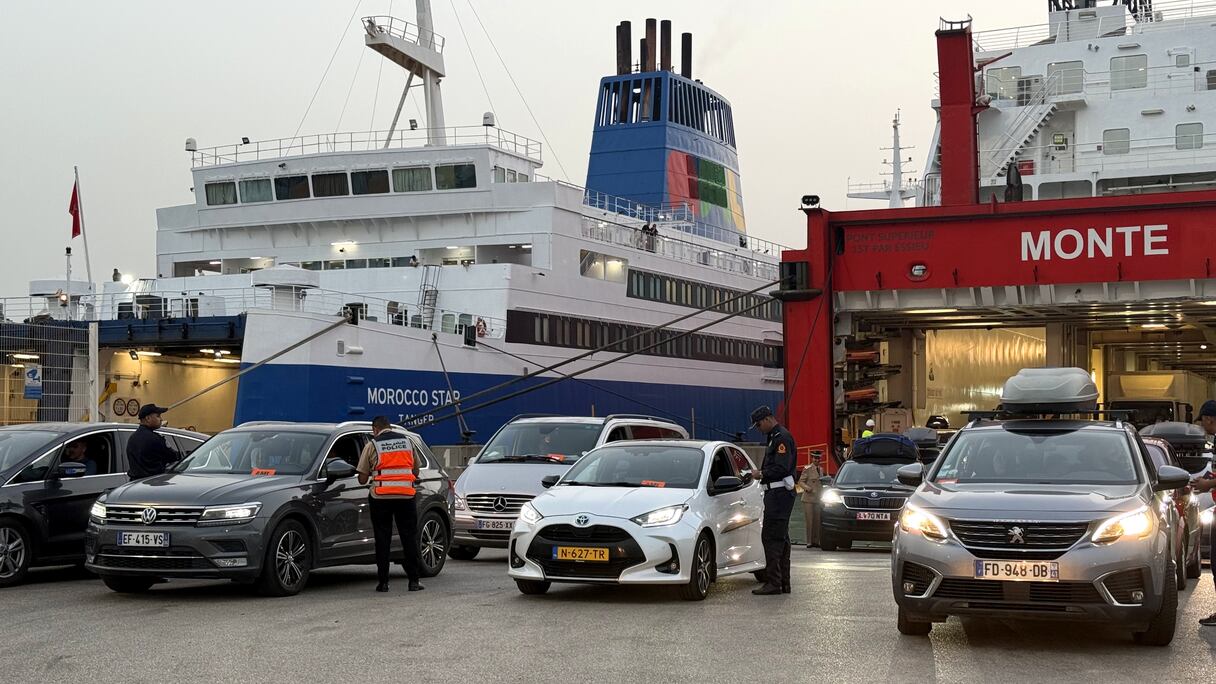
We accompanied one of the crossings between Tangier Med Port and Spain’s Port of Algeciras to take a closer look at how the operation is organized and to document the human and logistical efforts deployed on both sides of the Strait of Gibraltar to facilitate the return of Moroccans living abroad.
Steady increase in arrivals
According to Omar Moussa Abdellah, project manager at the Mohammed V Foundation for Solidarity, two months after the launch of Operation Marhaba, the number of arrivals in Morocco reached 1,862,609, an increase of 1.04% compared with the same period last year.
Arrivals were distributed almost evenly between air and sea transport, with airports receiving 938,641 people and ports receiving 923,968, reflecting the continued importance of maritime routes, particularly the Algeciras-Tangier Med route, for members of the Moroccan diaspora.
As of July 20, support services had assisted 21,413 beneficiaries, including 2,417 people who received healthcare services and 3,609 who received administrative, legal, or transport-related assistance, in addition to thousands of guidance and information services.
Reception network extends to the European shore
Operation “Marhaba” does not begin when ships arrive in Morocco. It starts at European ports that receive the largest flows of Moroccans during the summer.
For that purpose, the Mohammed V Foundation for Solidarity has established a reception network of 26 centers across Morocco and Europe, including six centers located at the ports of Algeciras, Almería, and Motril in Spain, Sète and Marseille in France, and Genoa in Italy.
Supporting this operation is a workforce of about 1,400 people, including 1,134 social workers and 216 doctors, paramedical professionals, and contracted staff.
These teams receive travelers, answer their questions, provide social and administrative assistance, and deliver medical care when necessary, while ensuring round-the-clock service at all reception centers.
The foundation has also deployed a dedicated team at its office in the Port of Algeciras to assist Moroccan travelers on both sides of the crossing. The Port Authority of the Bay of Algeciras has also implemented a dedicated plan to support the operation, allocating a budget of more than €2.2 million.
Read also : Al Hoceima welcomes first Marhaba ferry as Morocco’s summer homecoming begins
The plan includes the deployment of 750 employees, reinforcement of port police teams, and the creation of a service to assist travelers subject to procedures under the European Union’s new Entry/Exit System. It also includes a parking area with capacity for 7,000 vehicles, 30 sanitary units, and 6,000 square meters of shaded waiting areas to improve waiting conditions.
A digital system using cameras has also been introduced to monitor vehicle traffic and occupancy rates in waiting areas in real time, helping manage passenger flows during peak periods.
Manuel Sánchez Alcázar, spokesperson for the crossing operation at the Port of Algeciras, said coordination and planning are essential to managing traffic across the Strait. He said the close cooperation between the Moroccan Consulate, the Mohammed V Foundation, port authorities, and the Spanish government is a key pillar of the operation’s success.
He said this coordination ensures that both outbound and return journeys proceed smoothly and successfully. He added that this year’s focus has been on strengthening institutional cooperation among the different port authorities to address all potential emergencies, whether major or minor, during what he described as one of the largest logistical operations in the world. He said coordination between Moroccan and Spanish institutions remains essential to ensuring its success.
For his part, Abdellah Bido, Morocco’s Consul General in Algeciras, said the crossing operation is one of the initiatives that receives special attention, noting that it is conducted under the High Patronage of King Mohammed VI, who personally oversees it and issues instructions to ensure it proceeds under the best possible conditions and achieves its objectives while ensuring the comfort of Moroccans living abroad.
He said the operation has benefited from experience gained in previous years and that the introduction of the new border control system based on biometric data and Schengen standards initially raised some concerns, but those concerns quickly faded as the process proceeded without any significant obstacles.
He also urged citizens to verify the validity of their passports and travel documents before traveling, purchase tickets only from official outlets, and ensure their tickets are confirmed and dated to avoid delays and facilitate smooth crossings.
He concluded by stressing the importance of complying with safety rules while traveling and stopping only at official rest areas to avoid the risks of assaults and thefts reported every year, expressing hope that such incidents will eventually disappear altogether.
