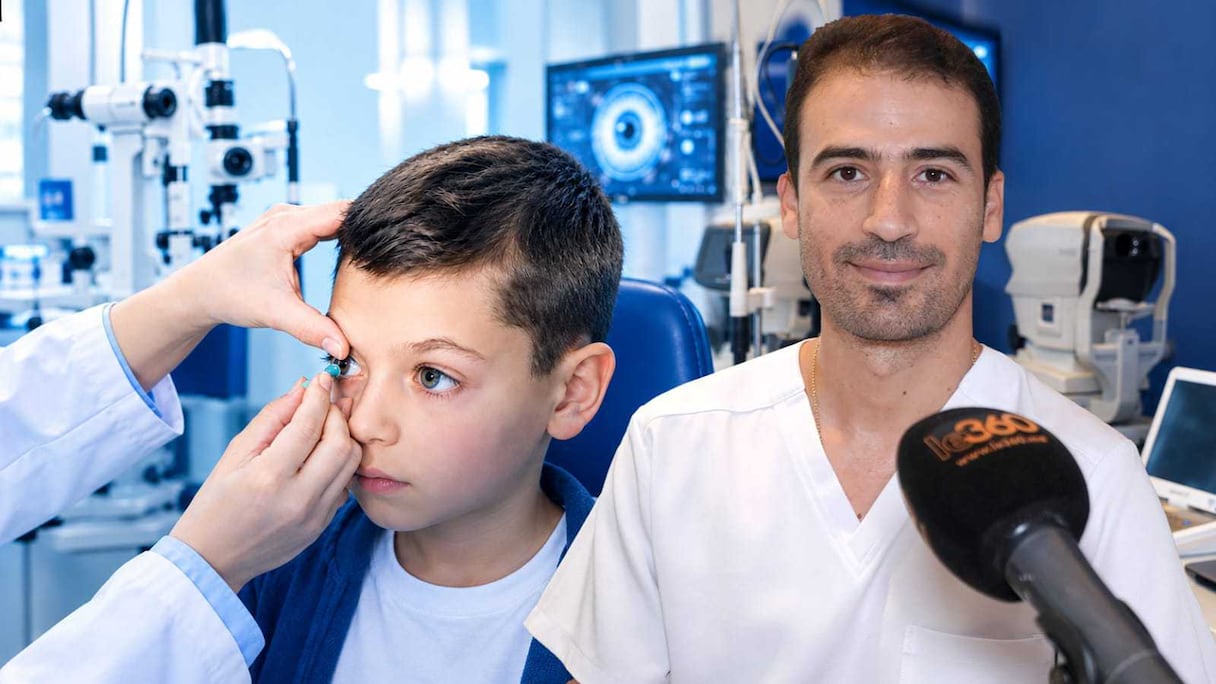
Dr. Mohamed Charif Khalifi, an ophthalmologist, explains how the treatment works, who can use it, its limits, potential risks and what it costs in Morocco.
Orthokeratology, commonly known as Ortho-K, uses specially designed rigid contact lenses worn for about eight hours overnight. They are removed in the morning, leaving the cornea temporarily reshaped and allowing the wearer to see without glasses during the day.
For children, however, the goal is not simply to improve vision temporarily. The technique can also be used to slow the progression of myopia, which has become increasingly common and can progress rapidly in some children.
“Orthokeratology lenses are primarily used for children under 16 who have progressive myopia. We have seen a sharp increase in cases since the Covid period, when children spent more time indoors and used screens for long periods,” Khalifi said.
In some children, myopia can worsen considerably within a relatively short period. “We have seen a child go, for example, from -1 myopia to -2, -3 or -4 within six months or a year,” the doctor said.
Ortho-K lenses work by applying controlled pressure to the cornea, temporarily changing its curvature and making it flatter. This reduces myopia and can provide clear vision during the day.
The effect does not necessarily appear immediately. “During the first week, some users may be able to see without glasses only in the morning. By the second week, clear vision may extend into the evening, and by the third week, some may be able to go without glasses for the entire day,” Khalifi said.
The correction is also reversible. “The result depends on wearing the lenses regularly. If the person stops using them, the cornea gradually returns to its original shape and the need for glasses comes back,” he said.
Read also : Six months without insulin, parents say; authorities deny shortage
For children with myopia, regular monitoring is essential to determine whether the condition is progressing and whether treatment is needed.
“A child should have their myopia and its progression monitored regularly. They should not have one examination and then wait two or three years before seeing an ophthalmologist again,” Khalifi said.
Screening can begin when children start school, particularly if parents notice signs such as a child sitting very close to the television or squinting to see clearly. Family history is another factor. Children whose parents both have significant myopia may face a higher risk.
In some cases, Ortho-K can be considered from the age of 6 or 7. “The child must be able to tolerate the lenses and use them properly,” he explained. Avoiding thick glasses can also be a consideration.
The technique has limits. According to Khalifi, Ortho-K can correct myopia of up to around -6 diopters. Beyond that, the correction may be incomplete.
“If the myopia is greater than -6, orthokeratology will not completely correct the vision. There may still be -1 or -2 myopia, depending on the case,” he said.
For astigmatism, the limit is around -3 diopters. Beyond that, the result may not be sufficient and glasses may still be needed for satisfactory vision.
“In adults, myopia generally stabilizes after the age of 18 or 20. As a child grows, the eye continues to develop as well. After that period, the situation stabilizes and the progression is no longer the same,” Khalifi explained. For people who want to stop wearing glasses, “there are other techniques, including laser surgery. But someone who does not want to undergo the procedure, or cannot have it, can also benefit from orthokeratology,” he added.
Not everyone can use these lenses. Myopia above -6 or astigmatism above -3 can be limiting factors. Certain corneal conditions, such as keratoconus, are also contraindications. “These conditions cannot be treated with orthokeratology. For adults, other options are available, including surgery, laser treatment or lenses implanted inside the eye, depending on the individual case,” he said.
As with other contact lenses, hygiene is essential. Orthokeratology lenses are rigid and require particularly careful cleaning and maintenance. Poor handling or inadequate cleaning can allow bacteria to contaminate the eye and cause an infection.
Users are also advised not to shower, wash their face or eyes, or swim while wearing the lenses. “If a person experiences a burning sensation, notices redness or has watery eyes, they should stop wearing the lenses and seek medical attention to make sure there is no inflammation or infection,” the specialist warned.
Parents also have an important role in the treatment. They need to make sure hygiene rules are followed, that the lenses are worn for the recommended amount of time and that the child attends regular medical checkups. They can also help change certain daily habits that may support myopia management.
The doctor recommends limiting screen time, encouraging outdoor activities and exposure to natural light, and promoting physical activity. “If a child uses orthokeratology, they need to wear the lenses at night and clean them properly. Parents therefore need to make sure the lenses are used correctly and take the child to follow-up appointments to check that they are doing their job,” he added.
Read also : Bloating and digestive discomfort: how to keep your gut happy this summer
Another development is that these lenses can now be manufactured in Morocco. “The good news is that Morocco now has the expertise to manufacture these lenses locally, which avoids the costs associated with importing them from abroad,” Khalifi said.
Each lens is custom-made, and production can take between two and three weeks. The price varies depending on the case, but the specialist estimates that it is generally comparable to the cost of glasses with thick lenses, although it can be slightly higher.
Unlike soft contact lenses designed for daily or monthly use, orthokeratology lenses can be kept for several months. “They need to be cleaned and maintained properly, protected from scratches and kept free of dirt buildup. When properly maintained, they can be used for up to a year,” he concluded.
