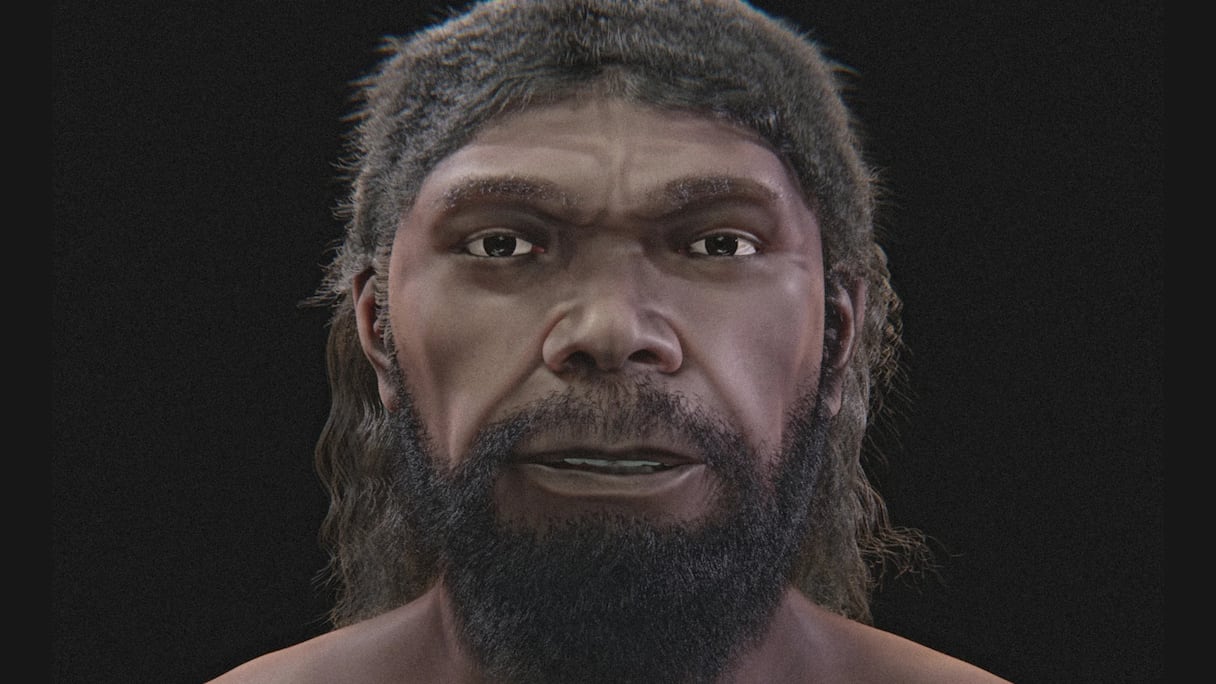
The fossils were found at Jebel Irhoud, where researchers initially believed the remains belonged to a Neanderthal who lived about 40,000 years ago. That interpretation changed after further excavations uncovered additional human remains and stone tools. In 2017, researchers dated the fossil-bearing layer to approximately 315,000 years ago, making the Jebel Irhoud remains the oldest known Homo sapiens fossils.
The new facial reconstruction, published in the journal Heritage on September 13, was led by Brazilian 3D designer Cicero Moraes and an international team of researchers. Rather than producing a portrait of a single individual, the team worked from a digital skull assembled from fossil remains belonging to more than one person.
Read also : 165-million-year-old crocodile-like predator discovered in Morocco’s Figuig Province
How the face was reconstructed
The team used a digital model of the Jebel Irhoud skull previously assembled by researchers at the Max Planck Institute for Evolutionary Anthropology in Germany. Most of the skull, including the braincase and upper face, came from a fossil known as Irhoud 1. The lower jaw and some teeth belonged to other individuals found in the same archaeological layer.
To reconstruct the face, Moraes and his colleagues first built a three-dimensional model from images and video of the composite skull. They then took a CT scan of an anonymous modern adult and digitally reshaped the skull to match the ancient remains, allowing the surrounding facial tissues to change with it.
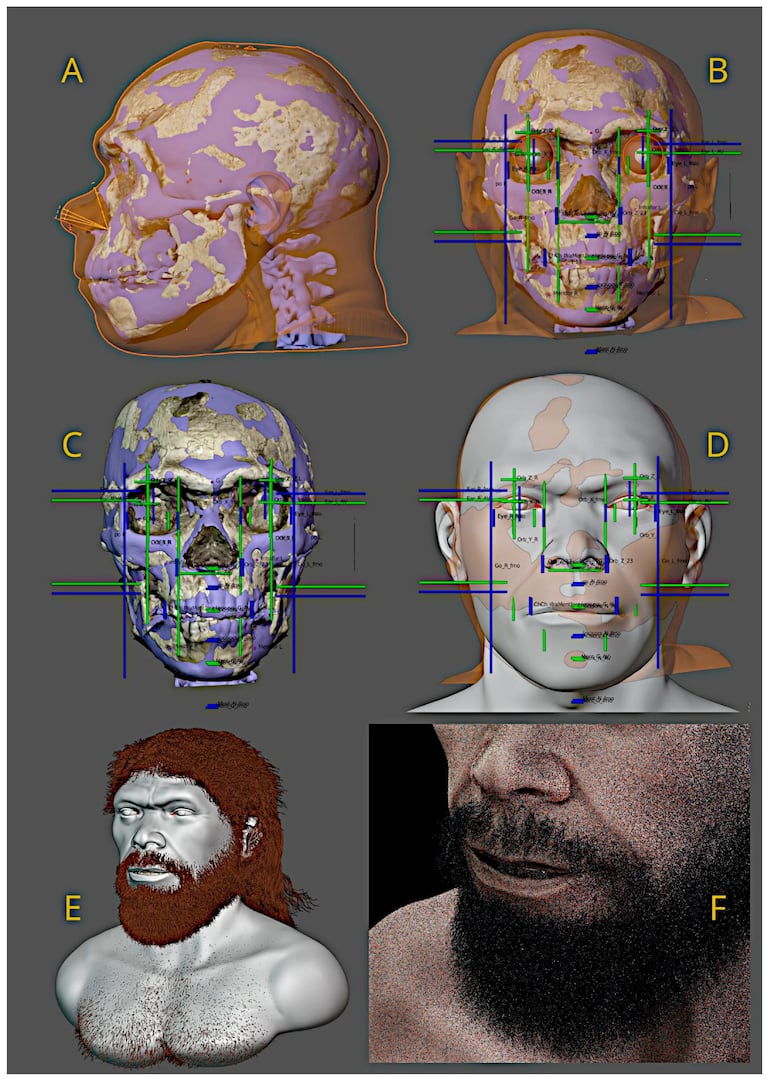
Measurements of soft-tissue thickness in living people of African ancestry helped the researchers estimate the depth of skin and muscle over the bones. They carried out the work using Blender, a free, open-source 3D modeling program, and tools developed for facial reconstruction.
The team also checked the dimensions of its digital model against earlier measurements of the fossil. Its cranial cavity measured 1,364 milliliters, close to a previous estimate of 1,375 milliliters obtained from CT data. This agreement supports the model’s proportions, but does not establish how accurately it reproduces the individual’s face.
A familiar face with some ancient features
The researchers produced two versions of the reconstruction. One is a grayscale rendering without hair, designed to focus on the estimated facial anatomy. The other adds skin pigmentation, hair and a beard to create a more lifelike image.
The reconstructed face has a prominent brow and a projecting jaw, features that distinguish it from the average face of a modern human. Yet its overall appearance remains recognizably human.
Moraes told ScienceAlert that the individual might go unnoticed in a crowd at first glance, although a closer look would reveal his robust features and projecting jaw.
Earlier studies of the Jebel Irhoud fossils had already identified a combination of modern-looking facial features and a more archaic braincase. The remains offer evidence that the traits associated with modern humans did not all emerge at the same time.
Read also : Dinosaur fossils, thermal springs and fairy chimneys: Boulemane’s hidden geoheritage
What the reconstruction cannot tell us
The images are a scientific approximation, not an exact portrait. Fossils preserve bone, not the skin, muscles, hair or other soft tissues needed to establish a person’s precise appearance. The researchers therefore relied on measurements from living people to estimate facial tissue, while the skin color, hair and beard in the finished bust remain artistic interpretations.
The composite skull also draws on remains from multiple individuals, meaning the reconstruction cannot be treated as the verified face of one specific person. Although the close match between the model’s cranial cavity and previous measurements supports its dimensions, it cannot confirm every detail of the reconstructed face.
The findings were published in Heritage, an open-access journal covering cultural heritage research.
