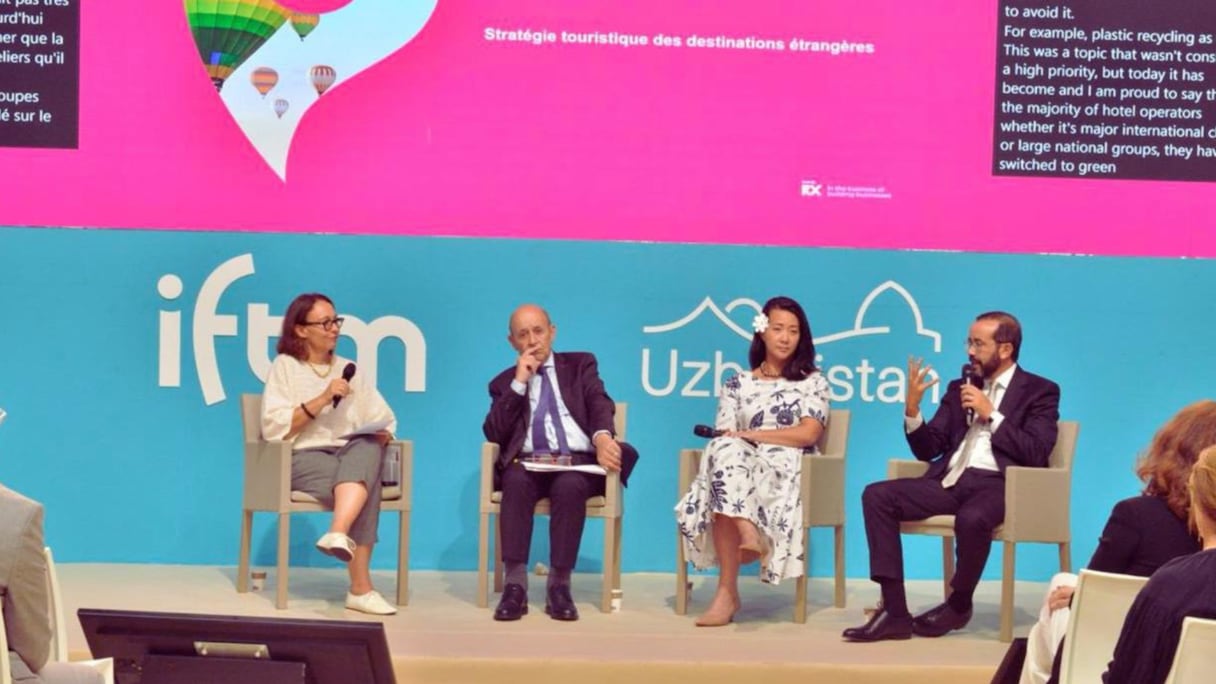
On the sidelines of IFTM Top Resa in Paris, the Moroccan National Tourism Office (ONMT) on Wednesday, September 16, presented the main drivers behind Morocco’s tourism development model, as the Kingdom’s mature and diverse tourism sector enters a new phase of growth.
The ONMT took part in a conference devoted to exemplary tourism strategies alongside Tahiti and AlUla, Saudi Arabia’s new tourist destination, the office said in a statement.
The meeting brought together Jean-Yves Le Drian, former French minister and current president of the French Agency for the Development of AlUla (AFALULA), and Achraf Fayda, director general of the ONMT, among others.
The discussion focused on three tourism models with very different trajectories and realities, while addressing three common challenges: attractiveness, hospitality and impact.
How can a destination continue to develop while preserving what makes it unique, managing visitor flows and maximizing the benefits generated by tourism? This was the central question addressed at the conference, which brought together Morocco, Tahiti and its islands and AlUla on the sidelines of IFTM Top Resa, the statement said.
The three destinations are following different paths. Tahiti faces the constraints of an island territory, where preserving its resources and ensuring local acceptance are major priorities. AlUla, in Saudi Arabia, is developing a new international destination, with particular attention to managing its growth and creating an economically sustainable model. Morocco, for its part, has a mature and diverse tourism destination that is entering a new phase of growth.
Represented by ONMT Director General Achraf Fayda, Morocco presented the main drivers behind this new momentum. Tourist arrivals increased by 6% and tourism revenues rose by 16% during the first six months of 2026, with growth supported in particular by strong European markets and improved air connectivity.
One of the main challenges now is to make better use of the diversity of Morocco’s territory. Through its 12 regions, the country aims to develop new experiences and destinations, including Ouarzazate and its desert, Dakhla and its water sports and the territories of the High Atlas. This diversification should help distribute tourist flows and the value generated by the sector more evenly.
The discussion with Tahiti and AlUla also addressed the issue of hospitality. For Morocco, this is based both on a deeply rooted tradition of welcoming visitors and on the continued modernization of infrastructure, particularly hotels, airports and transport, as the country approaches the major events of 2030.
Another challenge shared by the three destinations is tourism’s impact and the need to anticipate its effects. Morocco is choosing to act upstream, particularly by managing visitor flows in its most heavily visited destinations.
Marrakech is a particular focus in this regard, with the aim of maintaining a balance between tourism development, the quality of life of local residents and international attractiveness.
This approach is part of a broader transformation of Moroccan tourism. By 2030, the sector is expected to strengthen its role as an industry that creates value through employment, regional development, international visibility and the energy transition.
By bringing together three tourism models with very different realities, the IFTM Top Resa conference highlighted a shared challenge of building growth that can create more value, distribute it more widely and preserve the long-term attractiveness of destinations, the statement concluded.
